What MER Means and Why Installers Care About It
Estimated Reading Time: 12 minutes
A satellite field meter may show plenty of signal power while the receiver remains close to pixelation or complete loss of lock. This is why professional installers rarely stop after finding the strongest reading. They also examine MER, a measurement that reveals how cleanly the digital modulation has survived the complete transmission and reception path.
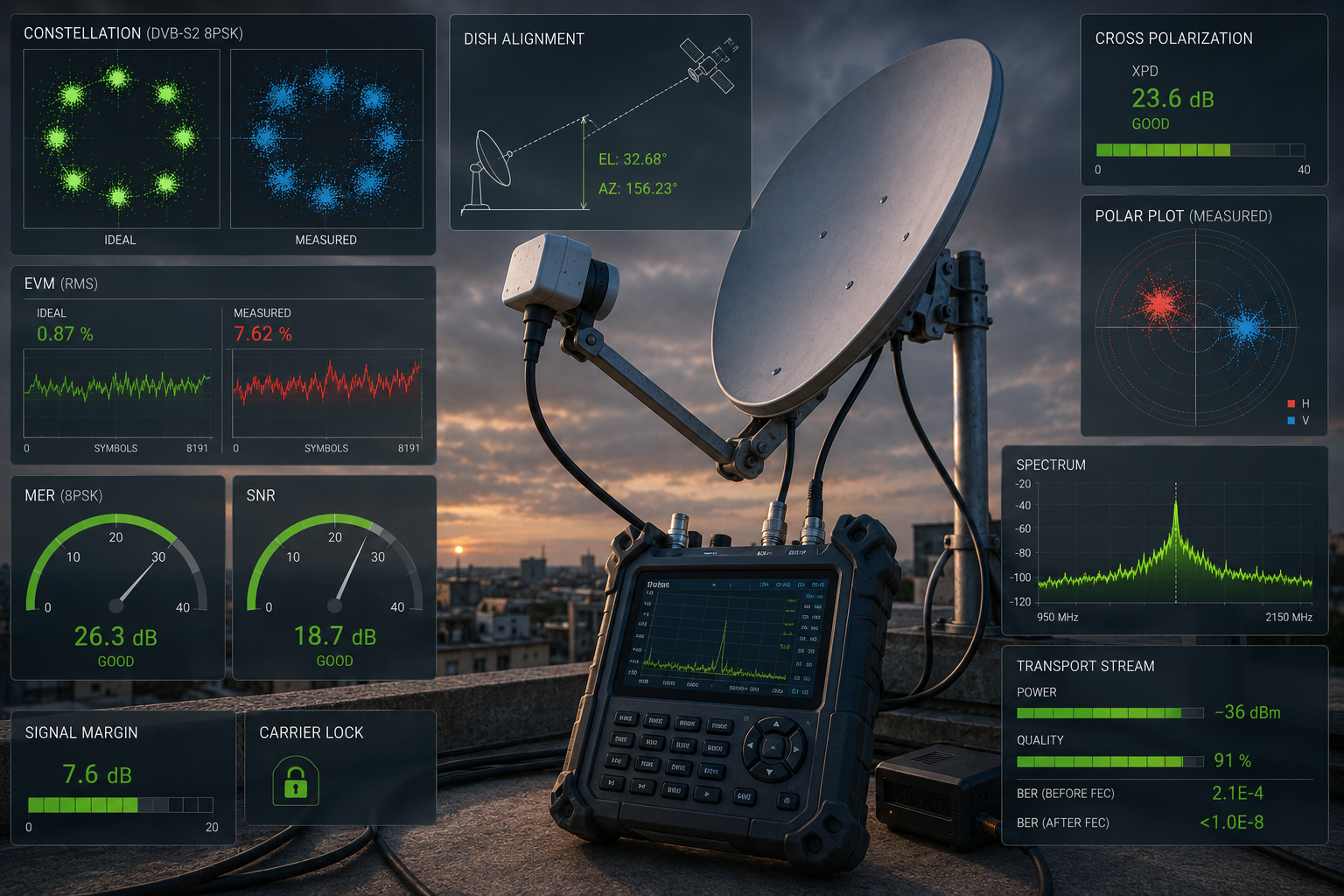
MER stands for Modulation Error Ratio. It compares the ideal positions of digitally modulated symbols with the positions actually measured by the receiver. The closer those received symbols remain to their intended locations, the higher the MER and the more reliably the satellite receiver can recover the transmitted data.
Signal strength measures how much RF energy reaches the tuner. MER measures how accurately the wanted modulation can be recognised after the signal has been affected by noise, interference, phase instability, distortion, dish alignment, LNB performance, cables, and connectors. Installers care about MER because it provides a more meaningful picture of reception quality than raw signal strength alone.
- What MER Actually Measures
- How a DVB-S2 Constellation Works
- Why MER Is Expressed in Decibels
- What Creates the Error Vector
- MER Versus Signal Strength
- MER Versus BER
- How Dish Alignment Changes MER
- Why LNB Skew Has a Major Effect
- Phase Noise and Oscillator Instability
- How Interference Reduces MER
- Cables, Connectors, and Distribution Equipment
- Why Different Transponders Show Different MER
- MER and the DVB-S2 Decoding Threshold
- Why Installers Need Signal Margin
- How to Use MER During an Installation
- Why Consumer Receivers May Not Show True MER
- Reality Check
- Final Verdict
- FAQ
What MER Actually Measures
Digital satellite transmissions carry information by changing the amplitude and phase of a radio-frequency carrier according to a defined modulation system. DVB-S and DVB-S2 commonly use modulation formats such as QPSK and 8PSK, while more advanced services can use higher-order formats under suitable link conditions.
Each transmitted symbol is supposed to occupy a precise position in an in-phase and quadrature coordinate system. A perfect signal would place every measured symbol directly on its intended reference point.
Real transmissions are never perfect. Noise, interference, phase errors, amplitude errors, nonlinear distortion, and receiver imperfections move measured symbols away from their ideal positions.
MER compares the average power of the ideal reference symbols with the average power of the errors separating the measured symbols from those reference positions. A larger ratio means the modulation is cleaner. A smaller ratio means the received symbols are more widely displaced and therefore harder to identify correctly.
MER is closely related to Error Vector Magnitude, or EVM. EVM describes the size of the error vectors, while MER expresses the relationship as a power ratio. In general, smaller error vectors correspond to higher MER.
How a DVB-S2 Constellation Works
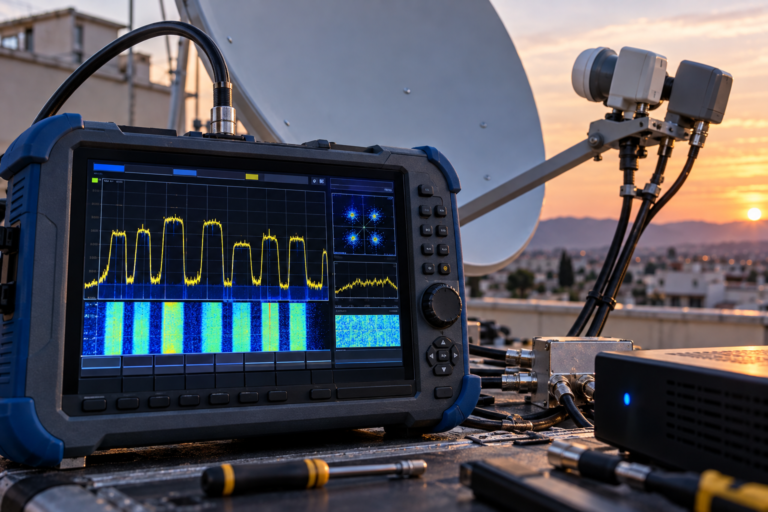
A constellation diagram provides a visual representation of digital modulation. Instead of displaying the television picture, it displays the locations of the received modulation symbols.
A QPSK transmission uses four main symbol positions. An 8PSK transmission uses eight positions arranged around a circle. The receiver examines the phase and amplitude of each incoming symbol and decides which reference position it most likely represents.
Under good reception conditions, the symbols form tight, clearly separated clusters around their ideal points. Under poor conditions, those clusters become wider, distorted, rotated, or uneven.
As the clusters spread, the receiver becomes more likely to assign a symbol to the wrong reference point. Those incorrect decisions create bit errors that must be repaired by the Forward Error Correction system.
MER converts the overall displacement visible in the constellation into one practical measurement. This allows an installer to evaluate modulation quality without relying only on visual inspection of thousands of constellation points.
Why MER Is Expressed in Decibels
MER is normally expressed in decibels because it represents a ratio between desired modulation power and error power.
A higher MER value means that the wanted symbol energy is much greater than the combined error energy. A lower value means the errors are becoming more significant relative to the intended modulation.
Because the decibel scale is logarithmic, a small numerical improvement can represent a meaningful reduction in modulation error. An increase of several decibels may substantially improve the stability of a marginal DVB-S2 transponder.
The correct MER target depends on the modulation, coding rate, measurement method, receiver implementation, and required operating margin. There is no universal value that guarantees perfect reception for every satellite service.
The practical goal is to achieve a measurement comfortably above the receiver’s minimum decoding requirement rather than merely obtaining lock under ideal weather conditions.
What Creates the Error Vector
An error vector connects the ideal position of a modulation symbol to its measured position. Its length and direction represent the combined amplitude and phase error affecting that symbol.
Many impairments can create or enlarge these vectors. Thermal noise spreads constellation points randomly. Phase noise moves them around their expected angular positions. Amplitude distortion pushes them closer to or farther from the centre.
Interference from another transmission can displace symbols in less predictable patterns. Incorrect equalisation, nonlinear amplification, frequency error, and timing problems can create further distortion.
MER combines the effect of these impairments into a single quality value. This makes it a powerful installation measurement, but it also creates an important limitation: poor MER confirms that a problem exists without automatically identifying its exact cause.
| Impairment | Possible Constellation Effect | Likely MER Result |
|---|---|---|
| Thermal noise | Random spreading around ideal symbol positions | MER decreases as noise becomes stronger |
| Phase noise | Symbols spread around the angular direction | MER falls even when signal power remains high |
| Amplitude distortion | Symbols move inward or outward | MER decreases because measured positions no longer match the reference |
| Incorrect LNB skew | Opposite-polarisation energy contaminates the constellation | MER may fall while strength changes very little |
| Adjacent-satellite interference | Clusters become wider or distorted | MER and decoding margin decrease |
| Frequency instability | Rotation, spreading, or unstable symbol positions | MER may fluctuate over time |
| Nonlinear amplification | Compression and constellation deformation | MER becomes worse despite higher displayed power |
MER Versus Signal Strength
Signal strength and MER measure fundamentally different properties.
Strength indicates the amount of RF power arriving at the receiver. Depending on the instrument, it may be displayed as a level in dBµV or dBm, or as an uncalibrated percentage.
MER indicates the accuracy of the digital modulation. It asks whether the receiver can distinguish the intended symbols clearly from the errors surrounding them.
A strong signal can still have poor MER. For example, an incorrectly aligned dish may receive substantial energy from a nearby satellite or an interfering transponder. The field meter sees power, but the wanted constellation remains contaminated.
The same problem can occur after unnecessary amplification. An amplifier may raise the wanted signal, noise, and interference together. The displayed level increases, but the error relationship may remain unchanged or become worse if the amplifier is overloaded.
A moderately powered signal with clean modulation and strong MER is generally more valuable than a powerful signal with distorted constellation points.
MER Versus BER
MER and BER are related, but they do not measure the same thing.
MER evaluates the accuracy of the modulation symbols. BER, or Bit Error Rate, measures how many recovered bits are incorrect.
As MER deteriorates, the probability of incorrect symbol decisions generally increases. This causes pre-correction BER to rise.
Forward Error Correction can repair many of those bit errors, so the television picture may remain perfect while MER is falling and pre-FEC BER is rising. The installation is still working, but its remaining safety margin is becoming smaller.
Once MER falls far enough, the raw error rate exceeds the correction capability. Post-FEC errors appear, transport stream packets become damaged, and the viewer begins to see pixelation, freezing, audio interruptions, or complete signal loss.
MER is therefore useful as an early quality indicator, while BER reveals the direct consequences of poor symbol recovery.
How Dish Alignment Changes MER
A satellite dish must concentrate the wanted microwave signal onto the LNB feedhorn. Small errors in azimuth or elevation reduce the wanted carrier reaching the focal point.
Poor alignment can also increase the relative influence of neighbouring orbital positions. The dish may still receive substantial total RF energy, but a smaller proportion belongs to the selected carrier.
During coarse alignment, signal level helps the installer find the general orbital position. During fine alignment, MER is more useful because it responds to the actual condition of the wanted modulation.
An installer normally moves the dish in very small horizontal and vertical steps while watching the MER measurement settle. The correct position is the one that produces the best stable MER across the required transponders.
The final result should not be based on one especially powerful frequency. Several transponders should be tested across different frequencies, polarities, modulation modes, and coding rates.
Why LNB Skew Has a Major Effect
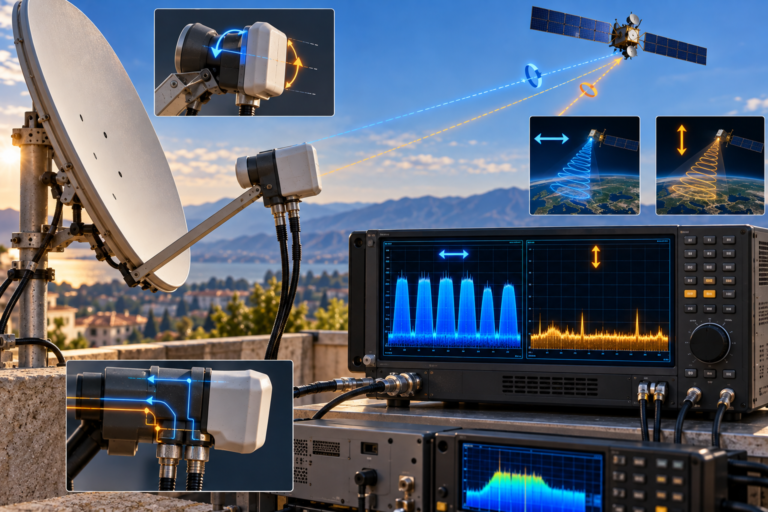
Satellite networks reuse frequency capacity by transmitting services on different polarizations. The receiving LNB must be rotated correctly to separate the selected polarization from the opposite one.
When skew is wrong, the LNB receives more unwanted energy from the cross-polarized transmission. That energy behaves as interference rather than useful carrier power.
The signal-level reading may remain stable or even increase because the tuner is receiving additional RF energy. MER falls because the extra energy does not belong to the intended modulation.
This is why professional installers adjust skew while monitoring MER rather than simply rotating the LNB until the strength bar reaches its maximum.
Skew optimisation can be particularly important when opposite-polarisation transponders occupy nearby frequencies or when the receiving location is a considerable longitude away from the satellite’s orbital position.
Phase Noise and Oscillator Instability
The LNB converts the satellite downlink frequency into a lower intermediate frequency that can travel through coaxial cable. This conversion depends on a local oscillator.
No oscillator is perfectly stable. Short-term phase fluctuations spread energy around the carrier and make received symbol phases less precise.
Phase noise can therefore reduce MER without producing an equally dramatic change in signal strength. The tuner still receives strong power, but the symbol locations become less sharply defined.
This effect matters more with modulation formats whose symbol positions are closer together. Higher-order modulation generally provides greater data capacity but leaves less separation between valid symbol decisions.
Temperature changes, component quality, ageing, and power instability can affect oscillator behaviour. A marginal LNB may work on robust QPSK services while producing weaker MER on more demanding DVB-S2 transponders.
How Interference Reduces MER
Interference adds unwanted energy to the wanted modulation. It may come from an adjacent satellite, the opposite polarization, terrestrial radio equipment, electrical devices, or a fault inside the distribution network.
Adjacent-satellite interference becomes more likely when a dish is too small, distorted, or poorly aligned. A larger or more accurate reflector usually provides a narrower reception pattern and better discrimination between orbital positions.
Poor cable shielding can allow external signals to enter after the LNB. Damaged connectors and unsuitable wall plates can create additional leakage paths.
Interference may affect only particular transponders. This is why one channel group can show poor MER while other services on the same satellite remain stable.
Comparing affected and unaffected frequencies can help distinguish a general alignment problem from localised interference or equipment failure.
Cables, Connectors, and Distribution Equipment
MER can be affected by every component between the LNB and the measurement instrument.
Coaxial cable introduces attenuation that normally increases with frequency and cable length. Moderate loss mainly reduces level, but excessive loss can push the signal closer to the receiver’s noise floor and reduce effective MER.
Loose, corroded, or poorly installed connectors can cause reflections, intermittent contact, shielding failure, and moisture ingress. These faults may create unstable MER readings that change when the cable is moved.
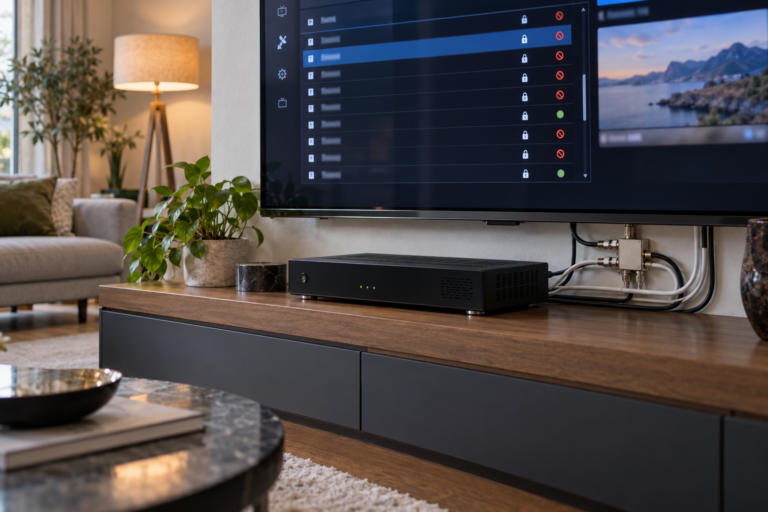
Multiswitches, splitters, amplifiers, wall plates, and DiSEqC switches must be suitable for the required satellite intermediate-frequency range. Poor-quality or overloaded equipment may add noise or nonlinear distortion.
An amplifier should not be used automatically whenever the signal level appears low. It should compensate for known distribution loss without overloading later stages or amplifying unnecessary noise.
Why Different Transponders Show Different MER
It is normal for MER to vary between transponders on the same satellite.
The services may use different beam patterns, downlink powers, frequencies, symbol rates, modulation formats, and coding rates. The receiving antenna and LNB may also perform slightly differently across the frequency band.
Local interference can affect one frequency range more than another. Cable attenuation is usually greater at higher intermediate frequencies, while connector or switching faults may affect one polarization or band selectively.
An installer should therefore test representative transponders from the low band, high band, horizontal polarization, and vertical polarization.
A dish aligned only for the strongest transponder may leave weaker or more demanding services with inadequate margin.
MER and the DVB-S2 Decoding Threshold
Every DVB-S2 modulation and coding configuration requires a minimum signal condition before the receiver can decode it reliably.
Robust combinations such as QPSK with strong error protection can continue operating under poorer conditions than more capacity-efficient configurations such as 8PSK with a higher coding rate.
As MER approaches the required threshold, pre-FEC errors rise rapidly and the error-correction decoder must work harder.
The picture may remain completely clear until the available quality falls below the operating threshold. Reception then collapses rapidly in what is commonly called the digital cliff.
This sudden failure explains why measuring only whether the channel currently works is inadequate. An installation may have lock but almost no reserve for rainfall, equipment drift, or normal mechanical movement.
Why Installers Need Signal Margin
The difference between the measured operating condition and the minimum required condition is the reception margin.
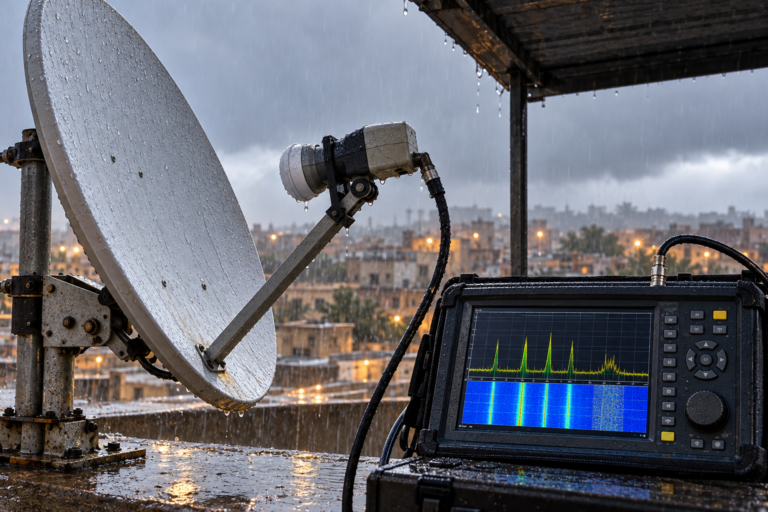
A healthy margin allows the system to tolerate rain attenuation, small dish movements, LNB temperature changes, cable ageing, and moderate environmental variation.
An installation with minimal margin may pass an initial test in clear weather but fail during the first heavy rainfall.
Professional installers therefore try to maximise stable MER rather than merely crossing the lock threshold. Every additional improvement provides more protection against future degradation.
The required reserve depends on the local climate, dish size, satellite footprint, cable length, system complexity, and service availability target.
How to Use MER During an Installation
Begin with the correct satellite, frequency, polarization, symbol rate, and modulation settings entered into a compatible field meter.
Use signal level for coarse dish positioning. Once the carrier is identified, switch attention to MER or an equivalent calibrated quality measurement.
Adjust azimuth slowly in both directions to identify the centre of the usable reception window. Repeat the process for elevation. Tighten the mounting hardware carefully while watching for movement.
Rotate the LNB in small steps to optimise polarization isolation. The best skew position is the one that produces the highest stable MER, not necessarily the greatest power level.
Test several transponders and record the results. Check whether MER remains stable when the cable, connectors, and switching equipment are included in the path.
When a transponder shows acceptable level but unstable decoding, do not immediately install an amplifier. Investigate alignment, skew, interference, LNB condition, connector integrity, and phase stability first.
MER also helps explain why a service can behave differently when its transport path includes additional network equipment. Our technical guide to why some television services work more reliably over Ethernet than Wi-Fi examines how the delivery path can introduce a different set of stability problems after the broadcast signal has been received.
Why Consumer Receivers May Not Show True MER
Many consumer receivers display a percentage labelled signal quality. That percentage may be related to MER, but it should not automatically be treated as a calibrated MER measurement.
Manufacturers can derive quality indicators from tuner estimates, carrier-to-noise readings, error rates, automatic gain-control values, decoder margin, or proprietary combinations of several measurements.
A reading of 75 percent on one receiver may represent a completely different operating condition from 75 percent on another.
Professional field meters provide measurements in engineering units and usually document the measurement point and method. Even professional instruments must have enough internal measurement performance to avoid adding significant error of their own.
Consumer quality bars remain useful for comparing adjustments on the same receiver and transponder. They should not be used as universal values across different devices.
MER is an excellent summary of modulation quality, but it does not identify the fault automatically. The same poor MER result can be caused by noise, interference, phase instability, distortion, poor alignment, incorrect skew, damaged cables, or measurement limitations.
MER must be interpreted alongside signal level, BER, constellation shape, carrier-to-noise ratio, spectrum analysis, lock stability, and knowledge of the installation.
There is also no single universal MER target for every satellite channel. The required value depends on modulation, FEC, receiver implementation, and the operating margin needed for reliable service.
MER measures how accurately the received modulation symbols match their ideal positions. It reveals the combined effect of noise, interference, distortion, phase errors, alignment, LNB performance, and the complete receiving path.
Installers care about MER because it shows usable digital signal quality rather than RF power alone. A high strength reading can hide a damaged constellation, while a strong MER result confirms that the receiver can distinguish the transmitted symbols with greater confidence.
The objective of a professional installation is not merely to obtain a picture. It is to maximise stable MER, minimise BER, and preserve enough margin for the system to survive rain, temperature changes, component ageing, and normal environmental movement.
| Question | Answer |
|---|---|
| What does MER mean in satellite reception? | MER means Modulation Error Ratio. It compares the power of ideal modulation symbols with the error power separating the measured symbols from their correct positions. |
| Is higher or lower MER better? | Higher MER is generally better because it indicates that the received symbols are closer to their ideal constellation positions. |
| Is MER the same as signal strength? | No. Signal strength measures received RF power, while MER measures the accuracy and cleanliness of the digital modulation. |
| Can a strong signal have poor MER? | Yes. Interference, incorrect skew, phase noise, distortion, or poor alignment can produce high RF power but weak modulation quality. |
| What is the difference between MER and BER? | MER measures modulation accuracy. BER measures how many recovered bits are incorrect. Poor MER usually increases the probability of bit errors. |
| Does better dish alignment improve MER? | Yes. Accurate alignment strengthens the wanted carrier and reduces the relative effect of noise and adjacent-satellite interference. |
| Can LNB skew affect MER? | Yes. Incorrect skew allows more opposite-polarisation energy to interfere with the wanted transponder, reducing MER. |
| Why does MER change between transponders? | Transponders can use different frequencies, beams, powers, modulation formats, coding rates, and polarizations. Equipment and interference can also affect frequencies differently. |
| Does an amplifier always improve MER? | No. An amplifier may compensate for distribution loss, but it can also amplify noise or create distortion if it is unsuitable or overloaded. |
| Can a receiver quality percentage be treated as MER? | Not automatically. Consumer receivers often use proprietary quality calculations that are not calibrated MER measurements. |
| Why can the picture remain clear when MER is falling? | Forward Error Correction can repair increasing numbers of bit errors until the signal reaches the decoder threshold. |
| Why do installers maximise MER after the channel locks? | A locked picture proves only that the minimum threshold has been crossed. Higher MER provides additional margin against rain, movement, ageing, and equipment variation. |