Why Total TV Works Better On Ethernet Than WiFi
Estimated reading time: 9 minutes.
- Bandwidth is not the main reason Ethernet performs better.
- Ethernet provides lower latency and more stable communication.
- WiFi performance changes with distance and interference.
- Packet loss affects receiver responsiveness.
- Jitter influences network consistency.
- Interactive Total TV services benefit from stable networking.
- A wired connection reduces unexpected interruptions.
- Speed Is Not The Whole Story
- Why Lower Latency Matters
- Jitter Creates Inconsistent Performance
- Packet Loss And Receiver Communication
- How WiFi Interference Changes Performance
- Why Ethernet Remains More Stable
- Which Total TV Features Benefit Most
- Technical Comparison
- How To Optimize Your Network Connection
- Reality Check
- Final Verdict
- FAQ
Speed Is Not The Whole Story
Many people immediately compare download speed when choosing between Ethernet and WiFi.
While bandwidth is important for large downloads, it is rarely the limiting factor for Total TV receivers.
Most receiver applications exchange relatively small amounts of information.
What matters much more is how consistently those packets arrive.
A connection with slightly lower speed but excellent stability often performs better than a faster connection with frequent fluctuations.
Why Lower Latency Matters
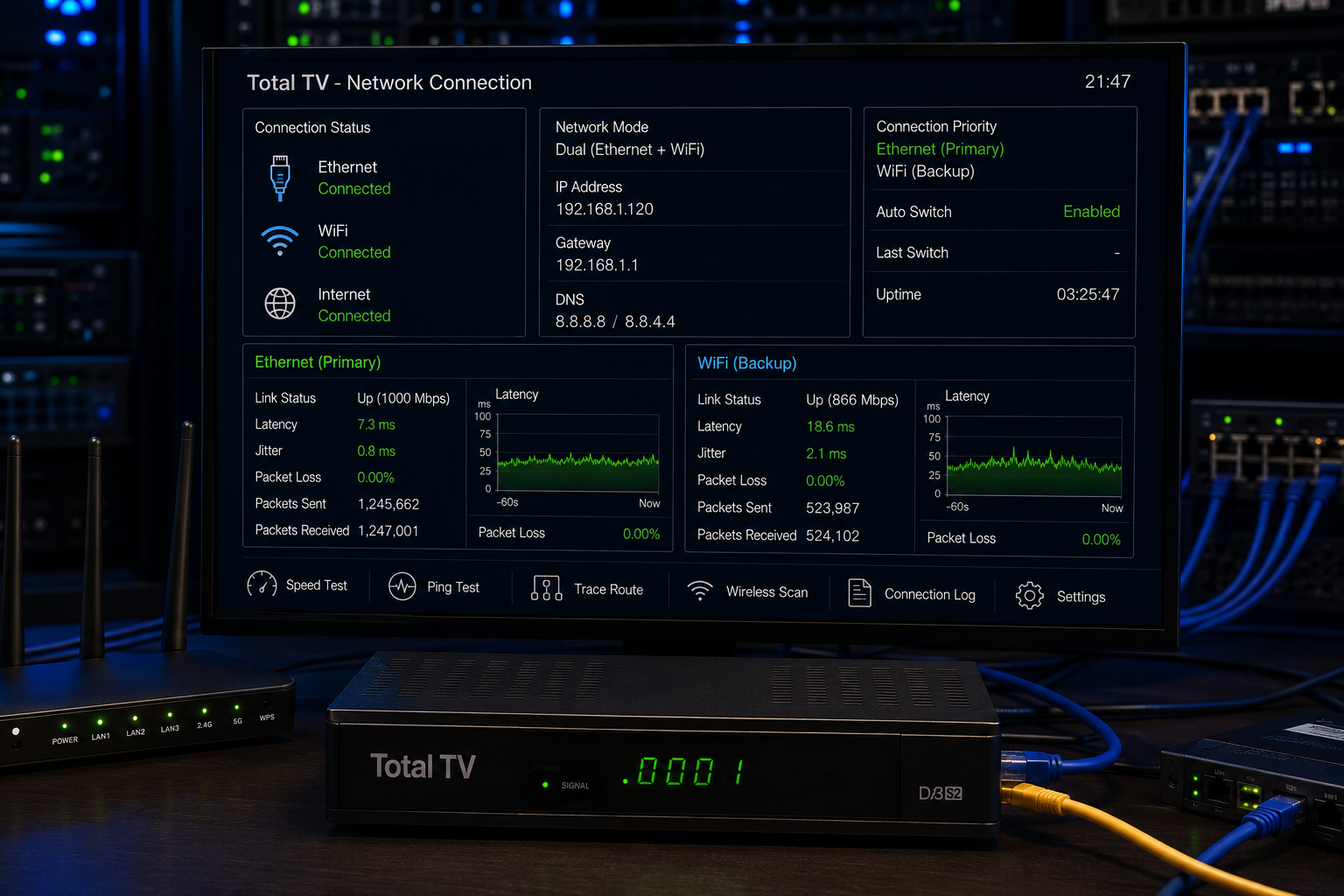
Latency measures how long data needs to travel between two devices.
Ethernet usually provides lower and more consistent latency because information travels through a dedicated cable rather than radio waves.
WiFi signals compete with other wireless devices, walls, furniture, and household interference.
Although the difference may only be a few milliseconds, consistent latency improves communication between the receiver and online services. Ethernet consistently provides lower latency than WiFi under comparable conditions.
Jitter Creates Inconsistent Performance
Jitter describes variations in latency over time.
A connection may have acceptable average latency while still suffering from large fluctuations.
These fluctuations make network communication unpredictable.
Interactive receiver services may respond more slowly, and cloud-based features can appear inconsistent.
Ethernet generally produces much lower jitter because the physical cable is unaffected by changing wireless conditions. High jitter is a sign of an unstable connection even when bandwidth remains high.
Packet Loss And Receiver Communication
Network communication depends on small packets of digital information.
When packets fail to arrive correctly, they must be transmitted again.
This retransmission creates delays.
For Total TV receivers, packet loss may slow software updates, interrupt interactive applications, or delay online authentication.
Ethernet connections normally experience far less packet loss because they avoid wireless interference. Wired connections generally experience lower packet loss than wireless connections under normal operating conditions.
How WiFi Interference Changes Performance
Unlike Ethernet, WiFi shares radio frequencies with many other devices.
Nearby wireless networks, smart home equipment, Bluetooth devices, microwave ovens, and even thick walls may affect signal quality.
Distance from the router also plays an important role.
As signal strength decreases, latency, jitter, and packet loss often increase.
The result is not necessarily slower download speeds but less predictable network behavior.
Why Ethernet Remains More Stable
Ethernet uses a dedicated physical cable between the receiver and the router.
Because no wireless transmission is involved, the connection is largely immune to radio interference.
Performance remains consistent regardless of nearby WiFi activity.
For devices that remain permanently installed beside a television, Ethernet provides one of the most reliable networking methods available. Ethernet is widely used because of its reliability, predictable performance, and compatibility with modern networking equipment.
Which Total TV Features Benefit Most
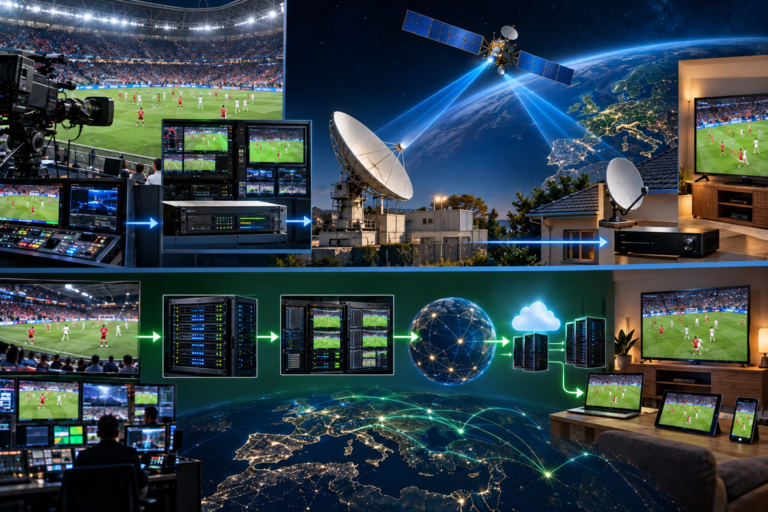
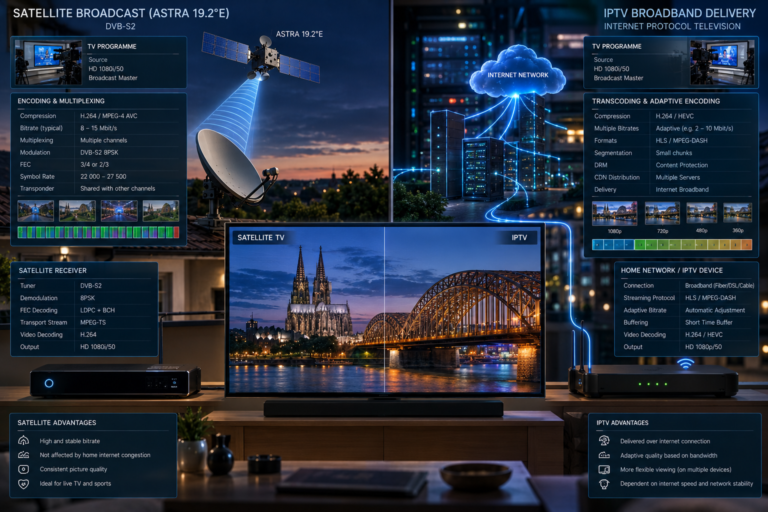
Live satellite television itself does not travel through your home network.
However, many modern receiver functions do.
Electronic program guides, firmware updates, hybrid television platforms, internet streaming features, online authentication, catch-up television, and remote applications all depend on network communication.
These services benefit from a stable Ethernet connection because fewer interruptions occur during data transfer.
Technical Comparison
| Feature | Ethernet | WiFi |
|---|---|---|
| Latency | Low and consistent | Variable |
| Jitter | Minimal | Can fluctuate |
| Packet Loss | Very low | More likely under interference |
| Signal Stability | Excellent | Depends on environment |
| Interference | Very limited | Affected by radio signals |
| Best Use | Permanent receiver installation | Flexible placement |
How To Optimize Your Network Connection
If possible, connect your Total TV receiver directly to the router using a high-quality Ethernet cable.
If WiFi is your only option, place the receiver within strong signal range of the router.
Reduce wireless interference by selecting less congested WiFi channels where appropriate.
Keep the receiver firmware updated and avoid placing the router inside enclosed cabinets.
For users who rely heavily on internet-based receiver features, Ethernet usually provides the most predictable long-term performance.
If you notice changes in picture quality during different times of the day, understanding signal stability is equally important. Read Why Total TV HD Quality Changes Every Evening to learn how reception conditions influence overall viewing performance.
Ethernet does not improve the satellite signal itself because live satellite channels arrive directly from the dish. Its advantage appears when the receiver uses internet-connected features. Lower latency, reduced packet loss, and better stability make Ethernet the preferred choice for receivers that depend on reliable network communication.
Total TV works better on Ethernet than WiFi because a wired connection delivers more predictable network performance. Lower latency, smaller jitter, minimal packet loss, and freedom from wireless interference create a stable environment for connected receiver features. While modern WiFi is suitable for many homes, Ethernet remains the most dependable option whenever maximum reliability is the goal.
FAQ
| Question | Answer |
|---|---|
| Does Ethernet improve satellite picture quality? | No. Satellite channels come directly from the dish, but Ethernet improves internet-based receiver functions. |
| Why is Ethernet more stable than WiFi? | Because it uses a dedicated cable and avoids wireless interference. |
| Can WiFi packet loss affect my receiver? | Yes. Packet loss may slow updates and interrupt online receiver services. |
| Is faster WiFi always better than Ethernet? | No. Stability, latency, and jitter are often more important than maximum speed. |
| Which connection is recommended for permanent installations? | Ethernet is generally the preferred option for permanently installed receivers. |
| Should I replace WiFi with Ethernet? | If running a cable is practical, Ethernet usually provides the most reliable long-term experience. |