Why Tring Sports Channels Lag During Big Matches
Estimated Reading Time: 10 minutes
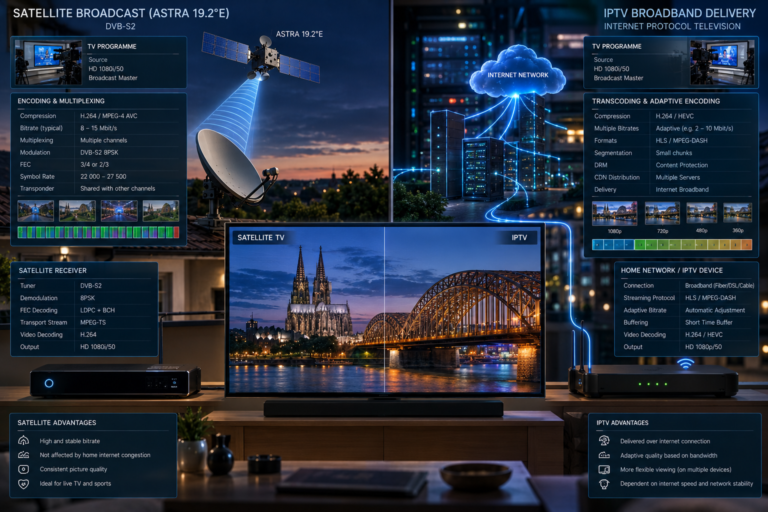
Few television experiences are more frustrating than watching an important football match when the picture suddenly pauses, the audio falls behind, or the receiver briefly freezes before continuing. Because these interruptions often happen during major sporting events, many viewers assume that the broadcaster is overloaded. In reality, satellite broadcasting works very differently from internet streaming, and the underlying causes are usually found inside the receiving system rather than at the satellite itself.
Modern Tring Sports channels are delivered through DVB-S2 transport streams that operate at a constant transmission rate. The satellite does not become slower because millions of people are watching the same match. Instead, temporary lag usually appears when the receiver struggles to maintain continuous synchronization with the incoming signal or when its internal decoder buffer must recover after transmission errors.
When Tring Sports channels appear to lag during live matches, the problem is normally related to signal quality, decoder buffering, transport stream recovery, or receiver synchronization. Large audiences watching the same satellite broadcast do not slow down the satellite transmission itself because one satellite transmission serves all viewers simultaneously. :contentReference[oaicite:0]{index=0}
- Does A Big Match Slow Down The Satellite?
- How Live Sports Reach Your Receiver
- Why The Decoder Uses A Buffer
- How Signal Errors Create Temporary Lag
- The Importance Of Signal Margin
- Receiver Synchronization During Live Broadcasts
- Environmental Conditions That Affect Sports Channels
- Logical Troubleshooting Steps
- Reality Check
- Final Verdict
- FAQ
Does A Big Match Slow Down The Satellite?
No.
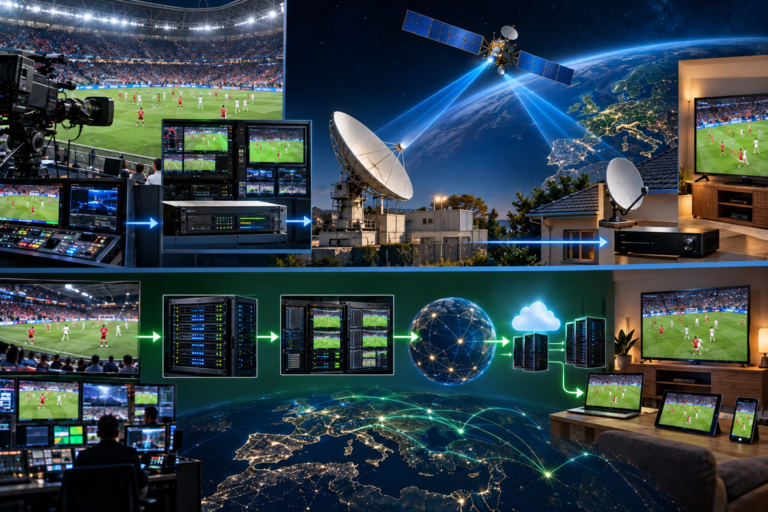
Unlike internet streaming, satellite television is a one-to-many broadcast system. The satellite transmits a single DVB-S2 carrier toward its coverage area regardless of whether one thousand people or several million people are watching. Every receiver simply captures the same RF signal independently.
This means audience size has virtually no influence on transmission latency. If two viewers experience different behaviour while watching the same Tring Sports channel, the difference almost always comes from their receiving equipment, installation quality, or local reception conditions rather than the satellite broadcast itself. :contentReference[oaicite:1]{index=1}
How Live Sports Reach Your Receiver
Before a football match appears on your television, the video passes through several engineering stages.
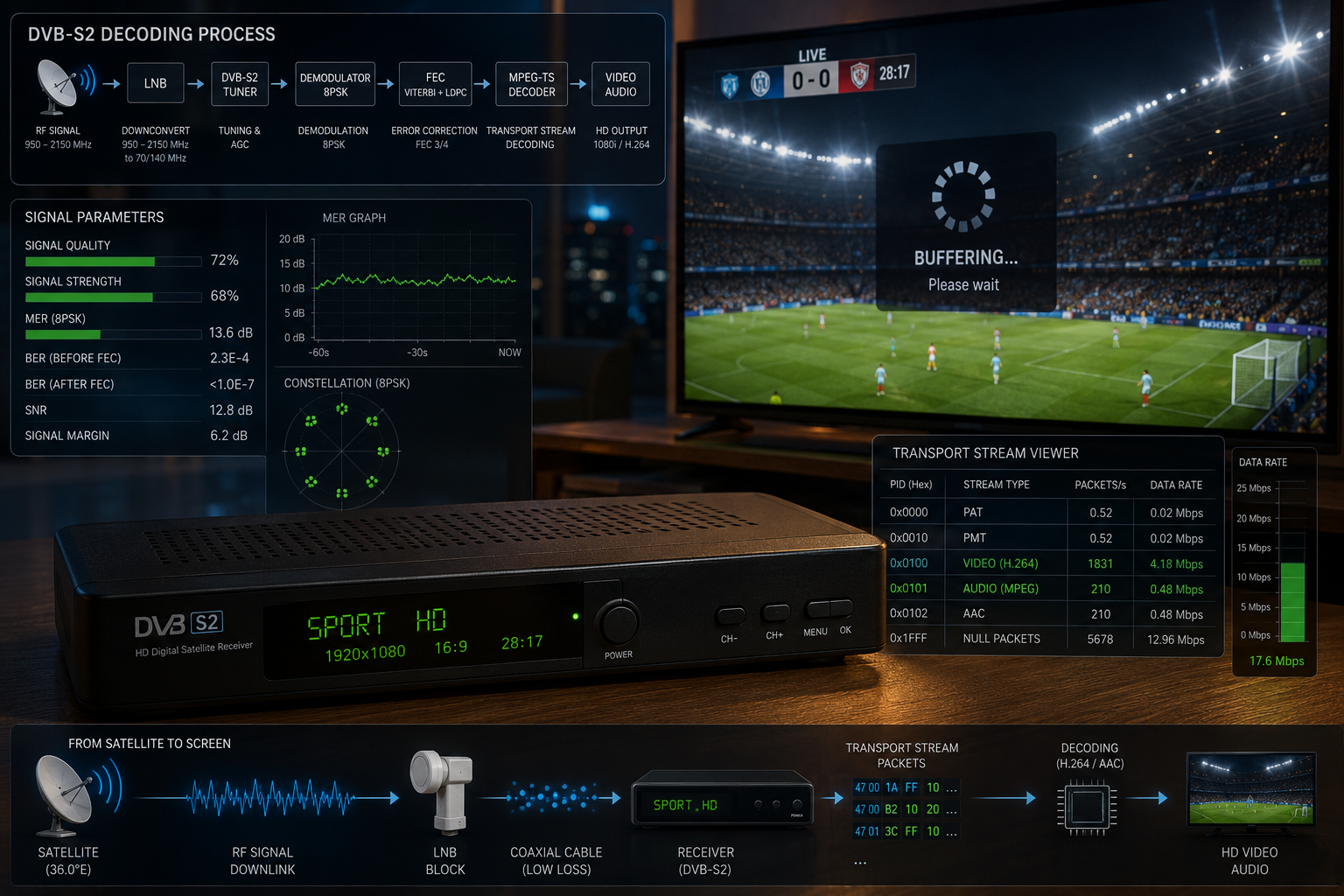
The cameras capture the event before professional encoders compress the video into an efficient format suitable for satellite broadcasting. The encoded video, audio, subtitles, and service information are multiplexed into an MPEG transport stream. That transport stream is then protected by powerful Forward Error Correction before modulation onto a DVB-S2 carrier for uplink to the satellite. DVB specifications define this coding and transport chain to deliver reliable television services over satellite links. :contentReference[oaicite:2]{index=2}
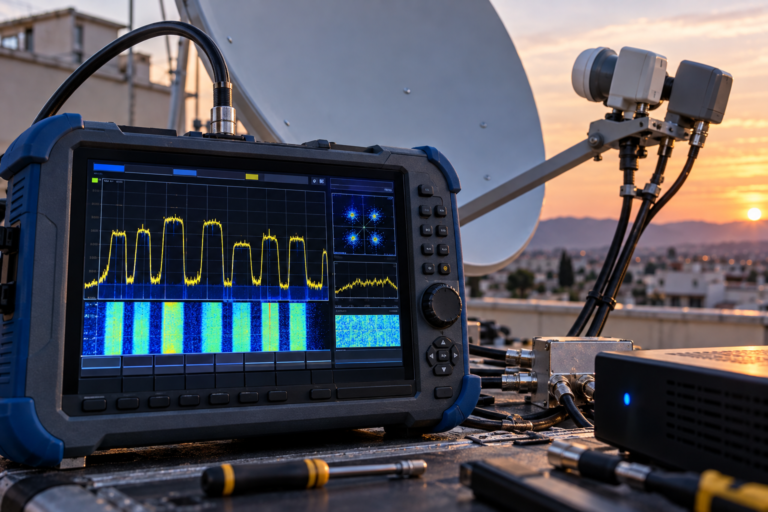
Inside your home, the dish receives the microwave signal, the LNB converts it to intermediate frequency, and the receiver reconstructs the transport stream before decoding the video and audio for display.
Why The Decoder Uses A Buffer
Many viewers associate the word “buffer” with internet streaming, but satellite receivers also use internal buffers.
These buffers temporarily store transport packets while the receiver performs synchronization, error correction, and video decoding. Their purpose is not to compensate for internet congestion but to ensure that compressed video is decoded smoothly even when tiny variations occur inside the incoming transport stream. DVB decoder models explicitly define transport buffers and data flow timing as part of reliable decoding. :contentReference[oaicite:3]{index=3}
If several transport packets arrive with excessive errors, the receiver may briefly pause video playback while recovering synchronization and rebuilding the transport stream. That short recovery period is often perceived as lag during fast-moving sports action.
How Signal Errors Create Temporary Lag
The DVB-S2 receiver constantly measures the quality of the incoming signal.
When Bit Error Rate begins increasing, the Forward Error Correction system attempts to repair damaged information before it reaches the video decoder. As long as enough packets can be corrected, viewers notice nothing.
If too many packets become corrupted within a short period, the decoder may temporarily lose enough information to continue smooth playback. Instead of immediately displaying a black screen, it often pauses for a fraction of a second while rebuilding the transport stream and resynchronizing the decoder.
This behaviour explains why viewers sometimes notice a brief freeze followed by normal playback without any manual intervention.
The Importance Of Signal Margin
Signal margin represents the safety distance between normal operation and complete decoding failure.
A receiver operating with generous signal margin can tolerate temporary increases in RF noise, atmospheric attenuation, or small dish movements without affecting video playback.
When signal margin becomes very small, however, even slight reductions in carrier quality may force the decoder to perform additional error correction and synchronization. During demanding HD sports broadcasts containing rapid scene changes and high data rates, this reduced operating margin becomes much easier to notice because the decoder has less tolerance for transport stream interruptions.
| Reception Condition | Receiver Operation | Viewer Experience |
|---|---|---|
| Large signal margin | Stable DVB-S2 decoding | Smooth live sports |
| Moderate BER | FEC repairs errors | No visible interruption |
| Low signal margin | Frequent decoder recovery | Brief pauses or freezes |
| Very high BER | Transport stream cannot be reconstructed | Signal loss or heavy pixelation |
Receiver Synchronization During Live Broadcasts
The receiver performs continuous carrier tracking, symbol timing recovery, phase correction, and transport stream synchronization while decoding live television.
Every one of these processes depends on receiving a sufficiently clean RF signal. If carrier tracking briefly loses accuracy because of reduced signal quality, the demodulator must reacquire synchronization before decoding can continue normally.
Although this recovery usually takes only a short time, viewers watching fast-moving football matches often notice these interruptions more easily than during slower television content because movement on the screen makes timing irregularities immediately obvious. DVB-S2 was specifically designed to provide highly reliable transport stream delivery with powerful channel coding close to theoretical channel limits. :contentReference[oaicite:4]{index=4}
Environmental Conditions That Affect Sports Channels
Weather remains one of the most common causes of temporary reception instability.
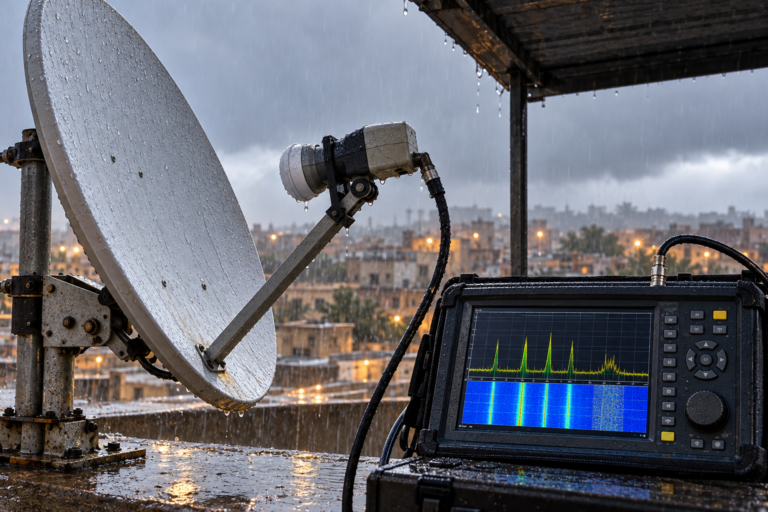
Rain absorbs microwave energy before it reaches the receiving dish. Strong wind may slightly alter dish pointing. Temperature changes can influence LNB oscillator stability, while moisture inside outdoor connectors increases signal attenuation.
Each individual effect may be relatively small, but together they reduce the available signal margin. Once the receiver approaches its decoding threshold, brief interruptions become much more likely during live HD broadcasts.
Logical Troubleshooting Steps
The first step is determining whether the interruptions occur only during poor weather or under all viewing conditions.
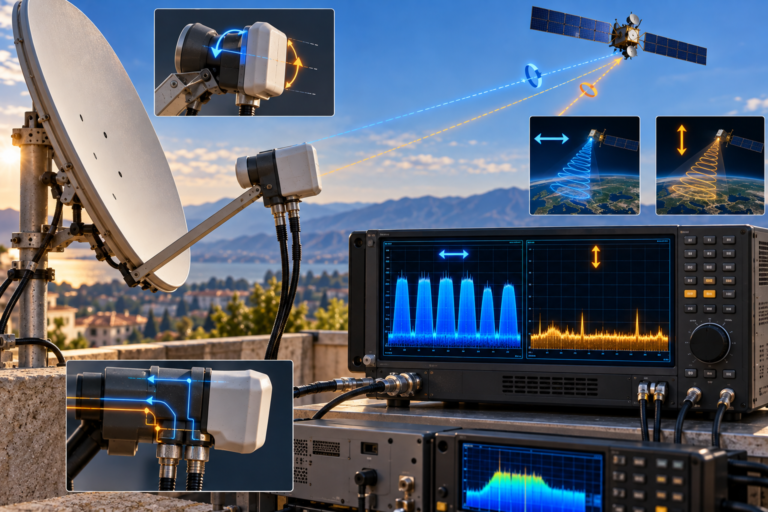
Inspect outdoor connectors for corrosion, verify that the dish has not shifted, confirm correct LNB skew, and check the receiver’s signal quality readings rather than relying only on signal strength.
If your receiver is connected through a local network for additional services or firmware updates, using a wired Ethernet connection can improve overall device stability compared with wireless networking for those network-based features. Our guide explaining why Total TV works better on Ethernet than Wi-Fi explores those networking differences in greater detail.
Major football matches do not overload satellite broadcasts. Satellite television delivers the same RF transmission to every viewer simultaneously. Most brief freezes are caused by reception quality, decoder recovery, or synchronization issues inside the receiving system rather than audience size.
When Tring Sports channels appear to lag during important matches, the satellite itself is rarely responsible. The receiver continuously balances transport stream buffering, Forward Error Correction, carrier synchronization, and video decoding while coping with changing RF conditions. Maintaining good dish alignment, healthy signal margin, stable LNB performance, and low BER allows the DVB-S2 decoder to reproduce live sports smoothly without unnecessary interruptions.
| Question | Answer |
|---|---|
| Can millions of viewers slow down a satellite channel? | No. Satellite broadcasting sends one transmission to every receiver simultaneously. |
| Why does the picture briefly pause before continuing? | The receiver may be rebuilding the transport stream after correcting transmission errors. |
| Does HD sports require better reception than SD channels? | Yes. HD services generally require cleaner signal conditions for reliable decoding. |
| Can rain cause temporary lag? | Yes. Rain fade reduces signal margin and increases the probability of decoder recovery. |
| Should I replace the receiver immediately? | No. Check dish alignment, signal quality, outdoor connections, and the LNB before replacing equipment. |