Why Total TV HD Quality Changes Every Evening
Estimated reading time: 9 minutes.
- Total TV broadcasts normally maintain the same video quality all day.
- Evening changes usually come from reception conditions.
- HD channels require cleaner decoding than SD channels.
- Signal quality is more important than signal strength.
- Temperature affects LNB frequency stability.
- BER increases can reduce HD picture quality.
- Improving signal margin produces more consistent evening performance.
- The Broadcast Usually Does Not Change
- Why HD Channels React First
- Signal Margin Becomes More Important During Evening
- How LNB Temperature Influences HD Reception
- BER And Digital Error Correction
- Receiver Synchronization Under Changing Conditions
- Environmental Changes After Sunset
- Technical Comparison
- How To Maintain Stable HD Quality
- Reality Check
- Final Verdict
- FAQ
The Broadcast Usually Does Not Change
A common misconception is that broadcasters reduce HD quality during busy viewing hours. Traditional satellite broadcasting does not work that way.
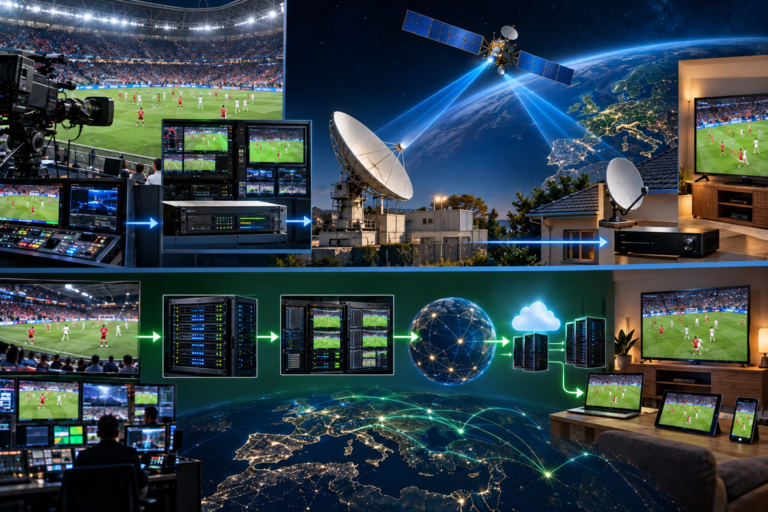
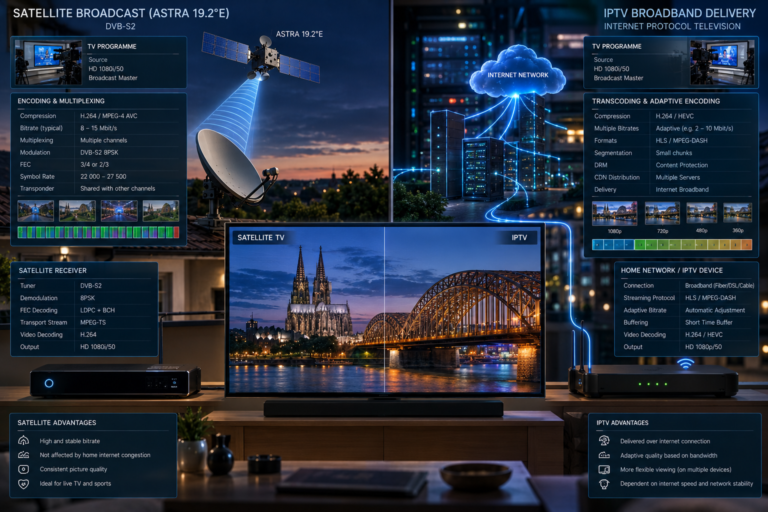
Every receiver inside the satellite coverage area receives exactly the same transmitted signal. Unlike internet streaming platforms, there is no adaptive bitrate that changes from one viewer to another.
If the picture becomes softer or less stable during the evening, the cause almost always exists inside the receiving system rather than inside the broadcast itself.
Why HD Channels React First
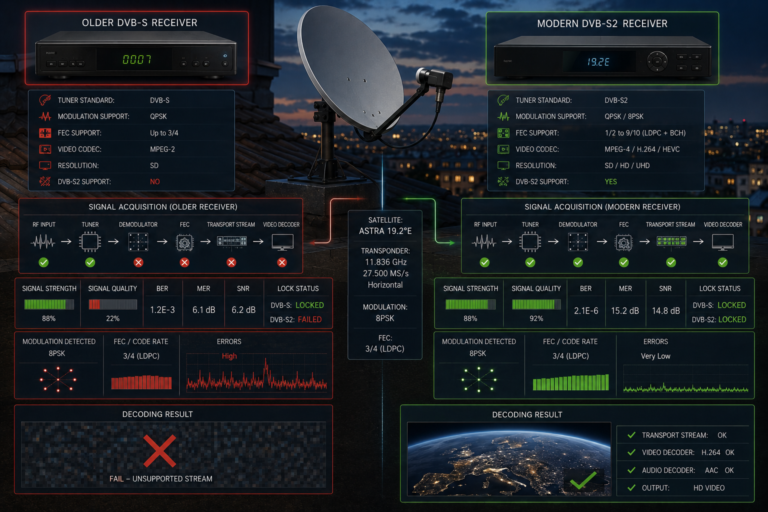
High-definition channels usually use DVB-S2 transmission with more demanding modulation and forward error correction settings.
These transmission methods deliver excellent efficiency, but they also require cleaner reception conditions.
A small increase in noise or BER may have little effect on SD channels while immediately affecting HD channels.
This explains why users often report that only HD services become unstable while standard-definition channels continue working normally.
Signal Margin Becomes More Important During Evening
Signal margin represents the reserve between your current reception quality and the minimum level required for reliable decoding.
If your installation has a large margin, evening changes may never become visible.
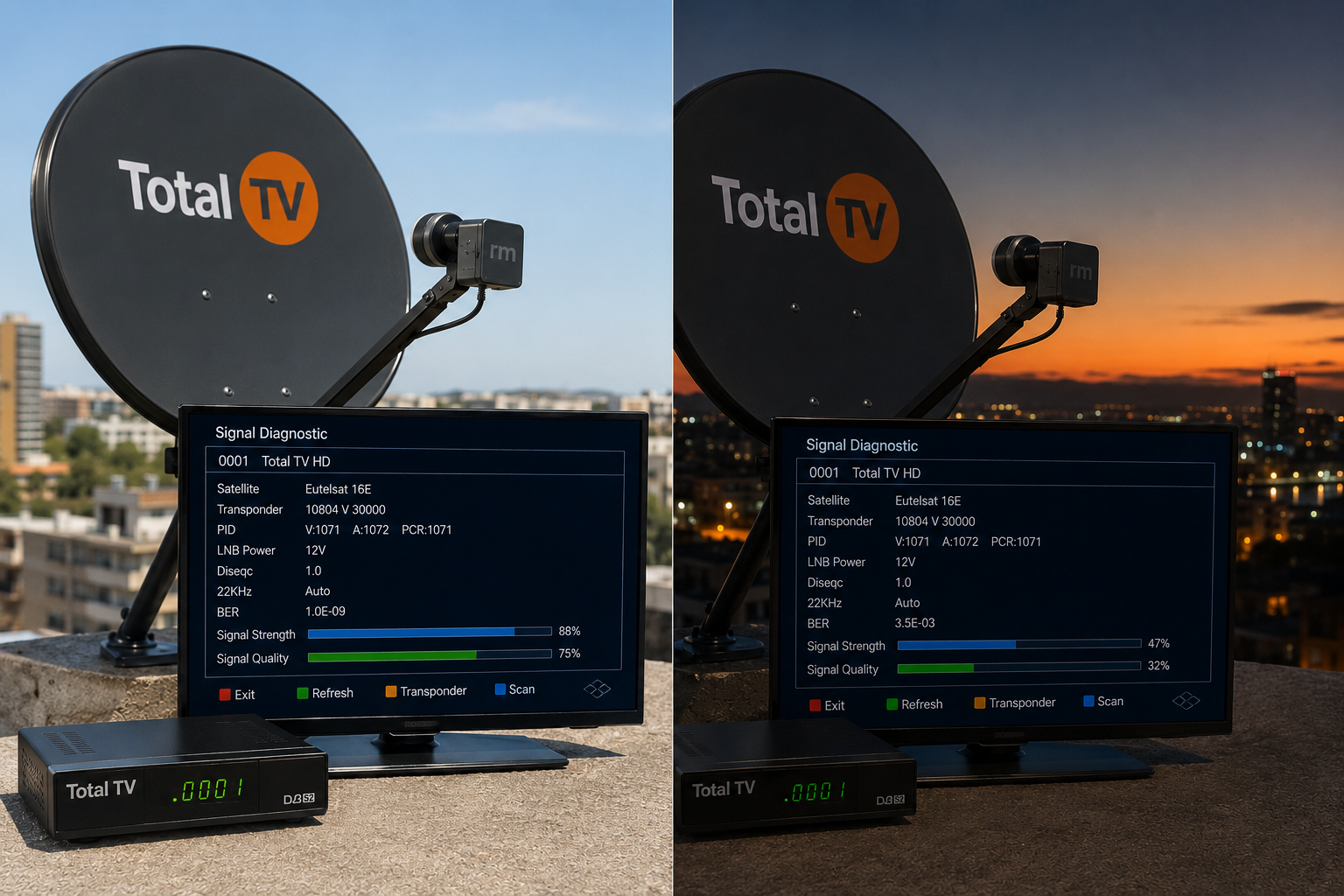
If the margin is small, even minor environmental variations can reduce reception quality enough for HD channels to begin showing compression artifacts, pixelation, or brief freezes.
The satellite remains unchanged. The available reserve simply becomes smaller.
How LNB Temperature Influences HD Reception
Throughout the day the LNB experiences constant heating from sunlight.
As evening arrives, its temperature gradually changes.
Electronic oscillators inside the LNB become more stable on some installations and less stable on others depending on hardware quality and age.
Small frequency drift is usually invisible on strong systems.
However, installations operating close to the decoding threshold may experience noticeable changes in HD reception during these temperature transitions.
A premium low-noise LNB usually maintains frequency stability more effectively than inexpensive models.
BER And Digital Error Correction
BER measures how many digital errors reach the receiver.
Modern receivers automatically repair many of these errors using forward error correction.
As BER increases, the receiver spends more processing time correcting damaged packets.
Eventually error correction reaches its limit.
At that point the viewer begins seeing pixelation, softer images, frozen frames, or short audio interruptions.
This is one reason HD quality may appear worse during the evening even though signal strength looks almost unchanged.
Receiver Synchronization Under Changing Conditions
A Total TV receiver continuously synchronizes itself with incoming transport streams.
Stable synchronization requires accurate timing and clean digital packets.
When BER increases, synchronization becomes more difficult.
The receiver may briefly lose lock, rebuild its internal buffers, then recover.
These short recovery periods often appear as momentary quality loss rather than complete signal failure.
Many users blame the receiver itself, but the receiver is often reacting correctly to changing signal conditions.
Environmental Changes After Sunset
Even after the sun disappears, environmental conditions continue changing.
Humidity rises in many locations.
Temperature gradients shift.
Equipment mounted outdoors cools gradually.
None of these factors alone normally causes reception problems.
However, when combined with a system that already has limited signal margin, they can reduce decoding quality enough for HD channels to become unstable.
This is why two neighboring installations may behave very differently even though they point toward the same satellite.
Technical Comparison
| Factor | Afternoon | Evening |
|---|---|---|
| Signal Margin | Usually higher | May become smaller |
| LNB Stability | Stable under daytime conditions | Temperature transition may affect weak LNBs |
| BER | Lower | Can increase on marginal systems |
| Receiver Synchronization | Easy | Requires more correction |
| HD Playback | Smooth | May show pixelation or freezing |
How To Maintain Stable HD Quality
Start by optimizing dish alignment using signal quality rather than signal strength.
Adjust the dish while monitoring the weakest HD transponder instead of the strongest one.
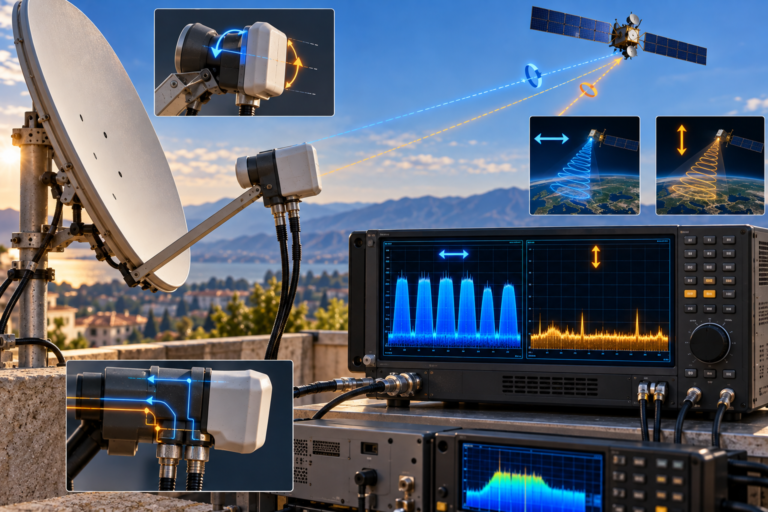
Verify LNB skew carefully because incorrect polarization alignment often affects HD reception before SD reception.
Inspect outdoor connectors for corrosion or moisture.
Replace aging LNBs that may suffer from excessive frequency drift.
Finally, use high-quality coaxial cable with proper shielding to minimize external interference and unnecessary signal loss.
Improving overall signal margin is usually the most effective solution because it allows the receiver to tolerate normal evening environmental changes without visible degradation.
Total TV HD quality usually does not change because the broadcaster modifies the signal every evening. In most situations the difference comes from your local reception conditions. Small reductions in signal margin, higher BER, temperature-related LNB behavior, and receiver synchronization all influence how cleanly the HD stream can be decoded.
If Total TV HD quality changes every evening, the most likely explanation is not the satellite broadcast itself. The receiving system is operating closer to its decoding limits as environmental conditions evolve. By improving alignment, maximizing signal margin, maintaining a stable LNB, and reducing BER, the same installation can deliver consistent HD quality throughout the entire day instead of becoming unstable after sunset.
FAQ
| Question | Answer |
|---|---|
| Does Total TV lower HD quality every evening? | No. The broadcast usually remains unchanged. |
| Why do only HD channels become unstable? | HD channels require cleaner decoding conditions than SD channels. |
| Can temperature affect the LNB? | Yes. Temperature changes can influence oscillator stability. |
| What is the most important measurement? | Signal quality is usually more valuable than signal strength. |
| Can improving dish alignment solve evening problems? | Yes. Better alignment increases signal margin and improves stability. |
| Should I replace the receiver first? | Usually no. Check alignment, LNB, cables, and signal quality before replacing the receiver. |