Why Blind Scan Misses Half The Channels On 16E
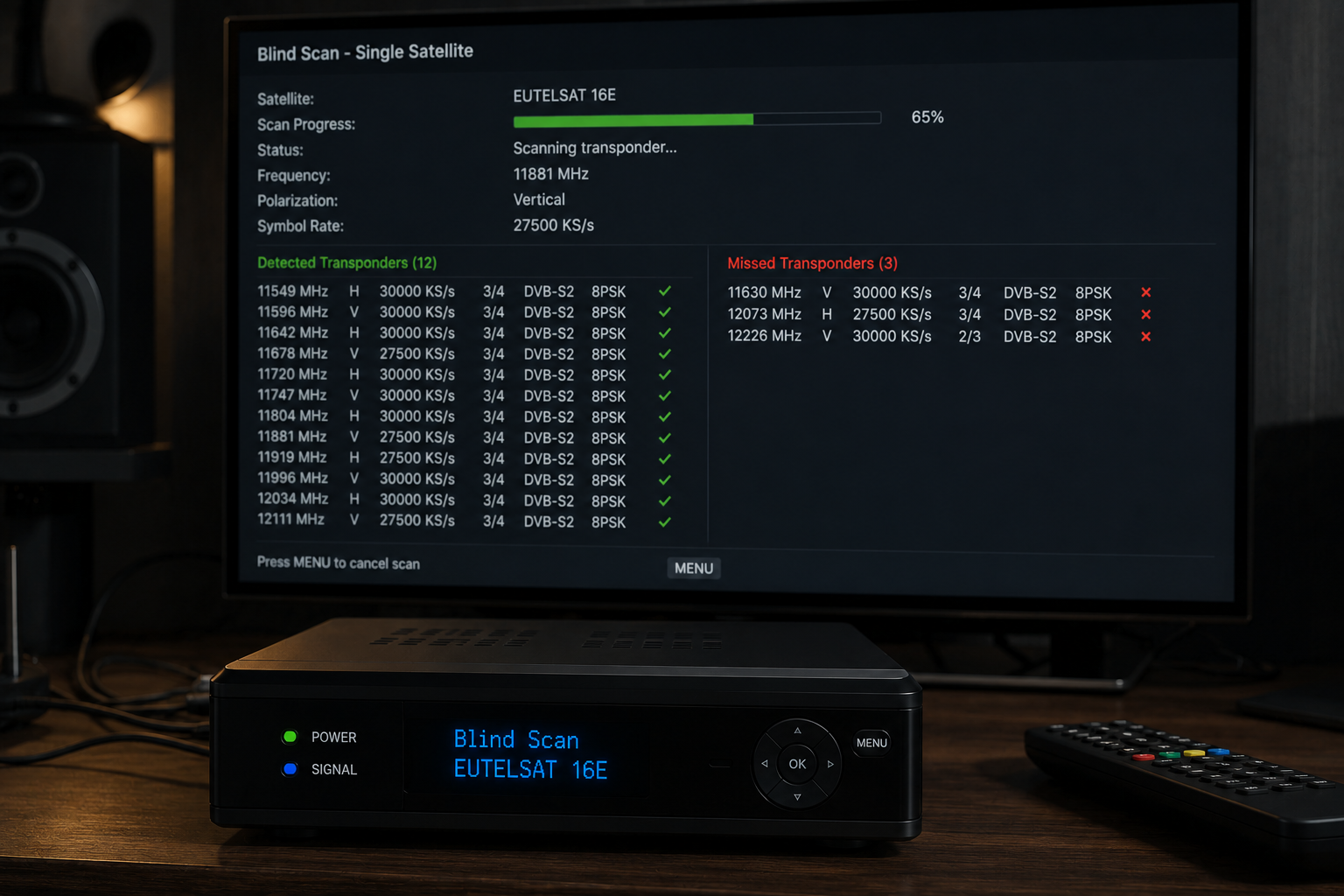
Estimated reading time: 18 minutes.
- How blind scan actually works.
- Why transponders get missed.
- Receiver hardware limitations.
- DVB-S2 detection challenges.
- Signal quality and scan accuracy.
- LNB frequency stability.
- Weak transponder behavior.
- How to improve scanning results.
- How Blind Scan Really Works
- Blind Scan Is Not Perfect
- Weak Transponders Are Often Missed
- Why DVB-S2 Frequencies Are Harder To Detect
- Receiver Hardware Makes A Difference
- LNB Stability Affects Scan Results
- Signal Quality During Scanning
- Different Scan Algorithms Produce Different Results
- Technical Comparison Table
- How To Improve Blind Scan Performance
- Reality Check
- Final Verdict
- FAQ
How Blind Scan Really Works
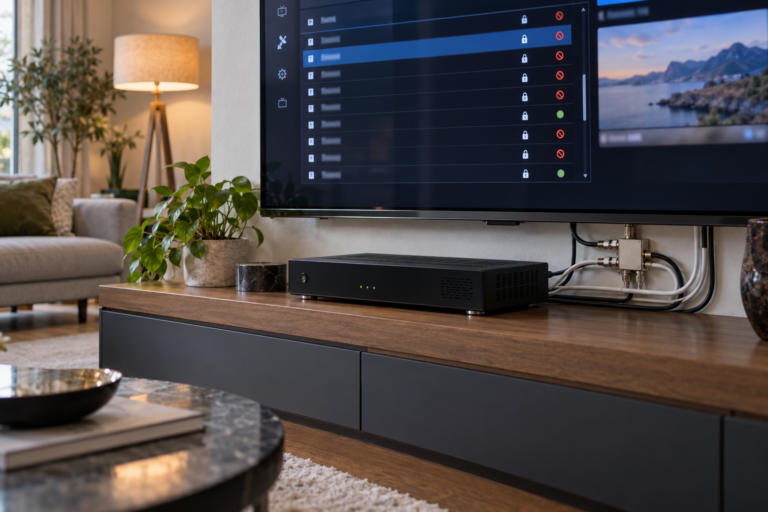
Blind scan works by searching frequency ranges rather than relying on a predefined transponder list.
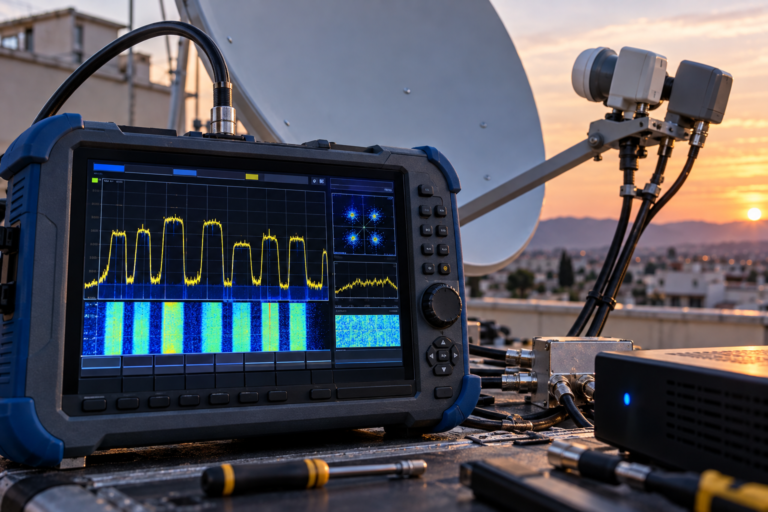
The receiver examines the satellite spectrum and attempts to identify active carriers automatically.
When it finds a carrier, it estimates symbol rates, identifies modulation parameters, and attempts to lock the signal.
If synchronization succeeds, channels are added to the database.
This process sounds straightforward, but in practice it involves significant signal analysis and estimation.
The receiver must make decisions quickly while scanning thousands of possible frequency combinations.
Any weakness in reception conditions can reduce detection accuracy.
Blind Scan Is Not Perfect
Many users assume blind scan should find every active channel automatically.
In reality, blind scan is an estimation process.
The receiver searches for likely signal patterns rather than reading a complete satellite directory.
Some transponders are easy to identify.
Others sit close to detection limits.
Small synchronization problems can cause the receiver to skip frequencies entirely.
This is why blind scan results often differ between receivers.
Each device uses different hardware and detection methods.
Weak Transponders Are Often Missed
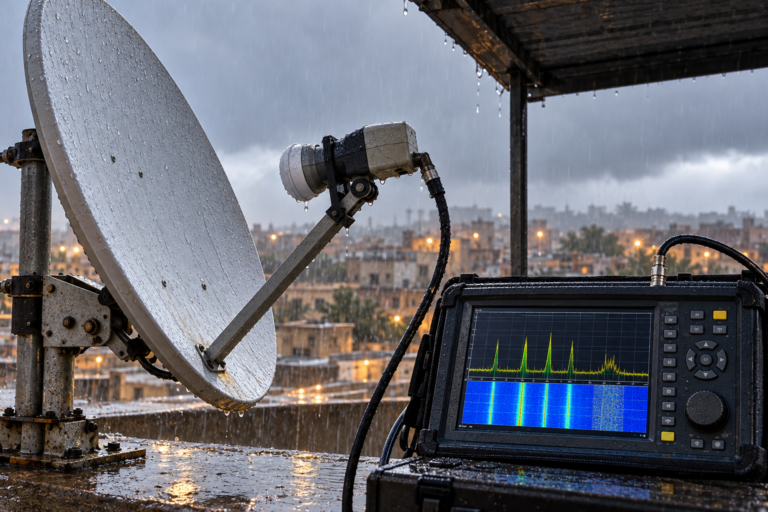
One of the most common causes of missing channels is weak transponder reception.
A transponder may remain strong enough for normal viewing once manually tuned.
However, during blind scan the receiver must first discover its presence.
Weak carriers are harder to identify.
If signal quality falls below a certain level, the receiver may never recognize that the transponder exists.
The result is an incomplete channel list even though reception would be possible with manual tuning.
Why DVB-S2 Frequencies Are Harder To Detect
Modern Eutelsat 16E services rely heavily on DVB-S2 technology.
DVB-S2 provides excellent efficiency but requires more precise synchronization.
Blind scan systems often struggle more with DVB-S2 than with older DVB-S signals.
High-density modulation requires cleaner reception conditions.
A slight reduction in quality may prevent successful detection.
This is why some HD channels never appear after a scan even though they work when entered manually.
Receiver Hardware Makes A Difference
Not all receivers perform blind scans equally.
The tuner is responsible for detecting and locking transponders.
Higher-quality tuners generally identify weak carriers more effectively.
Faster processors can analyze signals more accurately.
More advanced firmware may use better detection algorithms.
As a result, two receivers connected to the same dish can discover different numbers of channels.
The satellite has not changed.
The scanning hardware has.
LNB Stability Affects Scan Results
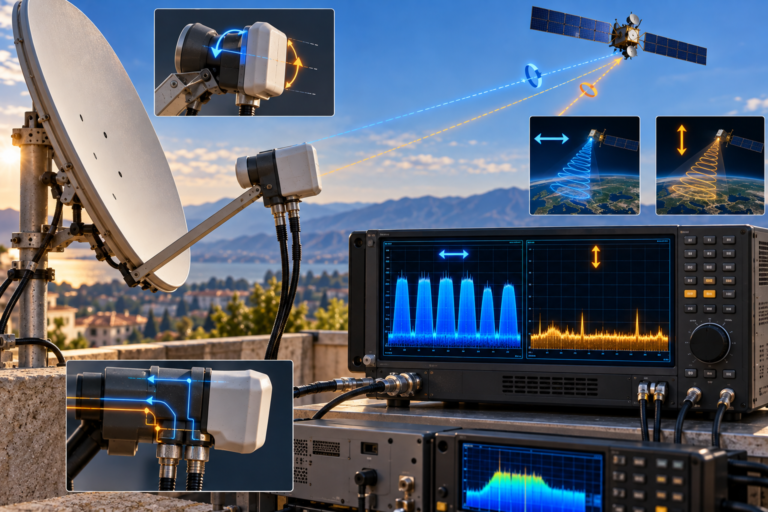
The LNB influences blind scan performance more than many users realize.
During scanning, the receiver depends on accurate frequency conversion.
If the LNB experiences frequency drift, carrier detection becomes more difficult.
The receiver may misinterpret frequency locations or fail to lock signals entirely.
Older LNBs often create inconsistent scan results because frequency accuracy changes with temperature.
A stable LNB improves overall detection reliability.
Signal Quality During Scanning
Blind scan depends heavily on signal quality.
Many users focus on strength readings while ignoring quality.
A strong but noisy signal can create detection problems.
High BER levels interfere with synchronization.
Weak signal margin reduces carrier recognition accuracy.
Improving quality often allows the receiver to discover channels that were previously invisible during scanning.
Different Scan Algorithms Produce Different Results
Every manufacturer develops its own blind scan software.
Some algorithms prioritize speed.
Others prioritize accuracy.
Fast scans may skip weak carriers.
More detailed scans take longer but often discover additional frequencies.
This explains why firmware updates sometimes improve blind scan performance dramatically.
The tuner remains unchanged.
The detection logic becomes better.
Technical Comparison Table
| Factor | Successful Detection | Missed Channels |
|---|---|---|
| Signal quality | High | Low or unstable |
| BER | Low | Elevated |
| LNB stability | Accurate frequency conversion | Possible frequency drift |
| DVB-S2 synchronization | Reliable | Difficult to achieve |
| Tuner sensitivity | Strong | Limited |
| Blind scan results | Complete channel list | Missing transponders |
How To Improve Blind Scan Performance
Start by maximizing signal quality before running a scan.
Fine-tune dish alignment carefully.
Check LNB condition and frequency stability.
Inspect connectors and cables for losses.
Run a full blind scan rather than a quick scan whenever possible.
Update receiver firmware if newer versions improve tuner performance.
If important frequencies remain missing, compare results with manual transponder entry.
Many channels that fail during blind scan can still be received successfully through manual tuning.
For a deeper understanding of how pixelation and weak signal quality affect digital reception, read The Real Cause Of Pixelation On Eutelsat 16E HD Channels.
Blind scan is a powerful tool, but it is not a guarantee that every channel will be found. Weak signal quality, DVB-S2 complexity, tuner limitations, frequency drift, and algorithm design all influence scan accuracy. Missing channels often indicate detection limitations rather than transmission failures.
Blind scan misses channels on Eutelsat 16E because the process depends on successful carrier detection, synchronization, and signal analysis. Weak transponders, low signal margin, DVB-S2 sensitivity, unstable LNB performance, and receiver limitations all contribute to incomplete results. Improving signal quality and using accurate hardware significantly increases the number of channels discovered during scanning.
FAQ
| Question | Answer |
|---|---|
| Why does blind scan miss channels that exist? | Because some transponders are difficult to detect due to quality or synchronization limitations. |
| Can manual scanning find channels that blind scan misses? | Yes. Manually entering known transponder parameters often works. |
| Does signal quality affect blind scan? | Yes. Quality is one of the most important factors for successful detection. |
| Why are DVB-S2 channels harder to find? | They require more precise synchronization and cleaner reception conditions. |
| Can an old LNB reduce scan results? | Yes. Frequency drift can make carrier detection more difficult. |
| Do all receivers scan equally well? | No. Tuner sensitivity and scan algorithms vary significantly between models. |