Why One Astra Transponder Breaks Up in the Rain
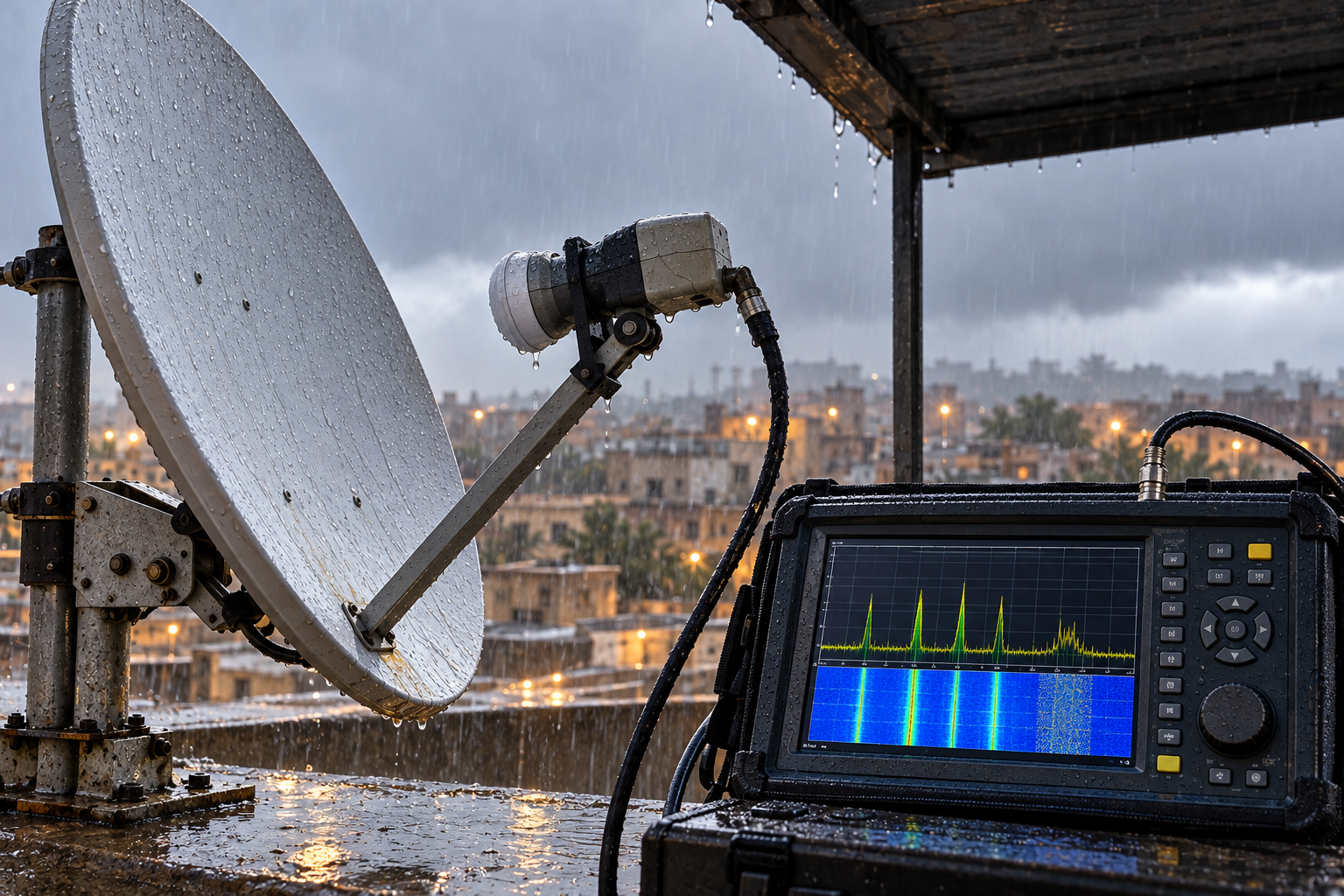
Rain begins falling, and one group of Astra channels suddenly breaks into digital blocks. A few seconds later, the picture freezes. You switch to another channel on Astra 19.2E, and it works perfectly. The dish is receiving the same orbital position, the weather has not changed, and yet one transponder has failed while another continues without interruption.
This is not necessarily a faulty channel or a satellite transmission problem. Different Astra transponders can operate with different reception margins, modulation requirements, beam characteristics and sensitivity to installation defects. Rain introduces additional signal loss, but the first carrier to fail is usually the one that reaches its decoding threshold first. Understanding that difference is the key to diagnosing selective rain-related picture breakup.
Rain fade affects Ku-band satellite reception by reducing the strength and quality of the received radio signal. However, not every transponder begins with the same link margin or requires the same signal quality for reliable decoding. One Astra carrier may fall below its usable threshold during rainfall while another remains comfortably above it. The difference can reveal a marginal installation rather than a problem with the satellite itself.
- Why Does Only One Astra Transponder Fail?
- What Rain Actually Does to Ku-Band Signals
- The Hidden Difference: Rain Margin
- Why Modulation and FEC Change the Failure Point
- Does Frequency Make One Transponder More Vulnerable?
- Why Astra Beam Coverage Matters
- How Slight Dish Misalignment Makes Rain Problems Worse
- The LNB and Wet Feed Cover Problem
- When Rain Reveals a Cable or Connector Fault
- Rain Fade or Wind-Induced Dish Movement?
- What to Measure Before and During Rain
- Step-by-Step Troubleshooting
- Will a Larger Dish Solve the Problem?
- Reality Check
- Final Verdict
- Frequently Asked Questions
Why Does Only One Astra Transponder Fail?
The important detail is that receiving several transponders from Astra 19.2E does not mean they all have identical reception conditions.
Astra 19.2E is an orbital position occupied by multiple satellite payloads. The transponders available at a particular receiving location can differ in transmitted power, beam coverage, frequency, polarization and modulation parameters.
Even when two carriers originate from the same orbital position, the receiver may have significantly more decoding margin on one than the other.
Consider a simplified example.
In clear weather, Transponder A has 5 dB of margin above its required decoding threshold. Transponder B has only 1.5 dB.
Now imagine rainfall introduces an additional 2 dB of attenuation into the relevant receiving paths.
Transponder A still has approximately 3 dB of margin remaining.
Transponder B has fallen below its required threshold.
The result is selective picture breakup: one group of channels disappears while another remains stable.
| Illustrative Measurement | Transponder A | Transponder B |
|---|---|---|
| Clear-sky decoding margin | 5 dB | 1.5 dB |
| Additional rain-related loss | 2 dB | 2 dB |
| Remaining margin | 3 dB | -0.5 dB |
| Likely result | Stable reception | Errors or loss of lock |
These values are illustrative, not measured Astra transponder specifications. Actual rain attenuation and decoding thresholds depend on the receiving path, waveform and equipment.
This simple example explains why selective rain failure does not automatically mean the affected transponder is defective.
What Rain Actually Does to Ku-Band Signals
Astra television reception commonly uses Ku-band downlink frequencies.
At these frequencies, rainfall can attenuate the wanted signal through absorption and scattering by water droplets.
The amount of attenuation depends on several factors, including rainfall intensity, frequency, polarization, elevation angle and the distribution of precipitation along the signal path.
Heavy rainfall generally creates more attenuation than light rain, but rainfall intensity at the dish is not the only factor.
The satellite signal travels through a slanted atmospheric path. Rain cells located elsewhere along that path can affect reception even when rainfall at the receiver is relatively light.
Rain attenuation also varies with frequency and polarization.
As the wanted carrier weakens relative to receiver noise, the available carrier-to-noise ratio and decoding margin decrease.
Once the signal falls below the level required by the demodulator and error-correction system, picture errors begin.
This is why a channel may remain perfect during the first minutes of rainfall and then suddenly freeze when the precipitation becomes more intense.
The receiver has not necessarily lost all RF energy. It may simply no longer have enough usable signal quality to recover the transmitted data reliably.
The Hidden Difference: Rain Margin
Rain margin is the amount of additional attenuation a satellite link can tolerate before its performance becomes unacceptable.
For a home satellite installation, the practical rain margin depends on the clear-sky carrier quality and the minimum quality required by the selected transponder.
A transponder that works in clear weather may still have very little spare margin.
That distinction is easy to miss because digital television often produces a perfect picture until reception approaches the decoding threshold.
A marginal carrier does not necessarily look worse than a stronger one during normal viewing.
Both may display clean HD pictures.
But when rainfall reduces the available signal quality, the weaker-margin carrier reaches its limit first.
Important distinction: A transponder can be receivable without being weather-resistant. Successful tuning during clear weather proves that the receiver can decode it under those conditions. It does not prove that the installation has sufficient reserve for heavy rainfall.
This is why installers should evaluate the weakest relevant transponders, not only the easiest carriers to receive.
Why Modulation and FEC Change the Failure Point
Rain attenuation reduces the quality available to the receiver, but the required quality depends partly on how the carrier is transmitted.
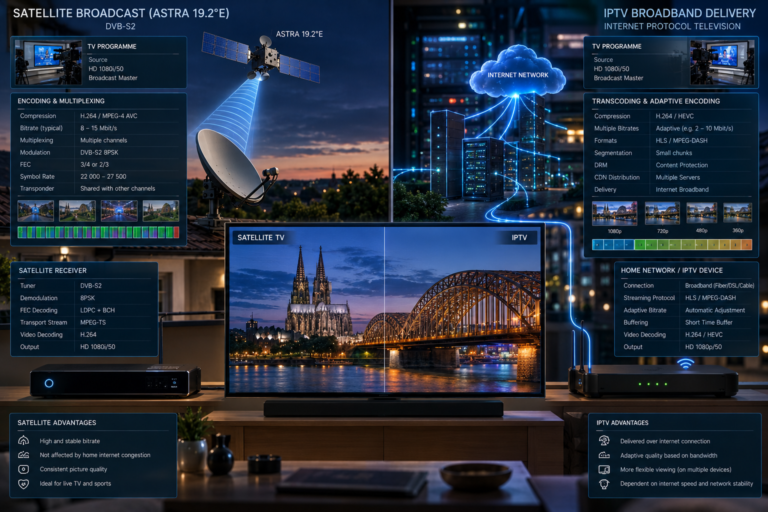
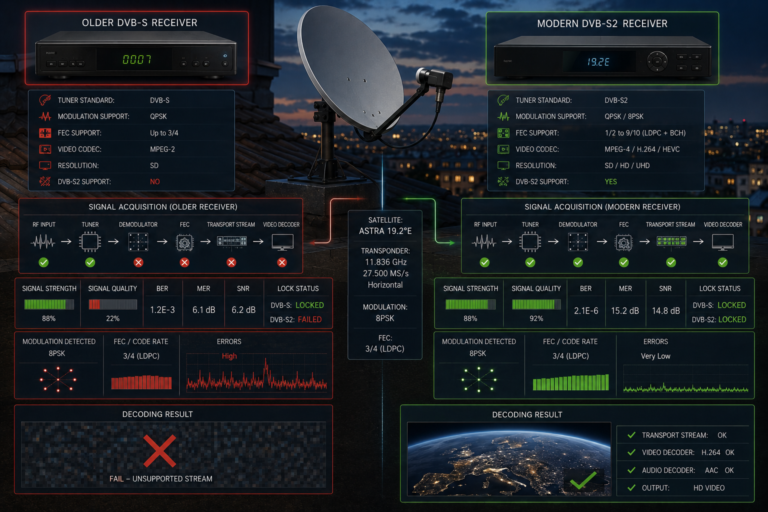
DVB-S2 supports different modulation and forward error correction configurations.
QPSK and 8PSK are common examples in satellite broadcasting.
QPSK uses four constellation states, while 8PSK uses eight.
At comparable coding conditions, the closer spacing of 8PSK constellation points generally makes it more demanding in terms of signal quality.
However, modulation format alone does not determine the complete reception threshold.
Forward error correction also matters.
A more robust coding configuration provides additional protection against transmission errors but uses more redundancy.
A less robust configuration can deliver greater useful throughput under suitable conditions but may require better carrier quality.
The practical threshold is therefore determined by the complete modulation and coding combination, often called the MODCOD.
| Transmission Parameter | Why It Matters During Rain |
|---|---|
| Modulation | Influences how much noise and distortion the receiver can tolerate |
| FEC coding rate | Determines the amount of error-correction redundancy |
| Symbol rate | Influences occupied bandwidth and receiver operating conditions |
| Carrier-to-noise ratio | Shows the available wanted signal relative to noise |
| MER | Indicates received modulation quality |
| Receiver implementation | Affects practical acquisition and decoding performance |
This explains why two transponders with similar signal-strength percentages can behave differently in the same rainstorm.
One may require more signal quality than the other, or it may simply begin with less margin.
Does Frequency Make One Transponder More Vulnerable?
Frequency can influence rain attenuation, but it should not be treated as the only explanation for selective reception failure.
Within Ku-band, attenuation caused by rain generally changes with frequency under otherwise comparable conditions.
Higher-frequency signals can experience greater rain attenuation than lower-frequency signals, although the exact difference depends on the atmospheric conditions and link geometry.
However, two Astra transponders also differ in other important ways.
They may use different beams, transmitted powers, modulation settings or polarizations.
A carrier at a slightly lower frequency can therefore fail before one at a higher frequency if its available margin is smaller.
Similarly, polarization can influence propagation loss during rainfall.
But the receiver’s horizontal and vertical channel groups should not be assumed to have a universal ranking in which one polarization always survives rain better than the other.
For a meaningful comparison, examine the actual transponder parameters and measured reception margin.
Why Astra Beam Coverage Matters
Astra 19.2E is widely received across Europe, but coverage is not identical for every carrier or every location.
Different satellites and payloads can use different antenna beams and effective isotropic radiated power distributions.
A location near the stronger part of a particular beam may receive one transponder with generous margin.
Another transponder may arrive with less available power because of its beam characteristics or the receiving location.
That difference can remain hidden in clear weather.
Rain then reveals which carriers have the least reserve.
This is especially important when receiving Astra outside the strongest intended coverage region for a particular beam.
A dish that provides reliable reception on one carrier does not guarantee identical weather performance on every other carrier at 19.2E.
Before assuming an installation fault, confirm the affected carrier’s actual satellite and coverage characteristics using current operator information.
How Slight Dish Misalignment Makes Rain Problems Worse
A satellite dish can be aligned well enough to receive most channels without being precisely optimized.
A small azimuth or elevation error reduces the antenna gain available in the wanted satellite direction.
In clear weather, that loss may not cause visible problems.
But it reduces the reserve available when rain adds further attenuation.
The first transponder to fail is often the one that already has the smallest margin.
Dish alignment should therefore be evaluated using reliable carrier-quality measurements, preferably on a marginal transponder.
Maximizing a generic signal-strength percentage is not the same as maximizing MER or carrier-to-noise ratio.
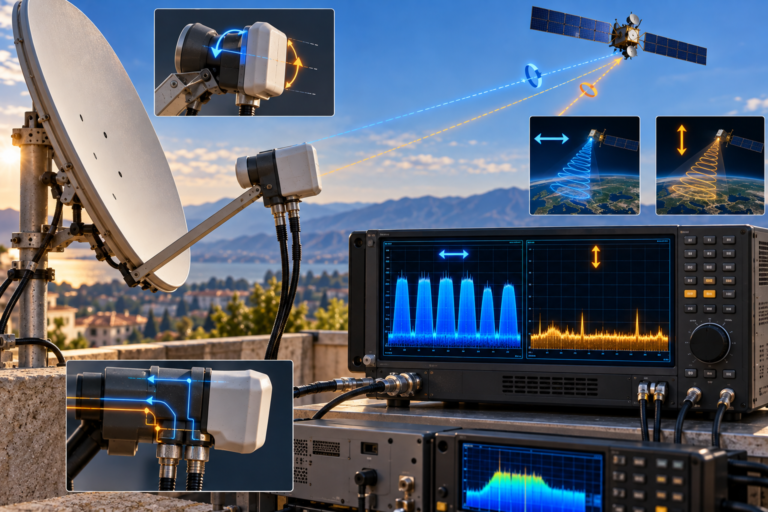
Another issue is LNB skew.
Incorrect skew can reduce cross-polarization isolation, allowing more unwanted energy from the opposite polarization to interfere with the selected carrier.
That impairment may become more significant when rain reduces the wanted signal.
However, skew and pointing adjustments should be performed carefully. Randomly rotating the LNB or moving the dish can make an otherwise acceptable installation worse.
The LNB and Wet Feed Cover Problem
The LNB is exposed directly to outdoor conditions.
During rainfall, water can collect on its protective feed cover, commonly called the radome.
A normal, undamaged radome is designed to protect the feed while allowing radio signals to pass with limited additional loss.
However, heavy water films, contamination or physical damage can introduce additional attenuation or reflection effects.
A cracked feed cover is a more serious concern.
If moisture enters the LNB, internal electronics and RF performance may deteriorate.
That can create faults that persist after the rain has stopped.
Possible warning signs include:
- Reception becoming worse after repeated rainstorms
- Visible cracks in the LNB feed cover
- Water trapped inside damaged external components
- Intermittent reception during wet weather
- Performance that does not fully recover after conditions dry
Do not assume that every wet LNB needs replacing.
The relevant question is whether the LNB is functioning correctly and whether moisture has damaged its protective structure or internal components.
When Rain Reveals a Cable or Connector Fault
Not every rain-related reception problem is caused by attenuation along the satellite path.
Rain can also expose weaknesses in the local installation.
Outdoor F-connectors that are poorly sealed may allow water to enter the coaxial connection.
Moisture can increase RF losses, contribute to corrosion and create intermittent electrical behavior.
Damaged coaxial cable can also allow water to migrate along the cable structure.
In some cases, the problem affects certain frequency ranges more strongly than others.
That can make one Astra transponder appear unusually sensitive to rain.
The difference between atmospheric rain fade and water ingress is important.
| Atmospheric Rain Fade | Water Ingress or Connection Fault |
|---|---|
| Related to precipitation along the satellite path | Related to moisture entering local equipment or connections |
| Often recovers as rainfall weakens | May persist after the rain stops |
| Primarily reduces available link margin | Can introduce attenuation, corrosion or intermittent contact |
| May affect several carriers differently | May affect particular bands or frequencies unevenly |
| Not necessarily an equipment defect | Usually indicates an installation problem requiring attention |
If reception remains unreliable long after the weather improves, inspect accessible outdoor connections and cable sections.
Always power off the receiver before disconnecting the LNB cable.
Rain Fade or Wind-Induced Dish Movement?
Rain and wind frequently occur together, making it easy to confuse two different causes.
Heavy rain can attenuate the satellite signal even when the dish remains perfectly stationary.
Strong wind can physically move a poorly secured dish or flexible mounting structure.
If the antenna shifts away from the satellite direction, reception quality decreases.
The symptoms may look almost identical on the television.
One useful clue is whether reception breaks up during strong wind even when there is little or no rainfall.
Another clue is whether the dish mounting visibly moves during gusts.
Do not attempt to hold or adjust an outdoor dish during a storm.
Inspect the mounting hardware only when conditions are safe.
What to Measure Before and During Rain
The most effective way to understand selective rain failure is to compare the affected carrier with one that remains stable.
Start with measurements during dry weather.
Record the affected transponder’s frequency, polarization, symbol rate, modulation and FEC settings.
Then record its carrier quality using the same receiver or measurement instrument.
Repeat the process for at least one unaffected carrier.
When rain occurs, compare how the readings change.
| Measurement | What It Reveals |
|---|---|
| MER | Changes in modulation quality and remaining decoding margin |
| Carrier-to-noise ratio | How the wanted carrier compares with noise |
| Pre-FEC BER | Whether raw or intermediate decoding errors are increasing |
| Post-FEC errors | Whether uncorrected errors remain after error correction |
| Carrier lock | Whether the receiver can maintain the selected transponder |
| RF power | Changes in received carrier level, when measured appropriately |
Consumer signal-strength percentages are not standardized and may provide limited diagnostic value.
Where possible, use a professional satellite meter capable of displaying MER and carrier quality.
The most important measurement is not simply how strong the transponder appears in dry weather.
It is how much usable margin remains before the carrier reaches its decoding threshold.
Step-by-Step Troubleshooting
Step 1: Confirm that the affected channels share a transponder.
Several television services may be carried on the same RF carrier. If all of them fail together, the shared transponder reception path becomes a strong area of investigation.
Step 2: Compare the affected carrier with a stable one.
Record their reception quality during clear weather. A transponder that begins with significantly less margin is more likely to fail first.
Step 3: Observe the timing of the failure.
Determine whether the problem follows rainfall intensity, strong wind or moisture exposure. These patterns can point toward different causes.
Step 4: Check carrier quality during rainfall.
If MER and carrier-to-noise ratio deteriorate as rain intensifies, atmospheric attenuation may be involved.
Step 5: Inspect accessible outdoor connections.
Look for damaged cable insulation, corroded connectors and inadequate weather protection after conditions are safe.
Step 6: Check dish alignment and mounting stability.
A professional installer can verify pointing accuracy, LNB skew and the available margin on the affected carrier.
Step 7: Inspect the LNB feed cover.
Check for cracks or visible damage that may allow moisture to enter.
Step 8: Evaluate the required dish size.
If the equipment is healthy and alignment is correct but rain margin remains inadequate, additional antenna gain may be needed.
Step 9: Verify the improvement.
Repeat measurements during dry weather and subsequent rainfall to determine whether the original problem has been corrected.
Will a Larger Dish Solve the Problem?
A larger dish can provide additional antenna gain when it is correctly designed and aligned for the operating frequency.
That additional gain can improve clear-sky carrier-to-noise ratio and increase the attenuation the link can tolerate before decoding fails.
However, a larger dish is not always the first or best solution.
If the existing dish is poorly aligned, correcting its pointing may recover lost performance without replacing the antenna.
If the coaxial cable is water-damaged, a larger reflector will not repair the faulty connection.
If the LNB is defective, increasing dish size may not eliminate the underlying instability.
There are also practical considerations.
Larger dishes require suitable mounting structures and must withstand greater wind loading. Their narrower beams can demand more precise alignment.
The correct dish size depends on the receiving location, relevant satellite beam, required availability and local rainfall conditions.
For an installation already operating near the edge of a particular beam’s coverage, a larger antenna may provide a meaningful improvement.
But it should be selected using the actual link requirements rather than assuming that any increase in diameter will guarantee reception during every storm.
Reality Check
If one Astra transponder fails in the rain while others remain stable, that does not prove the affected satellite transmission is faulty.
Different carriers can begin with different clear-sky margins and require different signal quality for successful decoding.
Rain introduces additional attenuation, but the first transponder to fail is generally the one that reaches its practical decoding threshold first.
That failure may reflect limited beam coverage, demanding modulation parameters, marginal dish alignment or a local installation defect.
Water ingress, damaged LNB components and wind-induced dish movement can also produce rain-associated symptoms that are not caused solely by atmospheric attenuation.
The correct diagnosis depends on comparing carrier quality before and during rainfall.
Final Verdict
One Astra transponder breaking up during rain is usually a question of available reception margin, not simply whether the dish receives Astra 19.2E.
Rain attenuates Ku-band signals, but individual carriers may have different starting margins and decoding requirements.
A transponder with comfortable reserve can continue operating while another falls below its required threshold and begins producing uncorrectable errors.
The most effective troubleshooting method is to identify the affected carrier, measure its clear-sky quality, compare it with stable transponders and determine how its margin changes during rainfall.
Before purchasing a larger dish, verify alignment, LNB condition, cable integrity and mounting stability.
If the installation is healthy but the affected carrier still lacks sufficient rain margin, additional antenna gain may be appropriate.
The goal is not merely to receive the transponder on a sunny day. It is to maintain enough usable signal quality for reliable reception under the weather conditions the installation is expected to handle.
Frequently Asked Questions
| Question | Answer |
|---|---|
| Why does only one Astra transponder break up during rain? | The affected carrier may have less clear-sky decoding margin, different modulation requirements or a reception disadvantage compared with other transponders. |
| Does rain affect every Astra frequency equally? | No. Rain attenuation varies with frequency, polarization and propagation conditions. Different carriers also have different starting margins and decoding requirements. |
| Can one transponder be weaker than another on Astra 19.2E? | Yes. Differences in beam coverage, transmitted power, modulation and installation performance can produce different usable margins. |
| What is rain margin? | Rain margin is the additional attenuation a satellite link can tolerate before reception performance falls below the required level. |
| Why does the picture freeze suddenly instead of becoming gradually worse? | Digital error correction can maintain a clean picture until the received signal approaches its decoding threshold. Beyond that point, uncorrected errors can increase rapidly. |
| Can LNB skew affect reception during rain? | Yes. Incorrect skew can reduce cross-polarization isolation and lower usable signal quality, leaving less margin when rain attenuation occurs. |
| Can water inside a coaxial cable cause rain-related freezing? | Yes. Moisture ingress can introduce attenuation, corrosion and intermittent faults that may affect some frequencies more than others. |
| Will replacing the LNB fix rain fade? | Not necessarily. Replacing a defective LNB may improve reception, but it will not eliminate normal atmospheric rain attenuation. |
| Will a larger dish improve Astra reception in rain? | A correctly installed larger dish can increase antenna gain and rain margin. However, alignment and equipment faults should be corrected first. |
| What should I measure to diagnose the problem? | Compare MER, carrier-to-noise ratio, error measurements and lock status on affected and unaffected transponders during both dry and rainy conditions. |