Why an 80cm Dish Can Transform Hot Bird Reception
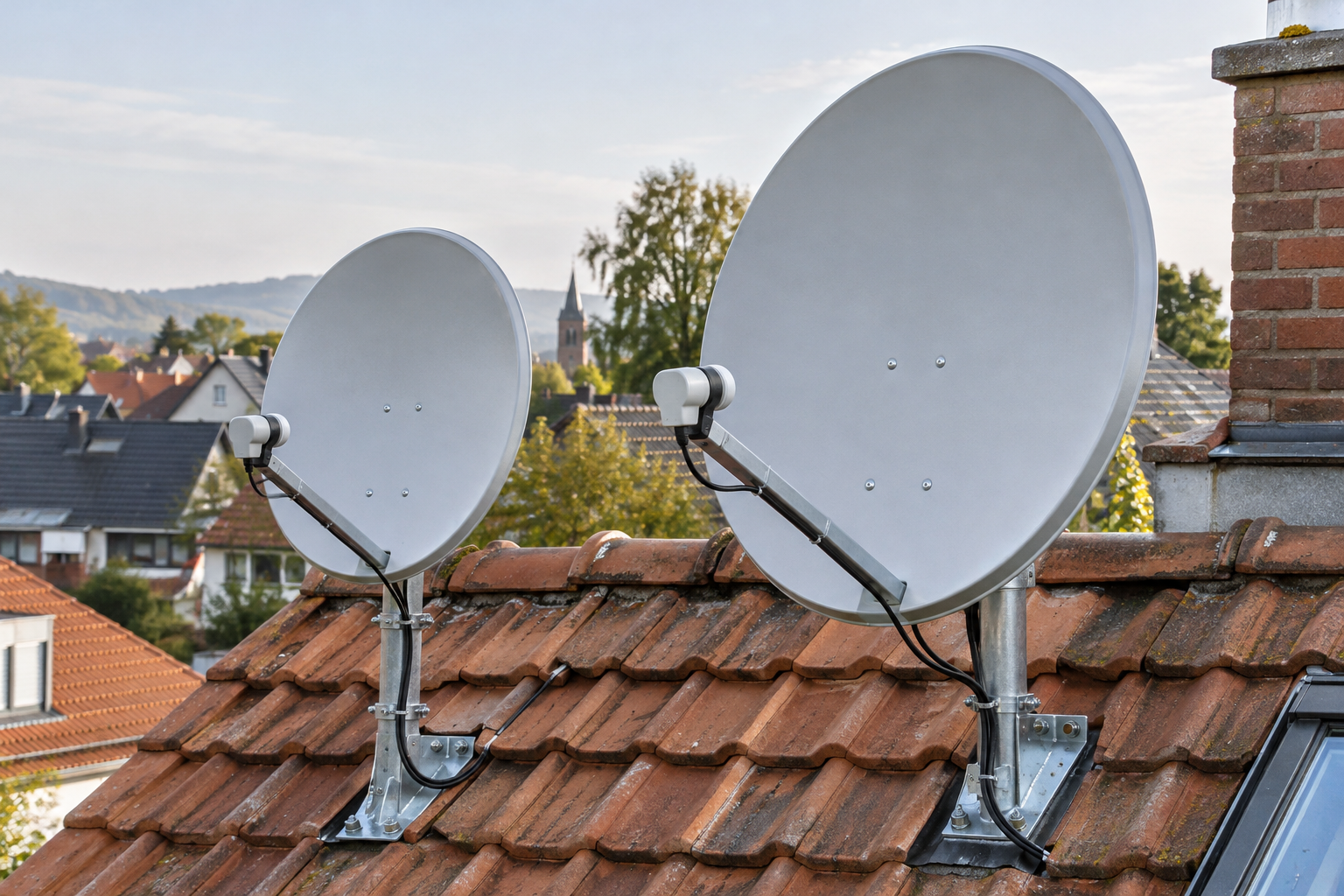
Your 60cm satellite dish receives Hot Bird 13°E perfectly on a clear afternoon. Most channels look fine, but a few transponders break up during bad weather, and some disappear with relatively small changes in reception conditions. Would replacing the reflector with an 80cm dish really make a noticeable difference?
It can, particularly when the installation is operating close to the minimum signal quality required for reliable reception. Increasing dish diameter improves the antenna’s ability to collect incoming satellite energy, potentially adding valuable link margin. But a larger dish does not automatically correct a poorly installed LNB, defective cable, incorrect receiver configuration, or outdated channel database. The important question is whether your current reception is limited by antenna gain or by something else in the system.
Hot Bird 13°E is served by Eutelsat’s HOTBIRD 13F and 13G satellites, providing Ku-band broadcasting coverage across Europe, North Africa, and the Middle East. An 80cm dish is not universally required throughout this coverage area. Its potential advantage depends on local EIRP, antenna efficiency, installation accuracy, weather margin, and the requirements of the transponders being received.
Why Satellite Dish Diameter Changes Reception
A satellite dish is a receiving antenna designed to collect electromagnetic energy from a particular direction and focus it toward the feed assembly.
For a parabolic reflector, increasing its effective aperture generally increases antenna gain when frequency and efficiency are held constant.
This matters because the power received from a satellite is extremely small by the time it reaches a household antenna.
The reflector’s purpose is not to amplify the signal electronically. It concentrates the incoming energy into the feed system, improving the usable carrier level relative to noise contributions from the receiving system and environment.
Effective Aperture Matters More Than Diameter Alone
Two dishes with the same nominal diameter do not necessarily provide identical gain.
Real performance also depends on aperture efficiency, reflector accuracy, feed illumination, obstruction, and mechanical alignment.
A well-designed and accurately installed smaller reflector can sometimes outperform a poorly manufactured or incorrectly aligned larger one.
For this reason, nominal dish size should be considered alongside antenna specifications and installation quality.
60cm vs 80cm: What Actually Changes?
For an idealized comparison using circular reflector apertures, antenna gain is proportional to the square of reflector diameter when operating frequency and aperture efficiency remain unchanged.
The relative gain difference can be expressed as:
Gain difference = 20 × log10(D2 / D1)
For D1 = 60cm and D2 = 80cm:
20 × log10(80 / 60) ≈ 2.50 dB
The theoretical gain advantage is approximately 2.5 dB.
This calculation assumes equivalent aperture efficiency, operating frequency, polarization performance, and appropriate alignment.
It is not a measured result from two actual Hot Bird installations.
Why 2.5 dB Can Be Significant
In digital satellite reception, a few decibels can determine whether a marginal carrier remains above its required operating threshold.
If a smaller antenna already provides adequate margin, the improvement may not produce any visible change in picture quality.
If a transponder is close to losing lock, however, additional antenna gain may improve reliability substantially.
The benefit is primarily improved reception margin, not enhanced video resolution or picture sharpness.
Illustrative Dish Diameter Comparison
| Dish Diameter | Relative Theoretical Gain vs 60cm | Practical Consideration |
|---|---|---|
| 60cm | 0 dB reference | May provide sufficient margin in favorable locations |
| 70cm | Approximately +1.34 dB | Modest potential improvement |
| 80cm | Approximately +2.50 dB | Can provide useful additional margin |
| 90cm | Approximately +3.52 dB | Greater potential gain with increased installation demands |
These are calculated differences for equal-efficiency idealized apertures, not guaranteed measured gains. Actual offset reflectors are commonly described by equivalent nominal dimensions, and manufacturers’ antenna specifications should take precedence when comparing real products.
Why a Small Gain Increase Can Transform Digital Reception
Digital satellite reception often remains visually stable until the available signal quality approaches the receiver’s decoding threshold.
As conditions deteriorate, the demodulator and forward-error-correction system may eventually become unable to recover the transmitted data reliably.
The result can be a sudden transition from a normal picture to visible artifacts, freezing, or loss of lock.
This behavior is often described as the digital cliff effect.
A Simplified Reception-Margin Example
Imagine a hypothetical transponder operating only 1 dB above its required reception threshold with a smaller antenna.
If an appropriately designed larger reflector provides an effective quality-margin improvement near the idealized 2.5 dB gain difference, the carrier could have noticeably more reserve against moderate degradation.
That does not mean antenna gain always translates directly into an equal MER or C/N improvement.
The actual result depends on whether the receiving system is limited by downlink carrier-to-noise conditions, interference, receiver noise, or another impairment.
In a noise-limited installation, additional antenna gain may be especially useful. In an installation dominated by a defective connection or incorrect receiver settings, the benefit may be negligible.
How an 80cm Dish Can Improve Hot Bird Reception During Rain
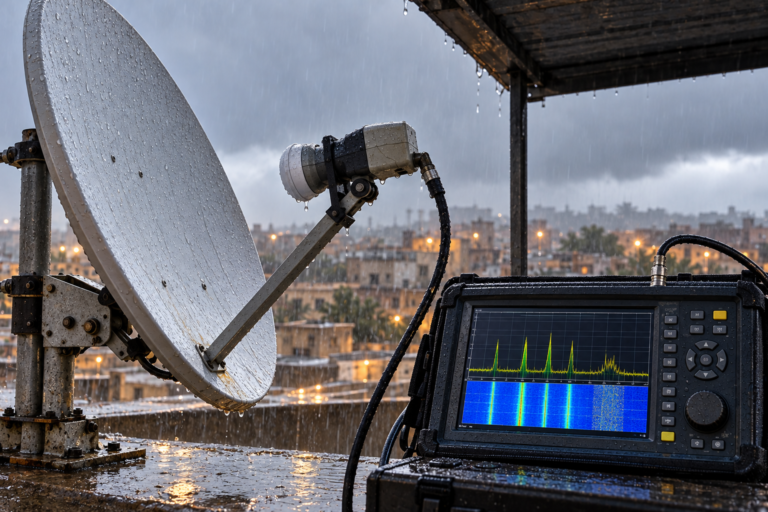
Rainfall can attenuate Ku-band satellite signals as they travel through precipitation.
The amount of attenuation depends on factors including rainfall intensity, signal frequency, polarization, and propagation-path geometry.
An antenna with greater usable gain can provide additional clear-sky link margin that may help offset some weather-related attenuation.
Why a Larger Dish May Reduce Interruptions
A transponder that operates close to its decoding threshold under clear skies has little reserve when reception conditions deteriorate.
Adding antenna gain may increase its margin enough to maintain lock during conditions that previously caused interruptions.
However, extreme rainfall can still exceed the available margin.
No practical residential dish size guarantees uninterrupted reception in every storm.
Rain Fade Versus Water-Damaged Equipment
Antenna gain cannot correct every problem that appears during wet weather.
Water entering an outdoor F-connector, coaxial cable, or LNB housing can cause signal loss, impedance mismatch, and unreliable electrical operation.
If reception remains poor long after the weather clears, inspect the installation for persistent faults.
Repairing defective weatherproofing may be more effective than installing a larger reflector.
Why Location and Hot Bird Coverage Matter More Than Country Names
Satellite coverage is determined by antenna beam patterns and the power available at different receiving locations.
Engineers often describe satellite downlink coverage using equivalent isotropically radiated power, or EIRP, contours.
These contours are not identical to national borders.
Two installations within the same country can experience different reception conditions because of geographic position, local obstacles, antenna performance, and other factors.
Why a 60cm Dish May Be Enough in One Location
Where the relevant Hot Bird carrier provides sufficient received power and the installation is properly designed, a smaller reflector may deliver reliable reception with adequate weather margin.
In such a location, upgrading to 80cm may offer additional reserve without producing a noticeable day-to-day improvement.
Why Another Location May Benefit From 80cm
A location with less available downlink power or more demanding reception conditions may require greater antenna gain.
Here, an 80cm dish can represent a meaningful improvement over a smaller reflector.
But the right antenna size should be determined from the relevant satellite beam, local EIRP, desired availability, equipment noise characteristics, and link-budget considerations.
It is not technically sound to promise reliable reception across an entire country using one universal dish-size recommendation.
Why Some Hot Bird Transponders Benefit More Than Others
Not every Hot Bird transponder has identical operating conditions or decoding requirements.
Individual carriers may differ in received power, transmission mode, modulation, coding, and available reception margin.
A larger antenna can improve the receiving system’s margin, but the practical effect may become visible mainly on carriers that were previously marginal.
When the Receiver Loses Only Certain Channels
If several channels disappear together, establish whether they share one transponder.
If that carrier genuinely loses lock because of inadequate reception quality, additional antenna gain may help.
However, missing services can also result from outdated channel entries, transmission changes, scan filters, and receiver decoding limitations.
Our related article, Why Hot Bird 13E Loses Only Some Channels, explains how to distinguish RF reception failures from service discovery and playback problems.
That distinction is essential before spending money on a larger dish.
Why DVB-S2 Requirements Matter
Different modulation and coding configurations have different reception requirements.
A higher-order modulation scheme may require cleaner signal conditions than a more robust alternative.
Therefore, two carriers using the same dish may have different amounts of margin relative to their decoding thresholds.
Do not assume that all DVB-S2 transponders require the same MER or C/N.
Why Installation Quality Becomes Even More Important With 80cm
Increasing reflector diameter can improve gain, but it also changes the installation’s mechanical requirements.
A Narrower Main Beam Requires Accurate Alignment
Larger dish antennas generally have narrower main reception beams at the same frequency.
This can improve directional selectivity but makes accurate pointing more important.
A poorly aligned 80cm dish may lose much of the theoretical benefit expected from its larger aperture.
Professional alignment should optimize usable carrier quality across several representative transponders rather than focusing only on the receiver’s signal-strength percentage.
LNB Position and Feed Illumination
The LNB feed must be positioned appropriately relative to the reflector geometry.
Incorrect feed positioning, unsuitable feedhorn characteristics, or poor polarization skew can reduce effective performance.
When replacing the reflector, do not assume the old feed-arm geometry or LNB position will automatically suit the new antenna.
Mast Stability and Wind Loading
A larger reflector generally presents a greater surface area to wind.
The mounting pole, brackets, and supporting structure must therefore be suitable for the manufacturer’s specified loads.
Movement under wind pressure can cause reception problems, particularly because a larger antenna’s main beam is narrower.
The installation should also comply with local structural, grounding, and electrical safety requirements.
When an 80cm Dish Will Not Solve the Problem
A larger antenna is not a universal repair for satellite reception faults.
Before upgrading, investigate whether the problem involves one of the following:
- Incorrect satellite selection: The dish or DiSEqC system may be selecting another orbital position.
- Wrong LNB settings: Incorrect local oscillator or switching configuration may prevent proper tuning.
- Defective coaxial cable: Excessive attenuation or damaged connectors may reduce reception quality.
- Polarization switching failure: A missing H or V group may result from electrical or distribution faults.
- Receiver incompatibility: Unsupported transmission formats cannot be repaired by antenna gain.
- Outdated service information: A missing channel entry may require updated tuning data rather than stronger reception.
- Interference or equipment overload: Increasing signal level may not correct the underlying impairment.
In some cases, improving an existing 60cm installation through accurate alignment or replacing damaged components may produce more benefit than increasing dish diameter.
How to Decide Whether an 80cm Dish Is Worth the Upgrade
A good upgrade decision begins with measurements, not assumptions about dish size.
Step 1: Confirm the Satellite and Carrier Parameters
Verify that the receiver is actually receiving Hot Bird 13°E and that the affected transponders use current, correct tuning parameters.
Exclude service-database errors before changing hardware.
Step 2: Measure Current Reception Quality
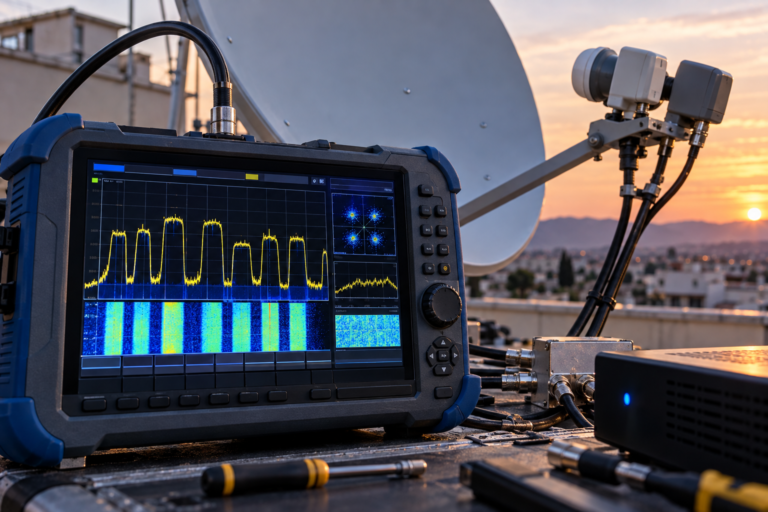
Use an appropriate satellite analyzer where available.
Record MER, C/N, lock stability, and relevant error measurements for representative carriers.
Compare their operating margins against the requirements of the actual transmission modes.
Step 3: Optimize the Existing Dish
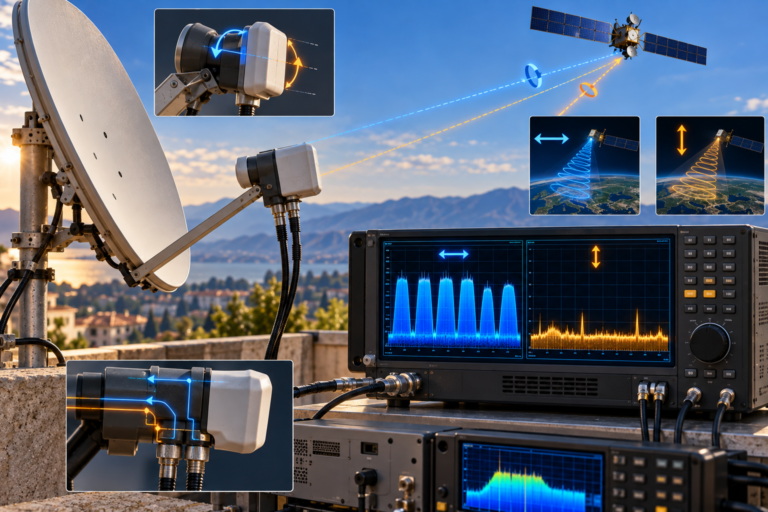
Check reflector alignment, LNB positioning, polarization skew, and cable condition.
A correctly adjusted smaller antenna provides a more meaningful baseline for an upgrade decision.
Step 4: Evaluate the Expected Gain
Compare the actual antenna specifications for the existing reflector and proposed 80cm model.
The idealized 60cm-to-80cm difference is approximately 2.5 dB at equal efficiency, but real products may differ.
Evaluate whether the expected improvement is sufficient for the required weather availability.
Step 5: Consider Mounting and Installation Requirements
Confirm that the mounting system can safely support the new reflector and its wind loading.
Use suitable brackets, a rigid mast, and appropriate outdoor cabling.
For rooftop work, use a qualified installer rather than attempting unsafe adjustments at height.
Step 6: Compare Results After Installation
Record measurements on the same verified transponders using comparable receiver and weather conditions.
Look for improved usable margin and lock reliability rather than assuming that higher receiver percentages prove success.
- Is the existing antenna correctly aligned?
- Do the affected carriers genuinely lack reception margin?
- Are the LNB, cable, and receiver configuration healthy?
- Does the proposed 80cm reflector offer meaningful additional gain?
- Can the mounting structure safely support the larger dish?
- Is the expected improvement worth the installation cost?
If the answers support an antenna-gain limitation, the upgrade becomes a technically justified option rather than guesswork.
Reality Check: An 80cm Dish Is Not a Universal Hot Bird Requirement
An 80cm reflector can improve reception margin, but it does not guarantee flawless Hot Bird reception in every location or under every weather condition.
The theoretical gain increase over a 60cm dish assumes equivalent aperture efficiency and operating conditions. Real antenna performance also depends on mechanical precision, feed design, pointing accuracy, and installation quality.
More antenna gain primarily improves the receiving system’s ability to maintain a usable carrier. It does not improve the original broadcast’s video resolution, recover discontinued channels, or repair incompatible receiver hardware.
The best dish is the one that provides adequate measured margin for the required services and weather conditions, not necessarily the largest reflector available.
Final Verdict
Moving from a 60cm to an 80cm satellite dish can transform Hot Bird 13°E reception when the existing installation is limited by insufficient antenna gain.
Under equal-efficiency conditions, the theoretical gain difference is approximately 2.5 dB. That additional margin can be significant for transponders operating close to their decoding thresholds, especially when weather-related attenuation reduces available signal quality.
However, actual performance depends on local beam coverage, antenna design, feed alignment, receiver characteristics, and the health of the complete RF path.
Measure and optimize the existing installation before upgrading. If insufficient link margin is confirmed, an appropriately installed 80cm reflector can provide a worthwhile improvement in reception reliability.
Frequently Asked Questions
Is an 80cm dish necessary for Hot Bird 13E?
No. Required dish size depends on the receiving location, relevant satellite beam, equipment performance, installation quality, and desired weather margin. Some installations operate reliably with smaller reflectors.
How much more gain does an 80cm dish provide than a 60cm dish?
For equal-efficiency circular apertures at the same frequency, the theoretical difference is approximately 2.5 dB. Actual gain differences depend on the specific reflector designs and their installation.
Will an 80cm dish improve Hot Bird reception during rain?
It can improve rain margin when antenna gain is the principal limitation. However, severe attenuation can still interrupt reception, and the upgrade will not fix damaged outdoor connections or other hardware faults.
Does a larger dish improve picture quality?
Not when the digital signal is already being decoded reliably. A larger dish can reduce freezing and signal loss by improving reception margin, but it does not change the broadcaster’s original video quality.
Can an 80cm dish receive weak Hot Bird transponders better?
Potentially yes. Additional antenna gain can help carriers with insufficient reception margin. It will not resolve every missing channel, particularly when the cause is outdated service data or receiver incompatibility.
Is an 80cm dish harder to align than a 60cm dish?
Generally, a larger reflector has a narrower main beam at the same frequency, making precise alignment more important. A stable mounting system is also necessary because the larger antenna usually experiences greater wind loading.
Should I replace my LNB when upgrading to an 80cm dish?
Not automatically. A compatible, properly functioning LNB may remain suitable. However, the feed assembly must match the new reflector’s geometry, and its positioning and skew should be checked during installation.