Why Public German TV Channels Stay Free on Satellite
Estimated Reading Time: 8 minutes
Point a compatible satellite receiver at Astra 19.2°E in Germany and major public television services such as ARD and ZDF can be received in HD without purchasing a commercial satellite television subscription. That may seem unusual when many commercial HD services elsewhere use encryption and conditional-access systems.
The reason is not that satellite broadcasting costs nothing. It is because Germany’s public-service broadcasting model separates the financing of broadcasters from the technical question of whether a satellite signal is encrypted. ARD and ZDF services can therefore be transmitted as free-to-air television while production and distribution are funded through the wider public-service system.
Free-to-air does not mean free to produce or distribute. In satellite engineering, FTA means that the broadcast signal is not protected by a pay-TV conditional-access system that requires a subscription smart card, module or equivalent authorization. ARD states that its HD satellite programmes are available unencrypted and without additional reception charges. :contentReference[oaicite:0]{index=0}
- What Free-to-Air Actually Means
- Who Pays for German Public Broadcasting?
- Why Satellite Remains Important
- Why Public Channels Do Not Need Pay-TV Encryption
- HD Does Not Automatically Mean Pay-TV
- What Changed When Germany Ended Public SD Satellite Broadcasting?
- DVB-S2 and Encryption Are Separate Technologies
- Why Commercial HD Television Can Work Differently
- Satellite and Internet Can Coexist
- Reality Check
- Final Verdict
- FAQ
What Free-to-Air Actually Means
In satellite television, the term free-to-air describes the accessibility of the transmitted service. A compatible receiver can demodulate the carrier, identify the service inside the transport stream and decode the programme without obtaining authorization from a commercial conditional-access platform.
That is different from saying that the programme itself has no economic cost.
Satellite capacity must be leased or otherwise provided. Uplink facilities consume resources. Broadcasters operate studios, contribution networks, encoders, multiplexing systems, transmission infrastructure and technical monitoring systems.
FTA therefore describes the absence of subscription-controlled encryption at the viewer’s receiver. It does not describe the broadcaster’s complete financial model.
| Term | What It Means | What It Does Not Mean |
|---|---|---|
| Free-to-air | No pay-TV conditional-access authorization is required to receive the broadcast | The service costs nothing to produce or transmit |
| Encrypted | Access to programme content is controlled by a conditional-access system | The RF carrier itself is invisible or impossible to receive |
| HD | A higher-resolution television video format than SD | The service must be encrypted |
| DVB-S2 | A satellite physical-layer transmission standard | The channel must be subscription television |
Who Pays for German Public Broadcasting?
Germany’s public-service broadcasters operate under a funding model that is fundamentally different from a conventional satellite pay-TV package.
ARD states that programme services and related activities are financed through revenues including the household broadcasting contribution, alongside other permitted income such as advertising. The broadcasting contribution therefore supports the wider public-service system rather than acting as a technical satellite subscription tied to a specific smart card or receiver. :contentReference[oaicite:1]{index=1}
This distinction is important.
A viewer receiving an unencrypted ARD or ZDF satellite signal is not obtaining a programme that somehow has no production cost. The funding mechanism exists elsewhere in the broadcasting system.
That allows satellite distribution to remain technically open at the receiver level.
In other words, financing and conditional access are two different layers of the system.
Why Satellite Remains Important
Satellite is particularly effective for large-scale linear television distribution because one transmitted signal can serve an enormous number of receiving antennas simultaneously.
Once a carrier is uplinked to the satellite and retransmitted over its footprint, adding another household with a correctly aligned dish does not require a dedicated physical transmission from the broadcaster to that household.
This is the classic one-to-many advantage of broadcasting.
ARD confirms that its television services are distributed via Astra at 19.2°E and that viewers require a suitable satellite installation and DVB-S2-capable receiving equipment for current HD reception. :contentReference[oaicite:2]{index=2}
For a national public broadcaster, this architecture can complement terrestrial, cable and internet distribution rather than replace them.
Different platforms serve different households and technical environments. Satellite remains particularly useful where direct reception is practical and where linear broadcasting to many viewers at once is valuable.
Why Public Channels Do Not Need Pay-TV Encryption
Encryption becomes useful when a broadcaster or platform needs to control who can decode the programme.
A pay-TV operator may need to restrict access by subscription status, package level, territory or contractual rights. Conditional-access systems therefore connect the encrypted service to an authorization mechanism.
Major German public satellite television services follow a different access model.
ARD explicitly describes its HD satellite services as unencrypted and available without an additional reception charge. ZDF likewise states that receiving its HD programme family does not create an additional HD reception cost. :contentReference[oaicite:3]{index=3}
Without a requirement for a commercial subscription authorization layer, a compatible receiver can process the broadcast directly.
This is why viewers should not confuse an unencrypted service with an uncompressed or technically simple one. The programme may still use modern digital compression, multiplexing and DVB-S2 transmission.
HD Does Not Automatically Mean Pay-TV
One of the most common misunderstandings in German satellite television is that HD and encryption somehow belong together.
They do not.
HD describes video. It concerns picture resolution and the associated production and encoding chain.
Conditional access describes authorization. It determines whether the viewer is permitted to decode protected programme content.
DVB-S2 describes satellite transmission. It specifies mechanisms used at the physical layer to carry digital information over the RF link.
These are separate technical concepts.
A broadcaster can therefore transmit an HD programme over DVB-S2 and leave the television service completely free-to-air.
That is precisely why the transition of German public broadcasters away from SD did not automatically transform those channels into pay-TV.
What Changed When Germany Ended Public SD Satellite Broadcasting?
Germany’s recent SD shutdowns provide a practical demonstration of this distinction.
On 7 January 2025, ARD ended the satellite SD distribution of Das Erste and the regional Dritten programmes. Their HD services continued. ARD explained that maintaining parallel SD and HD transmission was increasingly unnecessary and that ending the duplication reduced distribution costs. :contentReference[oaicite:4]{index=4}
ZDF followed on 18 November 2025. ZDF, ZDFneo, ZDFinfo, 3sat and KiKA became satellite HD-only after approximately fifteen years of parallel SD and HD distribution. ZDF also cited reduced duplication and lower distribution costs as reasons for the transition. :contentReference[oaicite:5]{index=5}
ARTE and phoenix had already ended their SD satellite distribution in November 2022. :contentReference[oaicite:6]{index=6}
What disappeared was the older parallel SD distribution, not free-to-air public satellite broadcasting itself.
For many viewers, the same satellite dish and LNB could continue to be used. What mattered was whether the television or receiver could process the current HD transmission.
This is why the distinction between an obsolete receiver and an obsolete satellite installation matters. Ending DVB-S/SD distribution does not necessarily mean replacing the complete antenna system.
For more detail about that transition, see Why Some German Channels Changed to HD Only.
DVB-S2 and Encryption Are Separate Technologies
A modern public HD service may use DVB-S2, but DVB-S2 itself does not create or require encryption.
The receiver first needs to recover the RF carrier. That includes the physical-layer tasks of synchronization, demodulation and forward error correction.
DVB-S2 can use modulation such as QPSK or 8PSK and uses powerful LDPC and BCH forward-error-correction mechanisms.
Once the receiver has successfully recovered the transmitted digital data, higher layers identify the transport stream and individual programme components.
Conditional access, if present, is a separate issue.
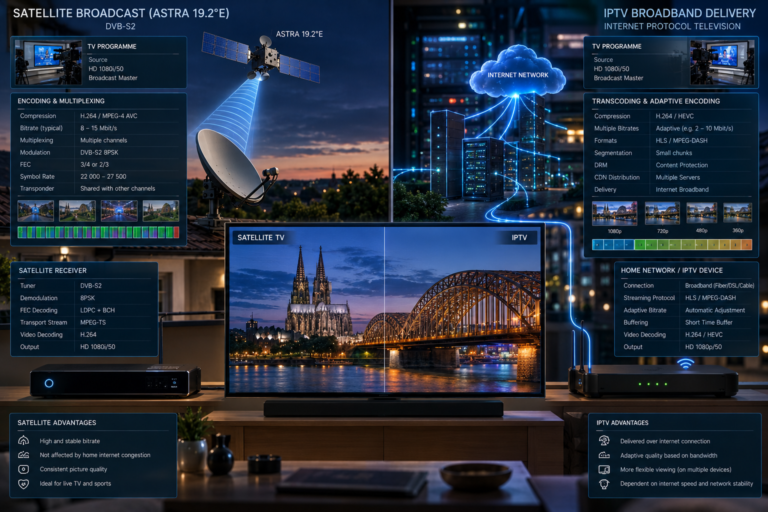
Satellite RF signal → DVB-S/DVB-S2 demodulation → error correction → transport stream → programme selection → conditional access if used → video/audio decoding.
A receiver may therefore support DVB-S2 perfectly and receive an unencrypted public HD channel without any subscription hardware.
Conversely, DVB-S2 compatibility by itself does not guarantee access to a commercial encrypted service.
Why Commercial HD Television Can Work Differently
German viewers may notice that the situation is different for some commercial HD services.
This does not mean commercial television and public television use fundamentally different laws of RF engineering. Both can travel through DVB-S2 carriers, multiplexes and the same general satellite infrastructure.
The difference can be in the business and access layer.
A commercial platform may choose conditional access for premium or packaged HD services. The satellite carrier can still be received by the antenna and tuner, while actual programme decoding requires authorization.
The important engineering lesson is that carrier reception and programme authorization are separate events.
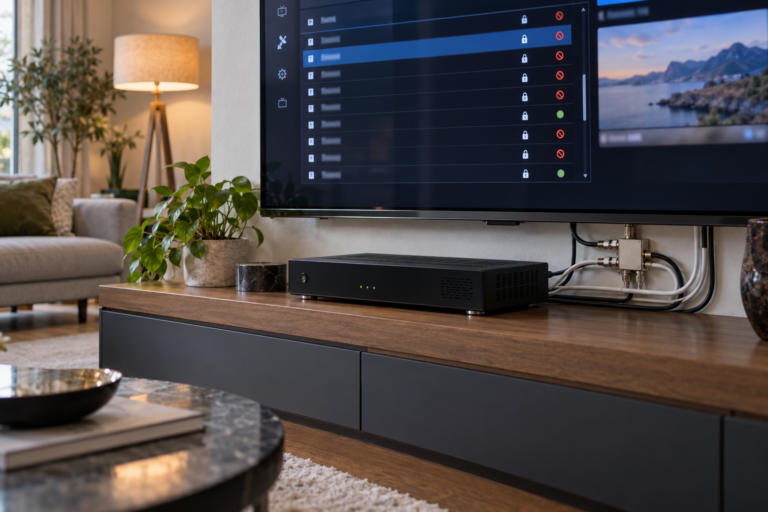
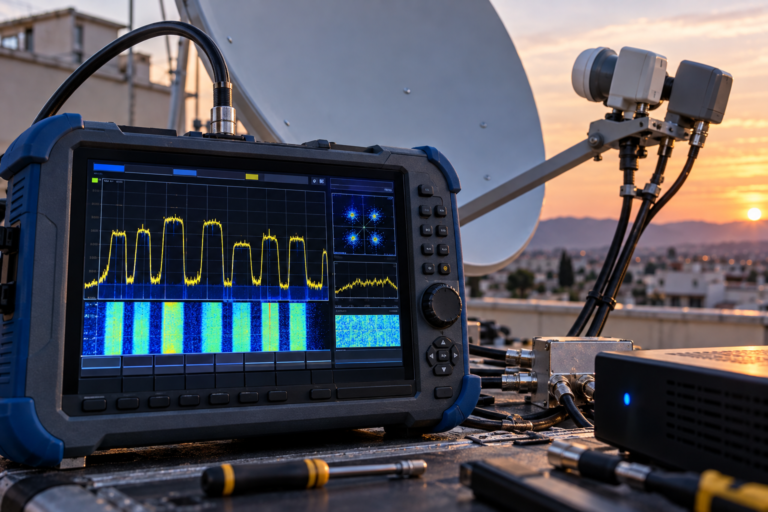
A spectrum analyzer can detect an encrypted carrier. A receiver can potentially lock that carrier. The transport stream can be present. Yet the viewer may still be unable to display the protected programme without valid authorization.
Public German FTA services remove that subscription-controlled step for the relevant broadcasts.
Satellite and Internet Can Coexist
Free-to-air satellite transmission also does not mean every modern public-service function must travel over the satellite link.
Linear television can arrive through the satellite RF path while additional functions are delivered over broadband.
Catch-up libraries, interactive applications, additional programme information and on-demand services are examples of functions that may use internet connectivity.
This hybrid architecture reflects a broader trend in modern television systems: satellite remains efficient for distributing the same live programme to many viewers, while IP networks can provide personalized or on-demand communication.
The presence of an internet service therefore does not automatically mean the satellite broadcast has been replaced.
Reality Check
German public television is not “free” in the sense that broadcasting has no cost. Production and distribution require substantial infrastructure and funding.
The technically accurate description is that major public services such as ARD and ZDF are available free-to-air on satellite: viewers do not need a separate commercial conditional-access subscription simply to decrypt those satellite broadcasts. ARD and ZDF continue to describe their public HD reception accordingly. :contentReference[oaicite:7]{index=7}
Free-to-air status, public-service funding, HD resolution, DVB-S2 transmission and video compression are distinct parts of the broadcasting system and should not be treated as interchangeable concepts.
Final Verdict
Public German television can stay free-to-air on satellite because programme financing and satellite access control are separate issues.
ARD and ZDF operate within Germany’s public-service broadcasting framework. Their major satellite television services can therefore be transmitted without requiring viewers to purchase a separate pay-TV authorization simply to decrypt the programme.
The move from SD to HD did not change that principle. ARD ended major SD satellite distribution in January 2025, and ZDF completed its corresponding transition in November 2025, while the current HD services remained available without an additional satellite HD reception charge. :contentReference[oaicite:8]{index=8}
From an engineering perspective, this is the key point: HD, DVB-S2 and encryption are three different things. A modern DVB-S2 HD channel can be technically advanced and still remain completely free-to-air.
Frequently Asked Questions
| Question | Answer |
|---|---|
| Are ARD and ZDF free on satellite? | Their major public satellite television services are transmitted free-to-air, meaning a separate commercial conditional-access subscription is not required for reception with compatible equipment. |
| Does free-to-air mean German public television costs nothing? | No. Programme production and distribution still have substantial costs. Free-to-air describes how the satellite signal can be accessed, not the broadcaster’s overall funding model. |
| Do I need to pay extra just because ZDF is now HD-only on satellite? | ZDF states that no additional reception charge applies to its HD programme family. The receiver must, however, be technically compatible with the current transmission. :contentReference[oaicite:9]{index=9} |
| Did ARD stop satellite broadcasting in 2025? | No. ARD ended the parallel SD distribution of Das Erste and the regional Dritten programmes on 7 January 2025. HD satellite distribution continued. :contentReference[oaicite:10]{index=10} |
| Did ZDF stop satellite broadcasting in November 2025? | No. ZDF ended its SD satellite versions on 18 November 2025. ZDF, ZDFneo, ZDFinfo, 3sat and KiKA continue in HD. :contentReference[oaicite:11]{index=11} |
| Does DVB-S2 mean a channel is encrypted? | No. DVB-S2 is a satellite transmission standard. A DVB-S2 service can be free-to-air or encrypted. |
| Does HD mean a channel must be pay-TV? | No. HD describes the video format. Encryption and subscription authorization are separate from picture resolution. |
| Why can commercial HD services require authorization while public HD services do not? | The difference is normally the service and access model, not HD technology itself. A commercial platform may apply conditional access, while an FTA public broadcaster can leave the programme unencrypted. |