Why Tring Sports Feel Delayed During Live Matches
Estimated Reading Time: 8 minutes
A goal can happen in a stadium while a viewer watching Tring Sport is still seeing the build-up to the attack. A phone notification, social media update or even a neighbour watching through a different television platform may reveal the goal before it appears on screen. That does not necessarily mean something is wrong with the satellite signal.
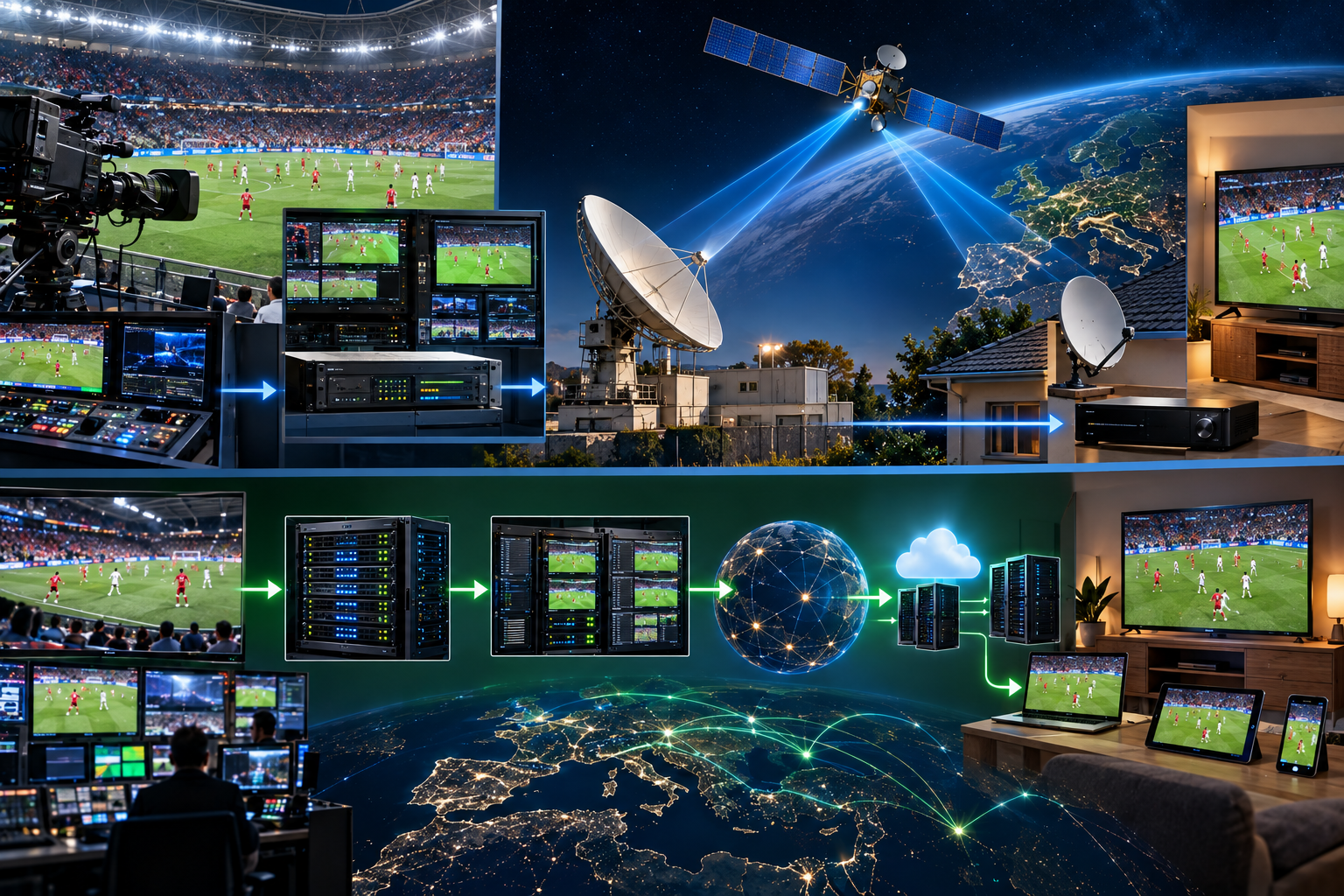
Every live sports broadcast passes through a chain of production, contribution, encoding, multiplexing, transmission and decoding stages. Each stage can add a small amount of latency. By the time those delays are combined, “live” television is no longer literally simultaneous with the event happening on the pitch.
There is no single universal Tring Sport delay. Latency depends on the exact programme source, contribution path, encoding configuration, distribution platform, receiver and television. Satellite and OTT versions of the same match can therefore reach viewers at different times even when both are correctly described as live broadcasts.
- What Does “Live” Actually Mean?
- The Delay Starts Before the Satellite
- Contribution Feeds Add Another Stage
- Why Video Encoding Creates Latency
- Multiplexing and Broadcast Processing
- How Much Delay Comes From the Satellite Path?
- Your Satellite Receiver Adds Processing Time
- The Television Can Add More Delay
- Why OTT Can Be Even Further Behind
- Why Phone Notifications Can Reveal a Goal First
- Why Two Viewers Can See the Same Goal at Different Times
- Broadcast Delay Is Not the Same as Lip-Sync Error
- Reality Check
- Final Verdict
- FAQ
What Does “Live” Actually Mean?
In broadcasting, live normally means that the programme is being distributed as the event happens rather than being delivered as a prerecorded programme.
It does not mean zero latency.
Light and radio waves travel extremely quickly, but the signal still needs to pass through cameras, production equipment, encoders, networks, satellite infrastructure, receivers and displays.
Some stages introduce only milliseconds. Others can add considerably more because they need to collect, analyze or buffer multiple video frames before producing their output.
The final latency is therefore cumulative.
Camera → stadium production → contribution feed → broadcaster processing → video encoding → multiplex → satellite uplink → satellite → household dish → receiver → television.
If the programme is watched through an internet service, additional transcoding, packaging, CDN delivery and playback buffering may enter the chain.
The Delay Starts Before the Satellite
The satellite is often blamed because it is the most visible long-distance part of the system. In reality, latency begins much earlier.
A professional football broadcast can involve many cameras, replay systems, graphics generators, audio processing, video switching and synchronization equipment.
Camera signals must reach the production system. Different sources need to remain synchronized. Graphics such as the score and match clock may be inserted. Replays and other production elements are integrated into the final programme output.
All of this processing takes time.
Digital video equipment also commonly uses buffers to maintain stable timing between different sources.
The output leaving the stadium may therefore already be behind the physical action on the pitch before it begins its journey toward the final television platform.
Contribution Feeds Add Another Stage
The signal produced at the stadium does not always travel directly into the final consumer satellite multiplex.
Broadcasters often receive a contribution feed first.
This may travel through fibre, managed IP networks, dedicated satellite contribution links or other professional transmission systems.
For an international sports event, the distribution chain can become more complex. A rights holder or host broadcaster may produce the original feed, distribute it internationally, and a local broadcaster may then receive and process that feed before sending it to viewers.
Each additional encoding, decoding, routing or buffering stage can add latency.
This is why two broadcasters showing exactly the same football match can already have different delays before their final satellite or internet distribution begins.
Why Video Encoding Creates Latency
Video compression is one of the most important sources of broadcast processing delay.
Raw HD video contains far too much data for efficient direct-to-home satellite distribution, so it must be compressed.
Modern encoders exploit similarities within individual frames and across sequences of frames.
Inter-frame compression can use information from nearby pictures to represent motion and changing image content more efficiently.
This is especially valuable for sports, where the encoder must process rapid player movement, camera pans, detailed crowds and complex textures such as grass.
But efficient compression can require frame analysis and buffering.
Depending on the encoder and configuration, the system may need to examine multiple pictures before completing the encoded output.
That introduces latency.
| Processing Stage | Why It Can Add Delay |
|---|---|
| Camera and production | Image processing, synchronization and switching |
| Contribution encoding | Compresses programme for transport from venue |
| Distribution encoding | Creates final consumer video stream |
| Multiplexing | Combines programme components and services |
| Receiver | Buffers, demultiplexes and decodes the programme |
| Television | Performs scaling and additional image processing |
There is usually a trade-off. Extremely low latency is possible in some systems, but reducing buffers and encoding complexity can affect compression efficiency, robustness or operational flexibility.
Multiplexing and Broadcast Processing
After the video and audio are encoded, they must be prepared for distribution.
The television service can be combined with other TV, radio and data services inside an MPEG Transport Stream.
Timing information must be maintained so the receiver can reconstruct synchronized playback.
Conditional-access processing may also be involved for protected services.
These processes do not necessarily create the largest delay in the chain, but they contribute to the total end-to-end latency.
The important point is that a satellite receiver is not receiving raw stadium video directly from a camera.
By the time the programme reaches the final DVB-S2 carrier, it has already passed through several digital systems.
How Much Delay Comes From the Satellite Path?
A geostationary satellite operates roughly 35,786 kilometres above Earth’s equator.
A direct-to-home signal does not travel only from the satellite down to the viewer. The broadcast carrier must first travel from an uplink station to the satellite and then from the satellite back to Earth.
That means the RF path alone covers well over 70,000 kilometres before allowing for the geometry between the actual uplink and receiving locations.
Electromagnetic waves travel close to the speed of light, so this creates an unavoidable propagation delay on the order of a quarter of a second for the basic uplink-and-downlink path.
That is real latency, but it is an important engineering mistake to blame several seconds of live-TV delay entirely on the spacecraft.
The satellite contributes propagation latency, but most of a multi-second television delay can come from processing and buffering elsewhere in the broadcast chain.
If the original programme has already passed through another satellite contribution hop before reaching the final broadcaster, additional propagation and processing delay can accumulate.
Your Satellite Receiver Adds Processing Time
The signal reaching the household dish still cannot be displayed immediately.
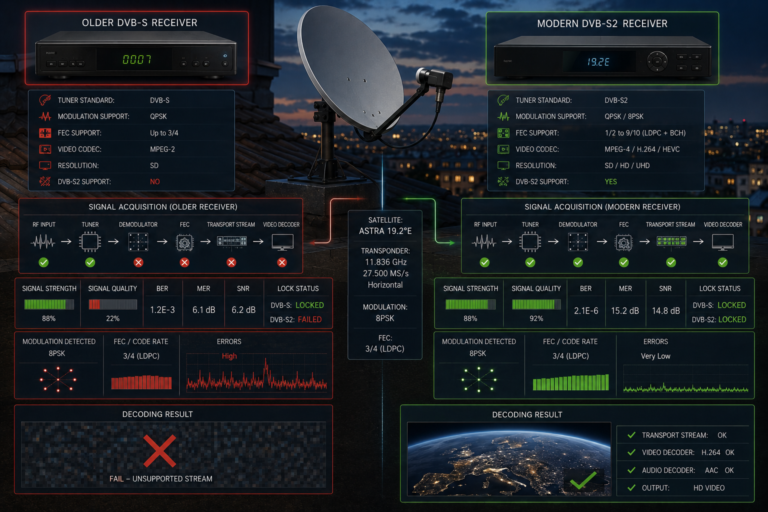
The LNB converts the received Ku-band carrier to satellite intermediate frequency, and the receiver tuner selects the wanted carrier.
The demodulator then recovers the DVB-S2 data and performs forward error correction.
Next, the receiver reconstructs the transport stream, identifies the selected service, processes any required conditional-access layer and sends the programme’s compressed video and audio to its decoders.
Video decoding requires buffering and frame reconstruction.
Receivers can implement these stages differently.
One receiver may therefore display a live programme slightly earlier than another receiver connected to the same satellite feed.
This does not necessarily mean the slower receiver has a reception problem.
It may simply use a different processing and buffering architecture.
The Television Can Add More Delay
The receiver is not always the final processing stage.
Modern televisions perform extensive digital image processing after receiving video over HDMI.
Depending on the television and selected picture mode, processing may include scaling, deinterlacing, noise reduction, motion interpolation, frame-rate conversion, dynamic contrast processing and other enhancements.
Some operations require one or more frames to be buffered before the image can be displayed.
That adds another small amount of latency.
This is one reason televisions often provide a Game Mode or similarly reduced-processing mode. Its main purpose is usually to reduce input latency for interactive sources, but it demonstrates how much display processing can influence timing.
For ordinary live television the additional delay may not be noticeable by itself. Combined with every earlier stage, however, it contributes to the final difference between the stadium event and the image on screen.
Why OTT Can Be Even Further Behind
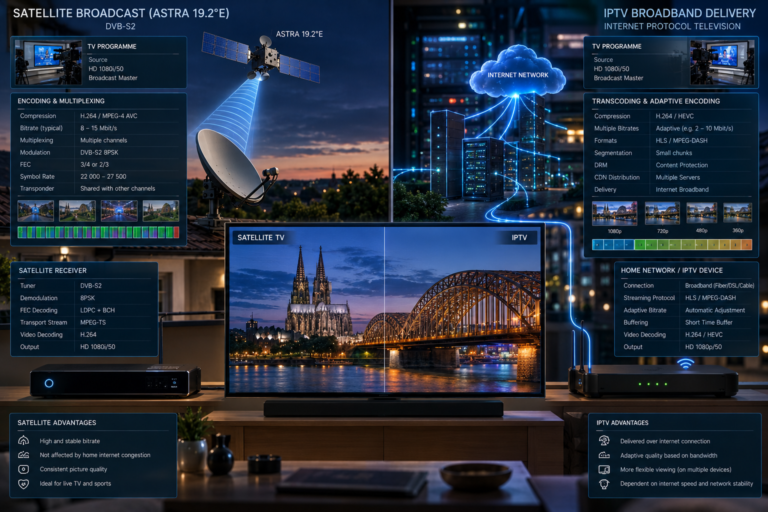
Watching the same sports programme through an internet service introduces a different distribution architecture.
An OTT platform may receive the programme and encode or transcode it into several quality levels for adaptive bitrate streaming.
The video is divided or packaged into units suitable for internet delivery. Those units move through origin infrastructure and content delivery networks before reaching the viewer’s device.
The player also maintains a buffer so short network fluctuations do not immediately stop playback.
Each of these stages can add latency.
| Satellite Distribution | OTT Distribution |
|---|---|
| Broadcast encoder | Encoder or transcoder |
| DVB multiplex | Adaptive bitrate packaging |
| Satellite uplink/downlink | Internet/CDN transport |
| Receiver buffer | Player/network buffer |
| One-to-many RF broadcast | IP delivery sessions to devices |
Traditional OTT implementations can therefore be noticeably behind satellite during a live match.
But this is not a universal law. Low-latency streaming technologies can reduce the difference substantially, while a satellite programme can itself contain significant upstream processing delay.
The only reliable comparison is to measure the specific services being watched.
The same principle applies when comparing picture quality between delivery systems. For more detail, see Why German Satellite TV Can Look Better Than IPTV.
Why Phone Notifications Can Reveal a Goal First
One of the most frustrating situations during live football is receiving a goal notification before seeing the goal on television.
This does not mean the phone somehow receives the complete live video faster.
A sports-data system only needs to communicate a small event message: a goal happened.
That information can originate from dedicated data providers and travel through a completely different path from the broadcast video.
The television programme, meanwhile, must continue carrying full synchronized video and audio through the complete production and distribution chain.
A tiny data event can therefore reach a phone before the corresponding encoded television frames reach the display.
Social media can produce the same effect when another viewer is watching through a distribution path with less total latency.
Why Two Viewers Can See the Same Goal at Different Times
Two people in the same building can watch the same football match and celebrate at different moments.
The difference can come from their delivery platforms.
One may use direct satellite reception. Another may use an OTT app. A third may receive the programme through cable or IPTV.
Even two satellite viewers can differ if they are watching different channel feeds or using receivers and televisions with different buffering behaviour.
Likewise, two OTT viewers can be at different positions in their playback buffers.
Different contribution feed → different broadcast processing → different distribution platform → different receiver/player buffer → different television processing.
There is therefore no technical requirement that every service carrying the same live match must show the same frame at exactly the same instant.
Broadcast Delay Is Not the Same as Lip-Sync Error
Live broadcast latency should not be confused with audio-video synchronization problems.
If the real-world goal happens and both the television picture and sound arrive five seconds later while remaining correctly synchronized with each other, that is end-to-end latency.
If the picture shows a player kicking the ball but the sound associated with that moment arrives noticeably earlier or later, that is an audio-video synchronization or lip-sync problem.
The two faults have different diagnostic paths.
Adding or removing overall programme latency does not automatically correct a mismatch between audio and video.
Lip-sync errors can originate in encoding, timestamp handling, receiver buffering, television processing or external audio equipment.
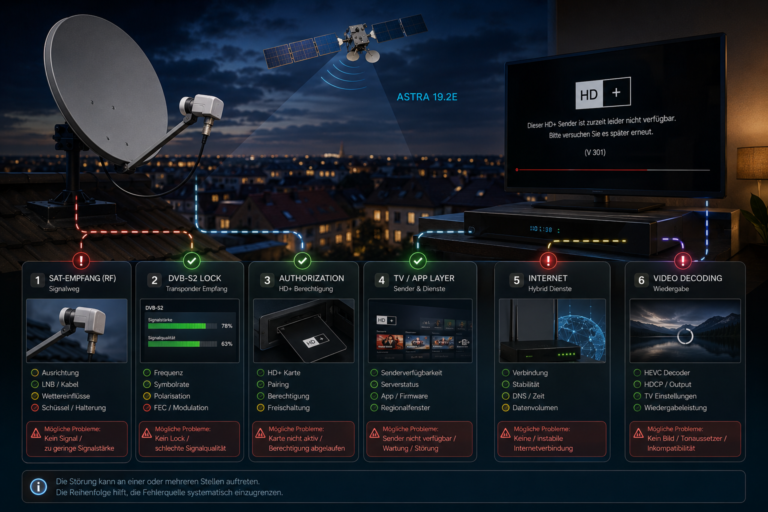
This distinction becomes especially important when troubleshooting a Tring Sport broadcast that feels “delayed.” First determine whether the entire event is late compared with another source or whether sound and picture are actually out of synchronization.
Reality Check
There is no technically defensible fixed delay that applies to every Tring Sport live broadcast.
The latency can change with the original sports feed, contribution network, encoder configuration, satellite distribution path, receiver and display. OTT delivery can introduce additional transcoding, packaging and playback buffering, but modern low-latency implementations can behave differently.
The geostationary satellite itself contributes unavoidable propagation latency, but it should not be blamed for every second between the real event and the television picture. Production and digital processing can contribute substantially more to the final delay.
Final Verdict
Tring Sports can feel delayed because live television is the result of a long processing chain, not an instantaneous connection between the stadium and your screen.
The programme may already have accumulated latency during stadium production and contribution distribution before reaching Tring’s final broadcast chain. Encoding and buffering add more. The geostationary satellite introduces unavoidable propagation delay, and the household receiver and television add their own processing.
If the same match is watched through OTT, additional transcoding, adaptive streaming, CDN delivery and player buffering can increase the difference further, although the exact result depends on the implementation.
That is why a phone notification, another television platform or even a neighbour can reveal a goal first. They are not necessarily receiving the same information through the same path.
In engineering terms, “live” means the event is being distributed as it happens. It does not mean zero latency.
Frequently Asked Questions
| Question | Answer |
|---|---|
| Why is a Tring Sport match behind the real event? | The programme passes through production, contribution, encoding, multiplexing, satellite transmission, receiver decoding and television processing. Each stage can add latency. |
| Is the satellite responsible for all of the delay? | No. A geostationary satellite adds unavoidable propagation latency, but multi-second television delays can include substantial processing and buffering before and after the satellite hop. |
| How much delay does a geostationary satellite add? | A basic uplink-and-downlink RF path introduces propagation delay on the order of a quarter of a second. The exact path length depends on geometry, and the complete broadcast latency is normally greater because of processing. |
| Why can a phone announce a goal before satellite TV? | A phone notification contains only a small data event and can travel through a different system. The television service must deliver and process continuous synchronized video and audio. |
| Is Tring OTT always slower than Tring satellite? | Not necessarily. OTT commonly adds transcoding, packaging, CDN and playback buffering, but latency depends on the specific streaming architecture. It should be measured rather than assumed. |
| Can two satellite receivers show the same goal at slightly different times? | Yes. Receiver buffering, decoding and television processing can differ between devices, although large differences may also indicate different programme feeds. |
| Does a larger satellite dish reduce live sports delay? | No. A larger dish can improve RF margin where appropriate, but it does not remove production, encoding, satellite propagation or receiver processing latency. |
| Will better signal quality make the match arrive faster? | Normally no. Once the receiver has stable error-free reception, additional RF margin improves reliability rather than eliminating the normal broadcast latency chain. |
| Is audio delay the same as live broadcast delay? | No. If audio and video remain synchronized but both arrive late, that is programme latency. If the sound does not match the corresponding picture, that is an audio-video synchronization problem. |