Why Satellite-to-Phone Struggles Inside Buildings
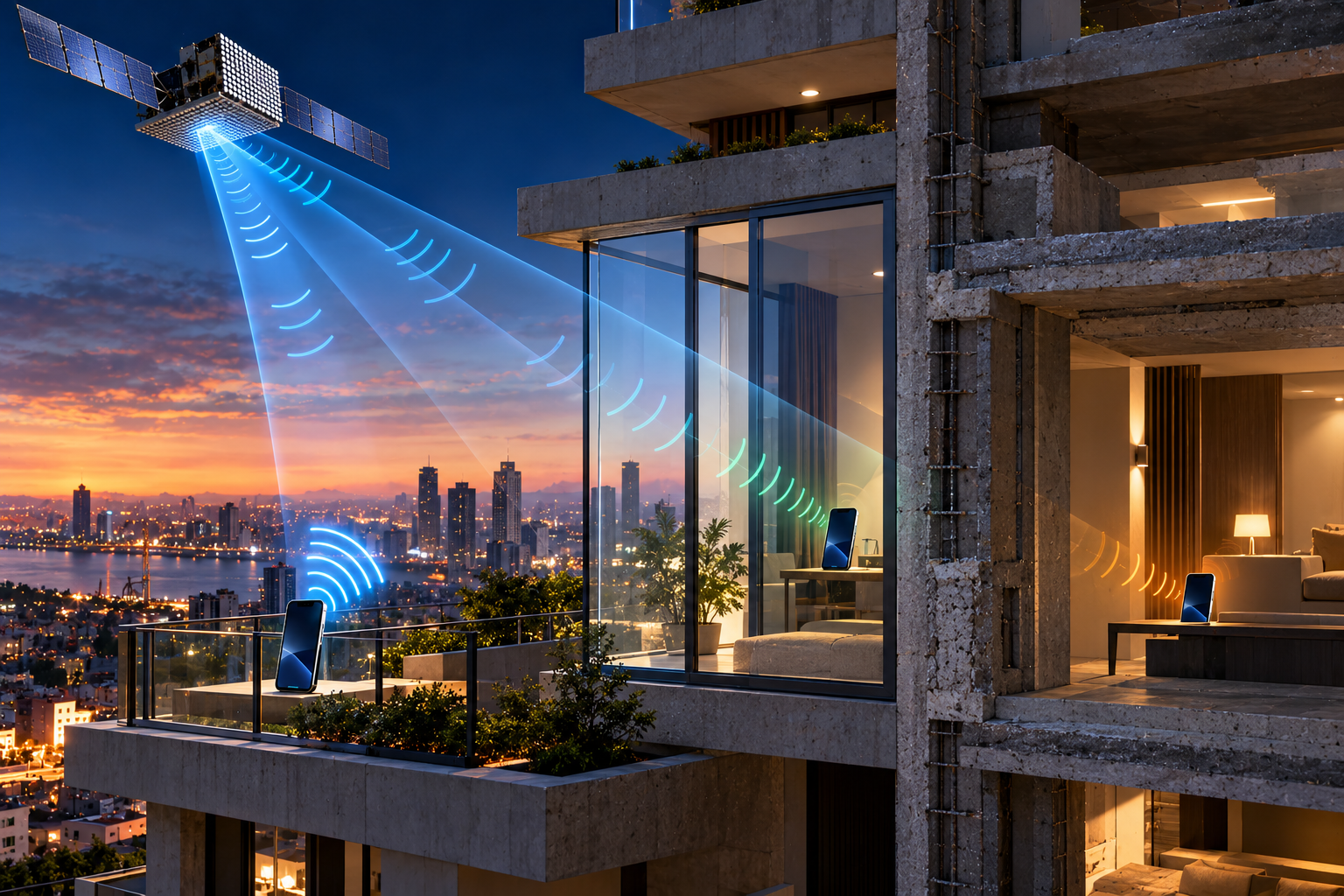
Satellite-to-phone technology promises something that once required specialized hardware: connecting an ordinary smartphone directly to a satellite. Outdoors, that radio link has one major advantage. There may be little between the phone and the sky. Move the same phone deep inside a building, however, and the RF problem changes dramatically.
Walls, reinforced concrete, metal structures, coated glass and multiple floors can consume part of an already demanding satellite link budget. That does not mean direct-to-device satellite service can never work indoors. Some modern systems are specifically engineered to penetrate limited building obstructions. But connecting through one wall is very different from maintaining broadband several rooms or floors inside a dense structure.
Satellite-to-phone indoor reception is not a simple choice between “works” and “doesn’t work.” Think of it as a link-margin problem. Every obstruction introduces additional loss. If enough usable margin remains, the connection can survive. If walls, distance, interference and device conditions consume that reserve, the link eventually becomes unreliable or disappears.
- Why Satellite-to-Phone Is Easier Outdoors
- What a Wall Does to a Satellite Signal
- Not All Building Materials Are Equal
- Why Standing Near a Window Can Help
- Why Deep-Indoor Coverage Is Much Harder
- Why Frequency Makes a Difference
- The Smartphone Uplink Has to Escape Too
- How Large Satellite Arrays Fight the Loss
- What Happens to the Signal Indoors
- Why Cars and Aircraft Create Similar Problems
- Does Weather Make Indoor Reception Worse?
- Coverage Is Not the Same as Capacity
- What Should You Expect From Indoor D2D?
- Reality Check
- Final Verdict
- FAQ
Why Satellite-to-Phone Is Easier Outdoors
Direct-to-device communication already starts with a difficult radio path.
An ordinary smartphone has limited transmit power and a compact internal antenna. A low Earth orbit satellite may still be hundreds of kilometers away.
Modern D2D systems compensate with large satellite antenna arrays, beamforming, sensitive receivers, suitable spectrum and sophisticated signal processing.
AST SpaceMobile, for example, says its satellites use very large phased arrays specifically because standard mobile phones have low transmit power and small antennas. The arrays form focused beams to maintain the link. :chatgpt-content-reference{index=”0″}
Outdoors, the system has the advantage of a relatively unobstructed radio path toward the sky.
Put a roof and several reinforced walls between the phone and satellite and additional attenuation is introduced before the signal even reaches open space.
What a Wall Does to a Satellite Signal
A radio wave does not necessarily stop completely when it reaches a wall.
Some energy can penetrate the material, some can be reflected, and some can be absorbed or scattered.
The amount that survives depends on factors including material composition, thickness, frequency, angle of incidence and the structures hidden inside the wall.
For a strong terrestrial cellular signal from a nearby base station, the network may have enough margin to tolerate substantial penetration loss.
A satellite-to-smartphone link is different.
The signal has already traveled a very long distance before reaching the building. On the uplink, the small phone must transmit through the same environment before its signal begins the journey toward the satellite.
Building penetration therefore becomes another item in the link budget.
A building does not need to block the satellite signal completely to cause trouble. It only needs to introduce enough additional loss to push the radio link below the level required for reliable acquisition and decoding.
Not All Building Materials Are Equal
“Indoors” is not one RF environment.
A phone inside a lightweight timber structure near a window faces a completely different radio path from a phone in the center of a reinforced-concrete office tower.
Dense construction materials generally create a more difficult penetration problem.
Metal is particularly important because conductive structures can strongly reflect or shield radio energy. Reinforced concrete combines dense construction material with embedded steel reinforcement, making some paths especially challenging.
Modern energy-efficient windows can also behave differently from ordinary glass because metallic coatings used for thermal performance can attenuate radio signals.
| Environment | Typical D2D Challenge |
|---|---|
| Open outdoor area | Few immediate structural obstructions |
| Near an ordinary window | Potentially less penetration loss than through several walls |
| Lightweight building | Performance depends on materials and satellite geometry |
| Reinforced-concrete building | Greater potential attenuation and shielding |
| Deep inside a large building | Multiple walls, floors and indirect propagation paths |
| Basement | Severe obstruction from surrounding structure and ground |
These are general RF patterns, not guaranteed performance categories. Actual results depend on the network, spectrum, satellite geometry and individual building.
Why Standing Near a Window Can Help
Moving several meters inside a building can completely change the radio path.
Near an exterior window, the phone may have fewer dense structures between itself and the satellite.
Move toward the center of the building and the path may pass through multiple walls, floors or structural elements.
This creates an important distinction between shallow indoor and deep-indoor coverage.
A system capable of maintaining a connection through one exterior obstruction should not automatically be expected to provide the same performance several rooms deeper inside the structure.
AST SpaceMobile currently describes its system as capable of connecting “one wall in,” including scenarios inside buildings, vehicles and aircraft. That is a useful example of why blanket statements that D2D always requires completely open sky are too simplistic. It is also not a claim of unlimited deep-indoor coverage. :chatgpt-content-reference{index=”1″}
Why Deep-Indoor Coverage Is Much Harder
Penetration losses accumulate.
A signal passing through one exterior wall may remain usable. Add another wall, a concrete floor and a metal structure, and the remaining margin can become much smaller.
The geometry can also be unfavorable.
A satellite is not necessarily directly overhead. Depending on its position during the pass, the radio path can cross the building at an angle.
That can increase the effective amount of material the signal must penetrate.
A user on the upper floor beside an exterior window can therefore have a very different experience from another user in the same building standing in an interior corridor.
Deep-indoor connectivity is one reason terrestrial cellular networks use techniques such as indoor small cells and distributed antenna systems in difficult buildings.
A satellite cannot simply place a base station inside every structure.
Why Frequency Makes a Difference
Radio frequencies do not interact with buildings identically.
In general, lower cellular frequencies can offer useful coverage and penetration characteristics, while higher-frequency spectrum can provide greater bandwidth and capacity but often faces more difficult propagation through obstacles.
This tradeoff is directly relevant to D2D.
AST SpaceMobile states that its spectrum strategy uses low- and mid-band resources and specifically notes the stronger coverage and penetration characteristics available from lower frequencies. :chatgpt-content-reference{index=”2″}
But frequency is not the only variable.
A lower band does not make reinforced concrete invisible. Antenna performance, bandwidth, transmit power, beam gain, interference and receiver sensitivity still contribute to the final link.
This is why the question “Does satellite-to-phone work indoors?” cannot be answered accurately without knowing something about the radio system and environment.
The Smartphone Uplink Has to Escape Too
Indoor D2D is a two-way problem.
It is easy to focus on whether the satellite can send a sufficiently strong signal through the roof or wall to the smartphone.
But the phone must also transmit back.
That uplink begins with a small battery-powered device and a compact antenna. After passing through the building, the remaining signal must travel hundreds of kilometers toward the satellite.
This makes penetration loss particularly important.
A phone may successfully detect a satellite-related downlink while still facing a difficult uplink under marginal conditions.
The complete connection depends on both directions meeting their respective link requirements.
For a deeper explanation of this weak uplink, see How Satellites Detect a Weak Smartphone Signal.
How Large Satellite Arrays Fight the Loss
One way to recover link margin is to put much more antenna capability on the spacecraft.
Large phased arrays provide high antenna gain and can form focused beams toward geographic coverage cells.
This helps compensate for the small antenna and limited power of an ordinary smartphone.
AST’s current architecture illustrates how far this concept can go. Its first commercial BlueBird satellites use 693-square-foot phased arrays, while its next-generation satellites use arrays approaching 2,400 square feet. :chatgpt-content-reference{index=”3″}
The objective is not to blast unlimited RF power through every building.
The array improves the overall link budget so that connections that would otherwise be impossible become practical.
Every additional obstruction still consumes part of that margin.
A bigger satellite antenna improves the link budget; it does not repeal building penetration loss.
What Happens to the Signal Indoors
Indoor radio propagation involves more than simple attenuation.
Signals can reflect from walls, metal structures, windows and other surfaces. Different versions of the same transmission can arrive through different paths.
This is known as multipath propagation.
Modern digital radio systems are designed to operate in complex propagation environments, but severe multipath combined with weak received power can still make the link more difficult.
The satellite geometry also changes over time in LEO systems.
A path that is partly blocked at one moment may become more favorable as the spacecraft moves, while another satellite position may place more building material in the path.
This means indoor performance can vary even without the user moving.
Why Cars and Aircraft Create Similar Problems
Buildings are not the only structures surrounding smartphones.
Cars, trains and aircraft place glass, metal and composite materials between the handset and the sky.
The same RF principles apply.
Some paths may remain usable through windows or less attenuating parts of the structure, while metal bodywork can create stronger shielding.
Modern D2D networks are being engineered with these environments in mind. AST, for example, explicitly includes vehicles and airplanes in its stated “one wall in” link objective. :chatgpt-content-reference{index=”4″}
Again, this should be interpreted as a network design target and reported capability, not as a guarantee that every seat in every vehicle or aircraft will always receive identical broadband performance.
Does Weather Make Indoor Reception Worse?
Weather and building penetration are separate parts of the radio path.
If weather introduces additional propagation loss while a wall has already consumed some of the available margin, the combined link can become more demanding.
However, the significance of weather depends strongly on operating frequency and system design.
It would therefore be inaccurate to assume that D2D behaves exactly like Ku-band satellite television, where heavy rain can produce familiar rain-fade effects.
Direct-to-device systems can operate in cellular-oriented lower-frequency spectrum with different propagation characteristics.
The useful engineering principle is broader: every meaningful loss in the path reduces the reserve available to tolerate other losses.
Coverage Is Not the Same as Capacity
Even when an indoor phone can establish a satellite connection, that does not tell you how much data capacity will be available.
Coverage asks whether the radio link can be established.
Capacity asks how much traffic the system can carry for all users sharing the available radio resources.
Modern D2D satellites use multiple beams or cells to increase frequency reuse and distribute capacity geographically. AST says its next-generation BlueBird design supports more than 2,000 active cells per satellite and peak rates above 150 Mbps per coverage cell. :chatgpt-content-reference{index=”5″}
Those are system-level peak design figures, not a promise that one indoor smartphone receives that speed.
User throughput depends on network load, spectrum, signal conditions, scheduling and the particular service deployed by the mobile operator.
What Should You Expect From Indoor D2D?
The most useful way to think about indoor satellite-to-phone coverage is as a progression rather than a binary rule.
Open outdoors: normally the most favorable satellite geometry.
Near an exterior opening: potentially usable if the radio path avoids heavy structural attenuation.
One wall inside: technically possible for systems designed with sufficient link margin and suitable spectrum.
Deep inside a dense building: substantially more challenging as penetration losses accumulate.
Basement or heavily shielded structure: potentially extremely difficult without another connectivity path.
This is deliberately not a universal coverage map.
D2D technologies differ. Spectrum differs. Satellite antennas differ. Buildings differ.
Even two rooms in the same building can produce different RF conditions.
Reality Check
“Satellite phones need a clear view of the sky” is becoming too simplistic as a universal description of direct-to-device technology.
Modern systems can be engineered with enough link performance to survive limited structural obstruction. AST SpaceMobile currently states that its architecture targets connectivity outdoors and “one wall in,” and it emphasizes low-band spectrum for coverage and penetration. :chatgpt-content-reference{index=”6″}
But the opposite claim would also be misleading. Demonstrating or designing for limited indoor penetration does not mean satellites can deliver identical service from an open field to the center of every reinforced-concrete building.
Indoor performance remains governed by RF physics: frequency, antenna gain, path loss, material attenuation, interference, geometry and the remaining link margin.
Final Verdict
Satellite-to-phone struggles inside buildings because the building becomes part of an already demanding radio link.
Outdoors, a smartphone and LEO satellite may have a relatively unobstructed path. Indoors, the same signal may need to penetrate glass, walls, reinforced concrete, metal structures or several floors before the satellite link can even begin operating under open-space conditions.
Modern D2D networks fight that problem with large phased-array satellites, focused beams, sensitive receivers, signal processing and carefully selected spectrum. That can make limited indoor connectivity possible without turning the smartphone into a traditional satellite phone.
But there is still a finite RF budget.
One wall may be manageable. Several dense barriers may not be. A window can create a better path. A basement can create a much worse one. And the uplink from the weak smartphone must survive the building just as the downlink does.
The important change is not that buildings stopped blocking satellite signals. It is that direct-to-device networks are becoming powerful enough to tolerate more obstruction than older assumptions about handheld satellite connectivity would suggest.
Frequently Asked Questions
| Question | Answer |
|---|---|
| Can satellite-to-phone work inside a building? | Potentially, yes. Performance depends on the D2D system, frequency, building materials, satellite geometry and how deeply inside the structure the phone is located. |
| Does satellite-to-phone always need a clear view of the sky? | Not necessarily. Some modern D2D architectures are designed to tolerate limited obstruction, but an open view generally provides a more favorable RF path than deep-indoor operation. |
| Why does concrete weaken satellite-to-phone signals? | Concrete can absorb and attenuate radio energy, while reinforced concrete also contains conductive steel that can further affect propagation. |
| Can a window improve satellite reception on a smartphone? | It can if the alternative path crosses denser walls or structural material. However, some coated windows contain metallic layers that can also attenuate radio signals. |
| Why is a basement difficult for direct-to-device service? | The signal may need to pass through substantial building structure and surrounding ground, leaving much less usable link margin. |
| Do lower frequencies work better inside buildings? | Lower cellular frequencies generally offer useful coverage and penetration characteristics, but actual performance still depends on the complete radio system and building environment. |
| Can a phone receive the satellite but fail to transmit back? | In marginal conditions, uplink and downlink budgets can differ. A complete service requires both directions to meet their respective reception requirements. |
| Does a large satellite antenna solve indoor coverage? | It improves antenna gain and overall link performance, but building penetration still consumes margin. It cannot make all structural attenuation disappear. |
| Will D2D work inside cars? | Some systems are designed to support limited in-vehicle penetration, but performance depends on vehicle construction, glass, metal shielding, spectrum and satellite geometry. |
| Is indoor satellite-to-phone coverage the same as indoor 5G? | No. A terrestrial network can use nearby macro sites, indoor small cells and dedicated building systems. D2D must close the radio link between the handset and a satellite hundreds of kilometers away. |