Why Netflix Quality Drops At Night
Estimated reading time: 18 to 22 minutes.
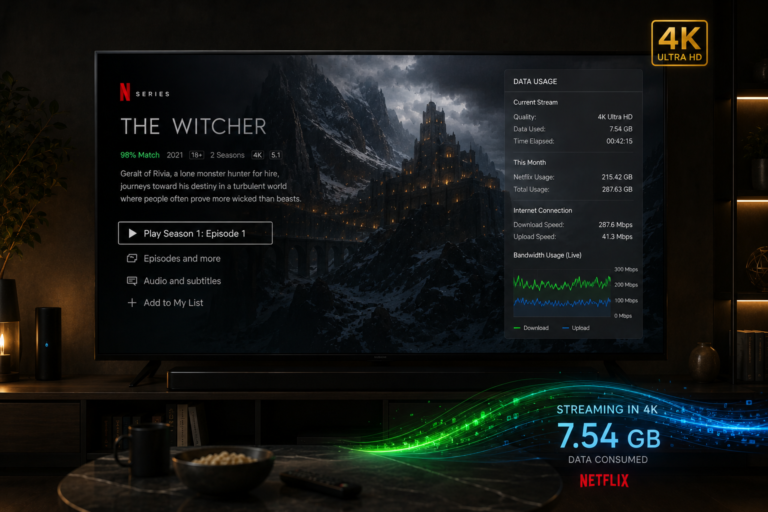
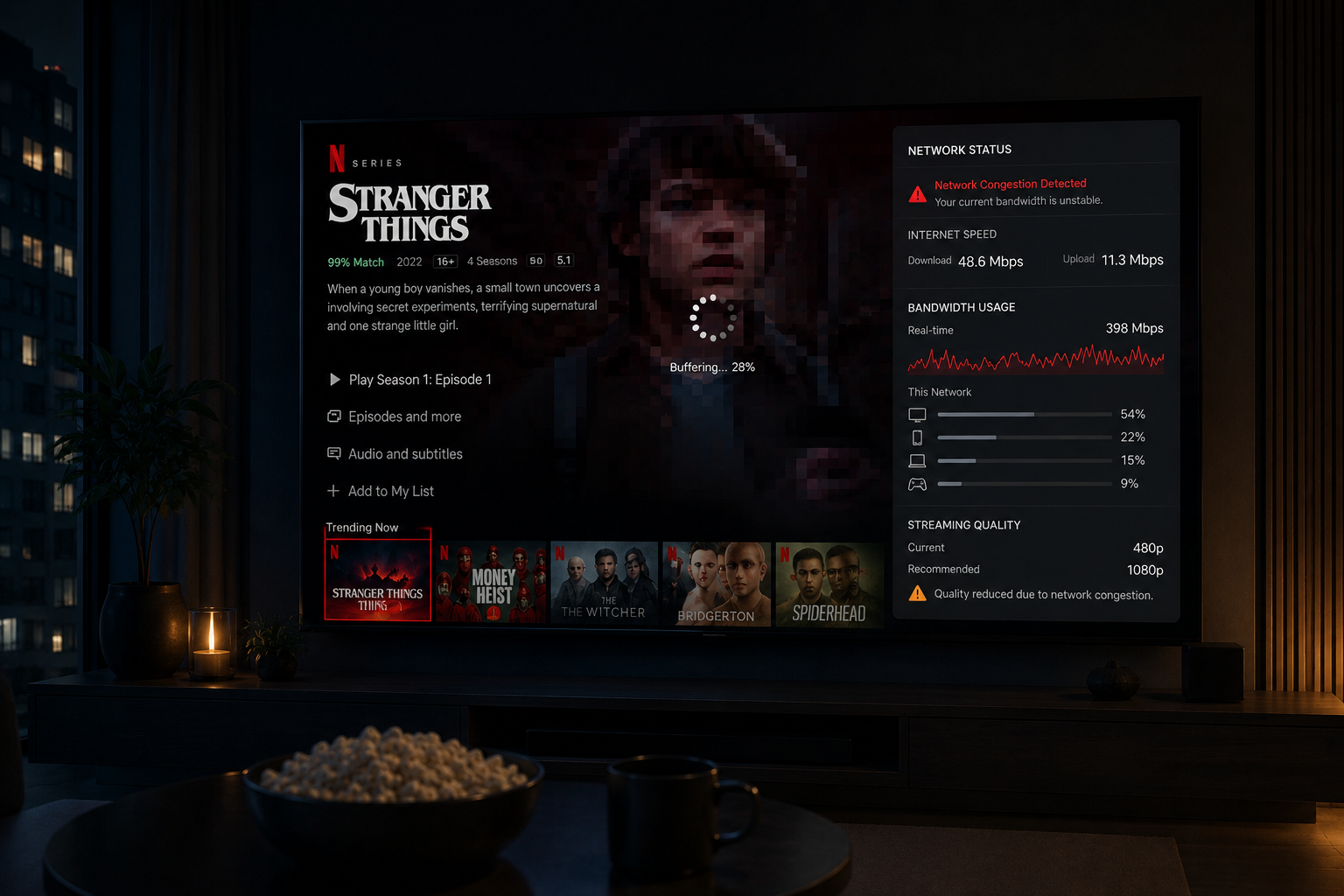
Many people notice the same strange pattern. Netflix looks sharp and smooth during the afternoon, but later at night the image suddenly becomes softer, blurrier, or less stable. Dark scenes break apart more easily, action scenes lose detail, and buffering becomes more common.
This is not random. Netflix quality often changes at night because streaming systems are heavily affected by network congestion, bandwidth competition, server pressure, and adaptive streaming behavior. What you see on your TV depends on how the entire network ecosystem behaves in real time.
Quick Context. Netflix quality drops at night because internet traffic increases dramatically during peak hours, forcing streaming systems to reduce bitrate and adapt to unstable delivery conditions.
Table of Contents
What happens during peak internet hours
Why internet infrastructure is shared
How congestion affects streaming quality
Why Netflix lowers bitrate automatically
Adaptive streaming and night time behavior
Latency spikes during evening traffic
Jitter and unstable delivery timing
Why WiFi often becomes worse at night
Compression artifacts become more visible
Why dark scenes collapse first
Netflix server pressure during peak usage
ISP routing and bandwidth competition
What happens during peak internet hours
The internet behaves very differently at night compared to the afternoon.
In the evening, millions of people simultaneously begin:
- Streaming movies
- Watching live sports
- Playing online games
- Joining video calls
- Downloading updates
This creates enormous pressure on internet infrastructure.
Streaming services suddenly compete for network resources with millions of other devices.
This period is called peak hour traffic.
Peak traffic changes how data flows across networks.
Why internet infrastructure is shared
Most users imagine their internet connection as a private dedicated pipeline.
In reality, internet infrastructure is heavily shared.
Your ISP distributes bandwidth across neighborhoods, buildings, and regional infrastructure.
When many users become active simultaneously:
- Bandwidth competition increases
- Congestion rises
- Latency becomes unstable
- Packet timing deteriorates
This affects streaming quality immediately.
How congestion affects streaming quality
Congestion is one of the biggest reasons Netflix quality drops at night.
Congestion happens when too much traffic attempts to move through the same network infrastructure.
Think of it like highway traffic.
When too many cars enter the highway simultaneously:
- Movement slows down
- Timing becomes unpredictable
- Delays increase
The same thing happens to streaming data packets.
Netflix segments begin arriving less consistently.
The streaming system responds by reducing quality.
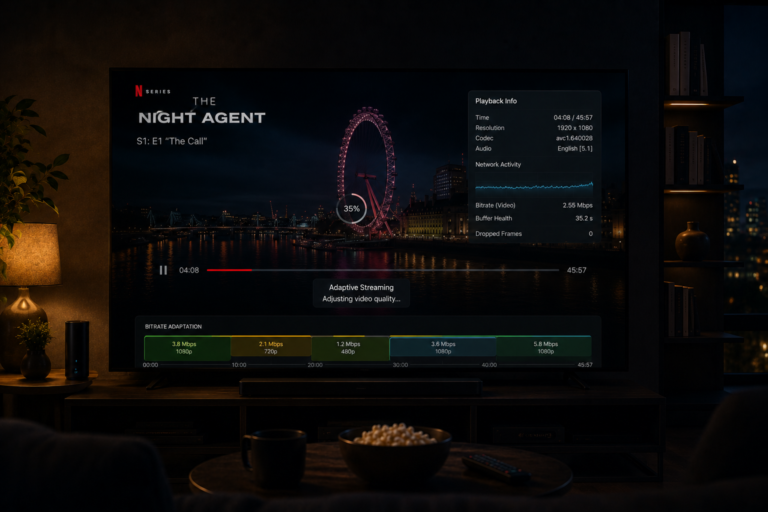
Why Netflix lowers bitrate automatically
Netflix constantly monitors connection stability.
When instability appears, Netflix lowers bitrate automatically.
This is not a bug.
It is a protection mechanism.
The system prefers:
Lower image quality instead of playback interruption.
When bitrate drops:
- Fine detail disappears
- Textures soften
- Dark scenes become blocky
- Motion clarity decreases
This is why Netflix often looks noticeably softer at night.
Adaptive streaming and night time behavior
Netflix uses adaptive bitrate streaming.
This means quality changes dynamically depending on conditions.
At night, conditions become less stable.
The system reacts continuously by adjusting:
- Resolution
- Bitrate
- Compression level
- Buffer behavior
Many users never realize these changes are happening in real time.
But the image quality constantly shifts underneath the surface.
Latency spikes during evening traffic
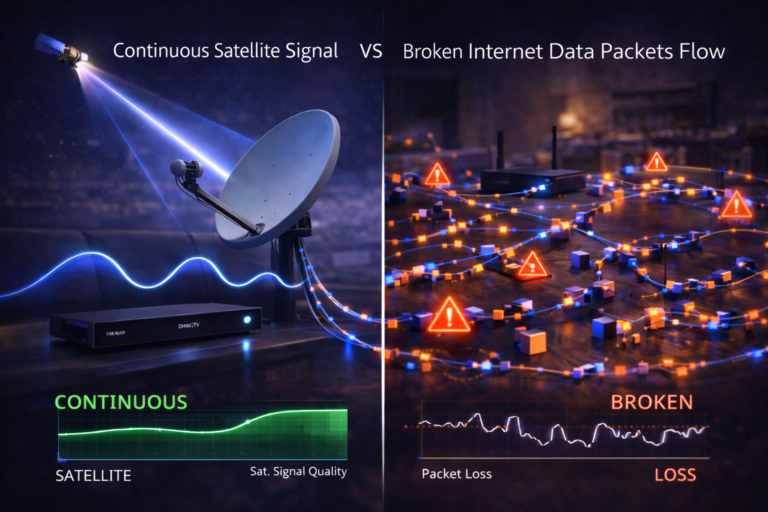
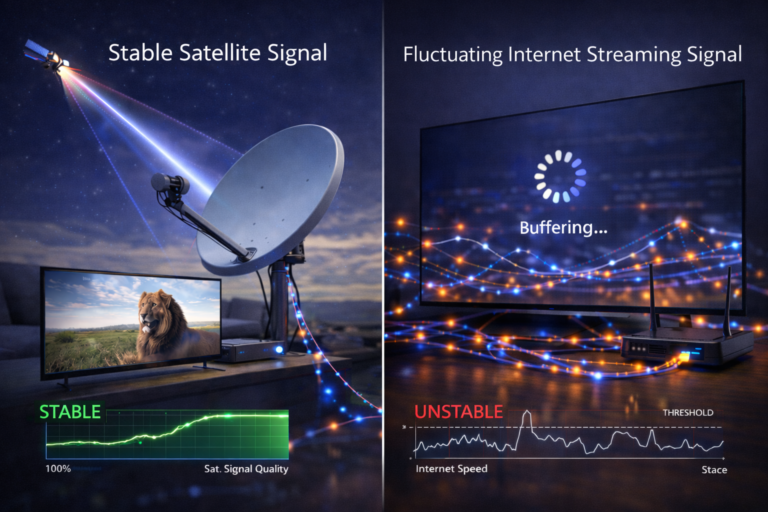
Latency increases significantly during congested periods.
But average latency is not the biggest problem.
The real issue is inconsistent latency.
When packet timing changes constantly:
- Segments arrive irregularly
- Playback timing becomes unstable
- Buffers shrink faster
Netflix reacts by lowering quality to stabilize playback.
This is why high speed internet can still produce poor quality during busy hours.
Jitter and unstable delivery timing
Jitter refers to fluctuations in packet arrival timing.
Streaming systems hate jitter.
Netflix expects packets to arrive smoothly and predictably.
During nighttime congestion, jitter increases dramatically.
Packets may arrive:
- Fast
- Slow
- Out of rhythm
This irregular delivery destabilizes playback.
The adaptive system lowers bitrate to compensate.
Why WiFi often becomes worse at night
WiFi environments also become more congested at night.
Apartment buildings and neighborhoods suddenly fill with active devices.
Nearby routers compete on the same wireless channels.
This creates:
- Signal interference
- Channel overlap
- Packet retransmissions
- Inconsistent timing
Your WiFi signal may still appear strong while actual streaming stability collapses.
This is why Ethernet connections usually perform much better during peak evening hours.
Compression artifacts become more visible
When Netflix lowers bitrate, compression becomes more aggressive.
The image begins losing information.
Compression artifacts become more visible:
- Smearing
- Blocking
- Banding
- Noise
- Loss of texture
These problems become especially obvious on:
- Large TVs
- OLED displays
- Dark scenes
- Fast motion scenes
The stream itself contains less visual information during congestion periods.
Why dark scenes collapse first
Dark scenes are extremely difficult for compressed streaming video.
Shadows require subtle gradients and fine detail preservation.
When bitrate drops:
- Shadow detail disappears
- Black areas become noisy
- Banding increases
- Compression blocks appear
This is why nighttime scenes in Netflix shows often look terrible during peak evening hours.
The system sacrifices shadow precision to maintain playback continuity.
Netflix server pressure during peak usage
Netflix infrastructure is enormous, but even massive systems experience pressure during peak demand.
At night:
- Server requests increase dramatically
- Traffic distribution becomes more difficult
- Regional CDN systems experience heavier load
Netflix handles this remarkably well compared to many streaming services.
But no large scale streaming platform completely escapes peak hour effects.
Heavy demand changes delivery behavior across the network.
ISP routing and bandwidth competition
Your ISP plays a major role in streaming quality.
Different ISPs manage nighttime traffic differently.
Some ISPs experience:
- Heavier congestion
- Poor routing decisions
- Regional overloads
- Bandwidth bottlenecks
This explains why two neighbors using different providers may experience completely different Netflix quality at the same time.
The path data takes through the network matters enormously.
A real world evening streaming example
Imagine a user watching Netflix at 2 PM.
The network is relatively quiet.
Netflix streams at high bitrate with stable delivery.
The image looks excellent.
Later at 9 PM:
- Neighborhood traffic increases
- WiFi interference rises
- ISP congestion grows
- Packet timing becomes unstable
- Netflix detects instability
The adaptive system lowers bitrate.
The image becomes softer.
Dark scenes begin breaking apart.
Motion quality decreases.
The user thinks Netflix suddenly became worse.
In reality, the entire streaming chain changed.
| Factor | Technical Effect | Visible Result |
|---|---|---|
| Peak hour traffic | Network congestion | Lower quality |
| Bitrate reduction | Less image data | Soft picture |
| WiFi interference | Packet instability | Buffering and blur |
| Latency spikes | Irregular timing | Playback instability |
| Heavy compression | Loss of detail | Artifacts and banding |
| Server pressure | Traffic redistribution | Adaptive quality changes |
| ISP congestion | Bandwidth competition | Reduced stream quality |
Reality Check
Netflix quality drops at night because streaming quality depends on the condition of the entire network ecosystem. Congestion, jitter, WiFi interference, server load, and bandwidth competition all increase dramatically during evening hours.
Final Verdict
Netflix often looks worse at night because internet infrastructure becomes heavily congested during peak viewing hours. Streaming systems respond by lowering bitrate and increasing compression to protect playback stability. The issue is rarely raw internet speed alone. It is the combined effect of congestion, unstable timing, WiFi interference, adaptive streaming behavior, and bandwidth competition across the network. Streaming quality is dynamic, and nighttime conditions create one of the most difficult environments for maintaining high visual quality.
FAQ
| Question | Answer |
|---|---|
| Why does Netflix look worse at night | Because network congestion increases during peak hours |
| Can fast internet still suffer quality drops | Yes because stability matters more than peak speed |
| Why do dark scenes look terrible at night | Lower bitrate causes compression artifacts in shadows |
| Does WiFi affect nighttime streaming quality | Yes because wireless interference increases significantly |
| Why does Netflix reduce quality automatically | To prevent playback interruptions during instability |