The Real Reason Eutelsat 16E Channels Vanish Randomly
Estimated reading time: 18 minutes.
- Why channels seem to vanish randomly.
- Signal quality vs signal presence.
- BER spikes and decoding collapse.
- Signal margin behavior.
- LNB drift and synchronization failure.
- Receiver lock instability.
- Why some transponders disappear first.
- Real technical fixes for stable reception.
- Why Random Channel Loss Usually Is Not Random
- Signal Presence Does Not Guarantee Decoding
- BER Spikes And Transport Stream Failure
- Signal Margin Collapse
- LNB Drift And Frequency Instability
- Receiver Synchronization Problems
- Why Some Transponders Disappear First
- Environmental Effects And Temporary Channel Loss
- Technical Comparison Table
- How To Stop Channels From Vanishing
- Reality Check
- Final Verdict
- FAQ
Why Random Channel Loss Usually Is Not Random
Most reception failures follow a pattern even when users cannot immediately see it.
The channel may disappear during certain weather conditions.
It may happen at similar times every evening.
It may affect only HD frequencies.
Sometimes only one transponder becomes unstable.
These patterns indicate that the issue comes from reception conditions rather than true random satellite behavior.
The satellite continues transmitting normally.
The receiving system temporarily falls below the decoding threshold.
That brief loss of decoding ability makes the channel appear to vanish.
Signal Presence Does Not Guarantee Decoding
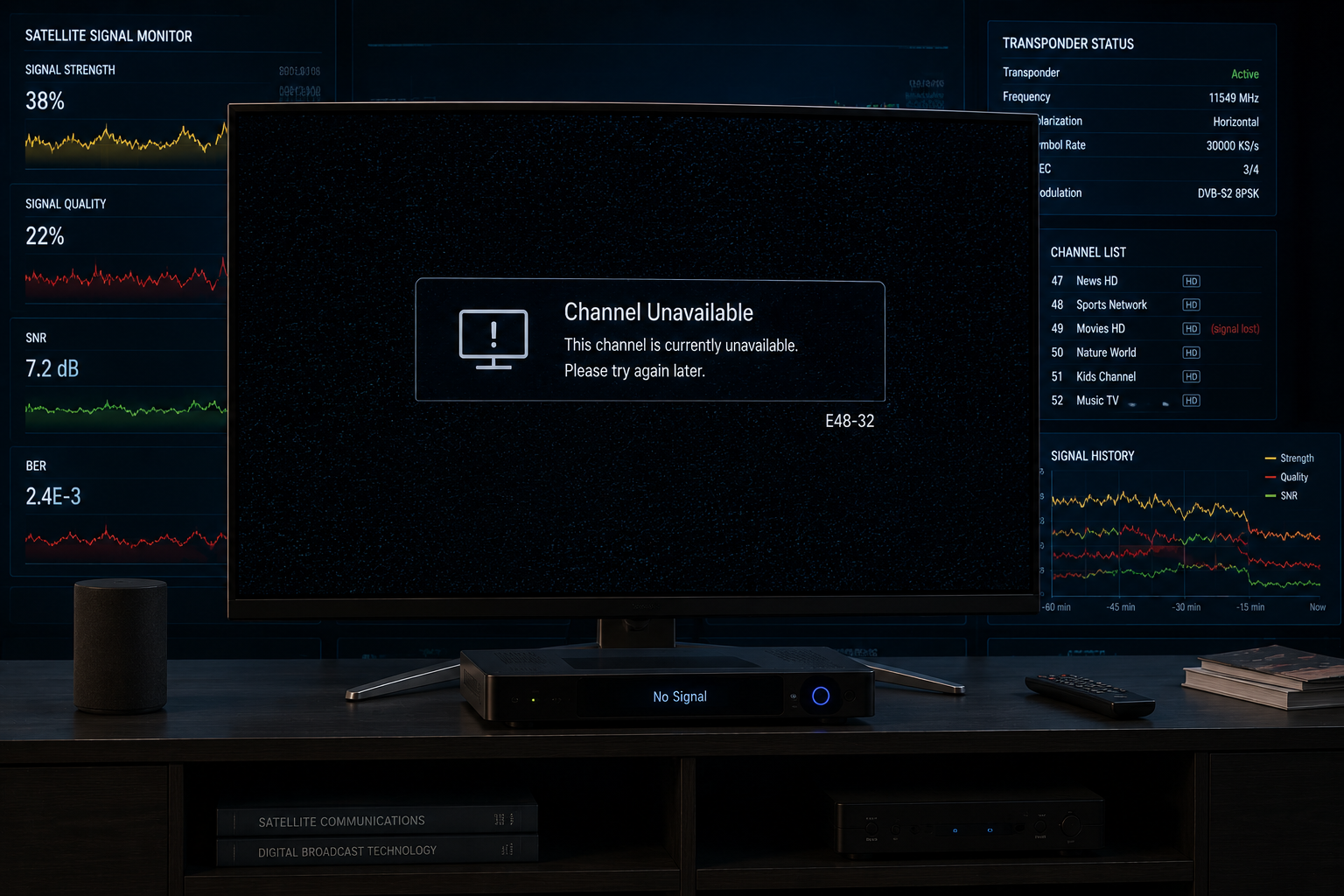
Many users assume that if the receiver shows signal, the channel should always work.
Satellite reception does not work that way.
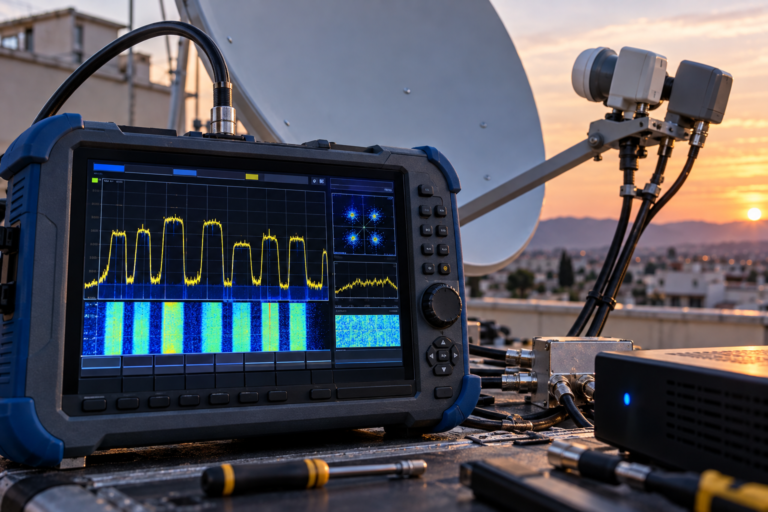
A receiver may still detect RF energy while failing to decode the transport stream correctly.
Signal presence only confirms that the tuner detects incoming satellite energy.
The receiver still needs enough quality and synchronization accuracy to rebuild the digital stream.
This is why channels sometimes disappear while signal strength remains visible.
The signal exists physically.
The decoding process is what fails.
BER Spikes And Transport Stream Failure
BER stands for Bit Error Rate.
It measures how many digital bits arrive corrupted during transmission.
Modern receivers constantly repair small transmission errors using forward correction systems.
When BER remains low, channels stay stable.
When BER suddenly rises, correction systems become overloaded.
The receiver begins losing transport stream integrity.
At first, pixelation may appear.
Then freezing begins.
Finally, the receiver loses lock completely.
To the user, the channel appears to vanish randomly.
The real cause is usually BER instability rather than actual signal disappearance.
Signal Margin Collapse
Signal margin is the hidden reserve above the minimum decoding threshold.
Strong installations maintain comfortable reserve capacity.
Weak installations operate very close to the edge.
Small environmental changes can remove the remaining margin.
The receiver suddenly struggles to maintain synchronization.
The channel disappears.
A few minutes later conditions improve slightly.
The receiver regains enough margin and the channel returns.
This cycle creates the illusion of random behavior even though the underlying cause remains consistent.
LNB Drift And Frequency Instability
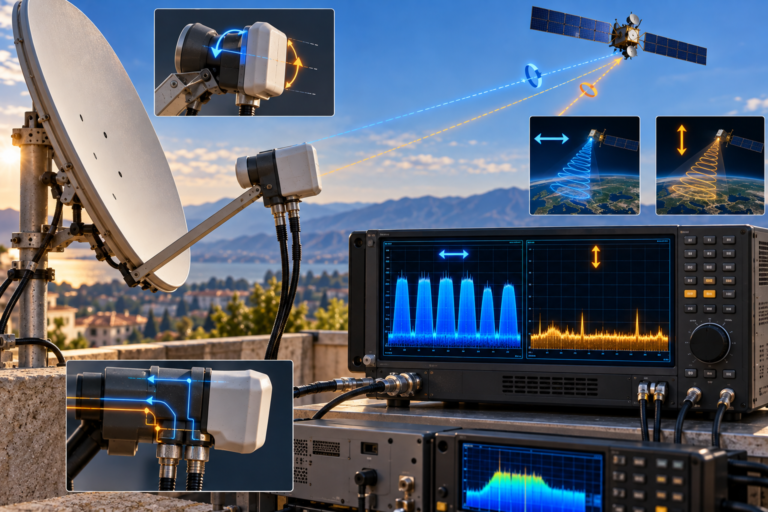
The LNB converts high satellite frequencies into lower frequencies that the receiver can process.
This conversion depends on oscillator stability.
Aging or low-quality LNB units may drift slightly as temperature changes.
Modern DVB-S2 transponders require precise synchronization.
Small frequency drift can increase BER significantly.
Some channels become unstable long before others.
The receiver may repeatedly gain and lose lock throughout the day.
Users often interpret this as random channel disappearance when the real issue comes from unstable frequency conversion.
Receiver Synchronization Problems
Receivers continuously synchronize themselves with incoming digital streams.
As signal quality weakens, synchronization becomes harder to maintain.
Different receivers behave differently under stress.
Some tuners tolerate difficult conditions very well.
Others lose lock quickly.
A receiver may temporarily fail on one transponder while continuing to decode others normally.
This often creates confusion because only certain channels disappear.
The receiver is reacting to different signal conditions across different frequencies.
Why Some Transponders Disappear First
Not all Eutelsat 16E frequencies behave equally.
Different transponders use different modulation settings, symbol rates, and correction parameters.
Some operate closer to decoding limits.
Others contain larger signal reserve.
HD DVB-S2 frequencies often require cleaner signal conditions than older SD services.
This explains why certain channels vanish repeatedly while others remain stable.
The disappearing channels are usually exposing weaknesses already present inside the reception system.
Environmental Effects And Temporary Channel Loss
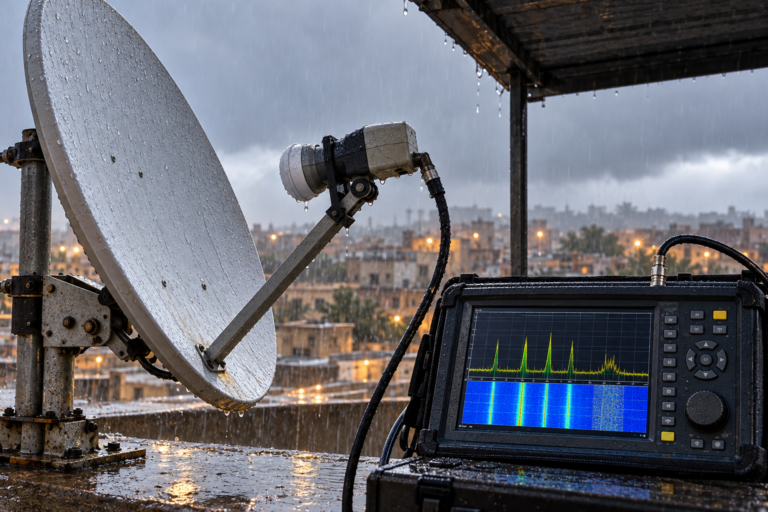
Weather often accelerates channel instability.
Rain fade reduces available signal margin.
Humidity changes can affect weak installations.
Temperature shifts influence LNB stability.
Strong systems absorb these changes easily.
Marginal systems begin losing channels.
The weather itself may not be severe.
The real problem is that the installation already lacked enough reserve.
Environmental stress simply exposes that weakness.
Technical Comparison Table
| Condition | Stable Channel | Channel That Vanishes Randomly |
|---|---|---|
| Signal margin | Comfortable reserve | Near decoding threshold |
| BER behavior | Low error rate | Frequent spikes |
| LNB stability | Stable frequency conversion | Possible thermal drift |
| Receiver lock | Consistent synchronization | Repeated lock loss |
| Weather tolerance | Higher resistance | Easily affected |
| HD transponder performance | Stable decoding | Frequent instability |
How To Stop Channels From Vanishing
Start by monitoring signal quality instead of strength alone.
Check whether the same frequencies disappear repeatedly.
Fine-tune dish alignment to maximize quality reserve.
Inspect LNB condition carefully.
Replace aging or unstable units if frequency drift is suspected.
Verify cable quality and connector health.
Water intrusion often creates intermittent signal problems.
Monitor BER behavior during difficult conditions.
Stable low BER is usually more important than high strength readings.
For deeper analysis of why some sports channels appear cleaner and more stable than others, read The Real Reason Some 16E Sports Channels Look Sharper.
Channels rarely disappear randomly without a technical reason. Most cases involve weak signal margin, BER instability, LNB drift, or synchronization failure. The channel is usually still being transmitted normally. The receiving system temporarily loses its ability to decode it correctly.
The real reason Eutelsat 16E channels vanish randomly is usually not satellite failure. Most cases come from unstable decoding conditions caused by shrinking signal margin, BER spikes, LNB frequency drift, weather stress, or receiver synchronization problems. Once the underlying reception weakness is corrected, the apparent randomness usually disappears as well.
FAQ
| Question | Answer |
|---|---|
| Why do channels disappear and return later? | Usually because signal quality temporarily drops below the decoding threshold. |
| Can strong signal strength still cause channel loss? | Yes. Signal quality and BER stability matter much more than strength alone. |
| Can an LNB cause random channel disappearance? | Yes. Frequency drift and instability often create intermittent decoding problems. |
| Why do only certain frequencies disappear? | Because some transponders are more sensitive to weak signal conditions. |
| Does weather always cause channel loss? | No. Weather usually exposes weaknesses already present in the installation. |
| What is the best long-term fix? | Improve signal quality margin through alignment, stable hardware, and healthy cabling. |