The Real Reason Some 16E Sports Channels Look Sharper
Estimated reading time: 17 minutes.
This article explains:
- Why some sports channels look sharper than others.
- The role of bitrate in sports broadcasting.
- Compression efficiency and picture quality.
- Transponder bandwidth allocation.
- DVB-S2 and HD sports transmission.
- Motion handling during fast sports action.
- Receiver processing and image reconstruction.
- Why resolution alone does not guarantee quality.
- Bitrate Is Often the Real Difference
- Why Resolution Alone Means Very Little
- Why Sports Channels Need More Data
- Compression Quality and Visual Sharpness
- How Transponder Management Changes Quality
- DVB-S2 Efficiency and Sports Broadcasting
- Fast Motion and Picture Breakdown
- Receiver Processing and Image Reconstruction
- Technical Comparison Table
- How To Maximize Sports Channel Quality
- Reality Check
- Final Verdict
- FAQ
Bitrate Is Often the Real Difference
The most important factor behind sports channel sharpness is usually bitrate.
Bitrate determines how much video information can be transmitted every second.
Higher bitrate allows more detail, smoother motion handling, and cleaner image reconstruction.
Lower bitrate forces the encoder to remove more visual information.
This reduction may not be obvious during static scenes.
It becomes highly visible during sports broadcasts where the entire image changes constantly.
Grass textures, crowd movement, camera pans, and fast player motion all require additional data.
Research analyzing Eutelsat 16E transponders shows that bitrate allocation varies significantly between channels and providers, directly affecting visible picture quality. :contentReference[oaicite:1]{index=1}
Why Resolution Alone Means Very Little
Many viewers assume that 1080i automatically guarantees excellent quality.
In reality, resolution only describes the number of pixels available.
Those pixels still need enough bitrate to carry useful image information.
A heavily compressed 1080i channel may look softer than a properly encoded lower-resolution channel.
Video quality depends on the balance between resolution, bitrate, compression efficiency, and motion complexity. :contentReference[oaicite:2]{index=2}
This is why two channels using identical HD resolution can produce dramatically different visual results.
The sharper channel often receives better bitrate allocation and more efficient encoder settings.
Why Sports Channels Need More Data
Sports broadcasting is one of the most demanding forms of video transmission.
Unlike news channels or studio programs, sports content contains constant movement across nearly the entire frame.
The camera pans rapidly.
Players move unpredictably.
Crowds create complex background motion.
Grass fields generate enormous texture detail.
Every one of these elements increases compression workload.
A sports channel with insufficient bitrate often develops soft textures, motion blur, macroblocking, or image breakup during fast action.
Channels that receive more bandwidth maintain cleaner motion and sharper detail under pressure.
Compression Quality and Visual Sharpness
Modern satellite broadcasters rely heavily on MPEG-4 and similar compression technologies.
Compression removes redundant information to reduce bandwidth requirements.
The challenge is deciding how much information can be removed before viewers notice quality loss.
Aggressive compression saves bandwidth but reduces image precision.
Sports channels usually suffer first because motion-heavy content exposes compression weaknesses more clearly.
Research examining Eutelsat 16E and other European satellites found that many HDTV services operate below recommended bitrate levels in order to maximize transponder efficiency. :contentReference[oaicite:3]{index=3}
When two sports channels use different compression strategies, the difference becomes visible immediately during live events.
How Transponder Management Changes Quality
A transponder contains limited available bandwidth.
Broadcasters must divide that capacity between multiple channels.
The more channels placed inside the same transponder, the less average bitrate becomes available for each service.
Some sports channels receive higher priority because broadcasters consider them premium content.
Others receive more aggressive compression to save bandwidth.
Statistical multiplexing also plays a major role.
Modern systems dynamically allocate bitrate depending on content complexity.
Fast sports action may temporarily receive additional bandwidth while less demanding channels use less capacity. :contentReference[oaicite:4]{index=4}
Channels benefiting from smarter transponder management often appear noticeably sharper.
DVB-S2 Efficiency and Sports Broadcasting
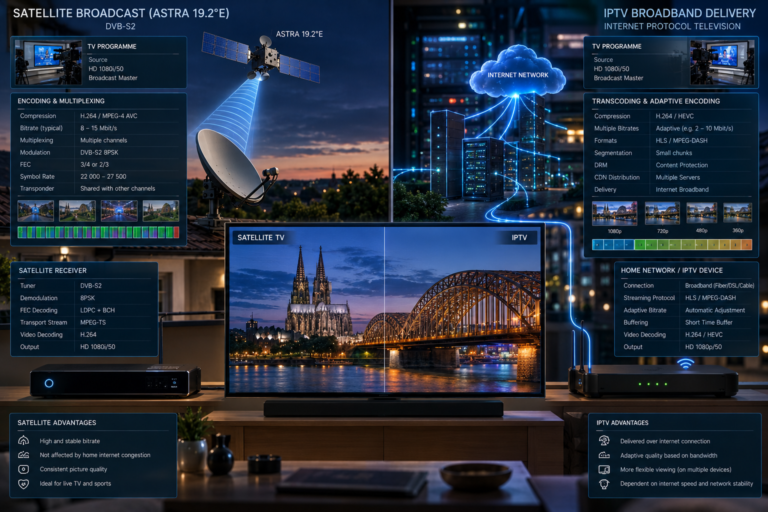
DVB-S2 significantly improved satellite broadcasting efficiency compared to older DVB-S systems.
Higher-order modulation schemes allow more data to fit inside the same transponder bandwidth.
This additional efficiency makes HD sports broadcasting more practical.
Many modern sports channels on Eutelsat 16E use DVB-S2 with advanced modulation and MPEG-4 compression. :contentReference[oaicite:5]{index=5}
The result is improved picture quality without requiring dramatically larger satellite capacity.
However, efficiency improvements still depend heavily on how broadcasters choose to allocate available bitrate.
Fast Motion and Picture Breakdown
Sports channels reveal compression weaknesses faster than almost any other content category.
A static studio image may look excellent even at moderate bitrate levels.
A football match immediately exposes quality limitations.
Fast pans create motion stress.
Player movement increases prediction complexity.
Crowd scenes generate massive amounts of changing detail.
When bitrate becomes insufficient, sharpness disappears first.
Then motion artifacts appear.
Eventually macroblocking becomes visible.
Channels with stronger bitrate support remain cleaner during these difficult moments.
Receiver Processing and Image Reconstruction
The receiver also influences perceived image quality.
Modern receivers contain advanced scaling and image processing systems.
Higher-quality hardware often reconstructs compressed streams more effectively.
Noise reduction, deinterlacing quality, and scaling accuracy all affect sharpness perception.
However, no receiver can fully restore detail that was removed during transmission.
The broadcast quality itself remains the most important factor.
A strong sports channel with proper bitrate allocation usually looks sharp across many different receivers.
Technical Comparison Table
| Factor | Sharper Sports Channel | Softer Sports Channel |
|---|---|---|
| Bitrate allocation | Higher | Lower |
| Compression pressure | Less aggressive | More aggressive |
| Motion handling | Cleaner fast action | More artifacts |
| Grass and texture detail | Better preserved | More blurred |
| Transponder priority | Often higher | Often lower |
| Visible sharpness | More detailed image | Softer image appearance |
How To Maximize Sports Channel Quality
The first step is ensuring strong signal quality rather than focusing only on signal strength.
Weak signal conditions increase error correction pressure and may reduce visible image quality.
Proper dish alignment improves stability and decoding performance.
Stable LNB performance also matters because frequency drift can affect synchronization.
High-quality HDMI output settings should be used whenever possible.
Receiver firmware updates may improve image processing and scaling behavior.
Most importantly, users should understand that some channels simply receive better bitrate allocation from broadcasters.
No dish adjustment can completely compensate for aggressive compression decisions made upstream.
For deeper analysis of signal stability and decoding behavior, read Why Your Eutelsat 16E Signal Looks Perfect Then Suddenly Dies.
Many viewers assume sharper sports channels use better cameras or stronger satellite transmission. In reality, bitrate allocation, compression efficiency, transponder management, and motion handling usually play a much larger role in visible picture quality than resolution alone. :contentReference[oaicite:6]{index=6}
Some 16E sports channels look sharper because they receive better bitrate resources, cleaner compression settings, and more efficient transponder management. Modern HD broadcasting depends on much more than resolution. The channels that preserve more data during fast-moving sports action naturally deliver clearer textures, smoother motion, and stronger overall image quality. Understanding bitrate behavior explains why two channels labeled as HD can look completely different on the same satellite system.
FAQ
| Question | Answer |
|---|---|
| Why do some HD sports channels look sharper? | Usually because they receive higher bitrate allocation and better compression settings. |
| Does higher resolution guarantee better quality? | No. Bitrate and compression quality are equally important. |
| Why is sports broadcasting more demanding? | Because fast motion requires much more video data and processing. |
| Can transponder management affect picture quality? | Yes. Bandwidth allocation directly influences channel sharpness. |
| Does DVB-S2 improve sports channels? | Yes. DVB-S2 provides more efficient use of available bandwidth. |
| Can receiver quality change image sharpness? | Partially, but broadcast bitrate remains the biggest factor. |