Why Some Hot Bird Channels Pixelate First
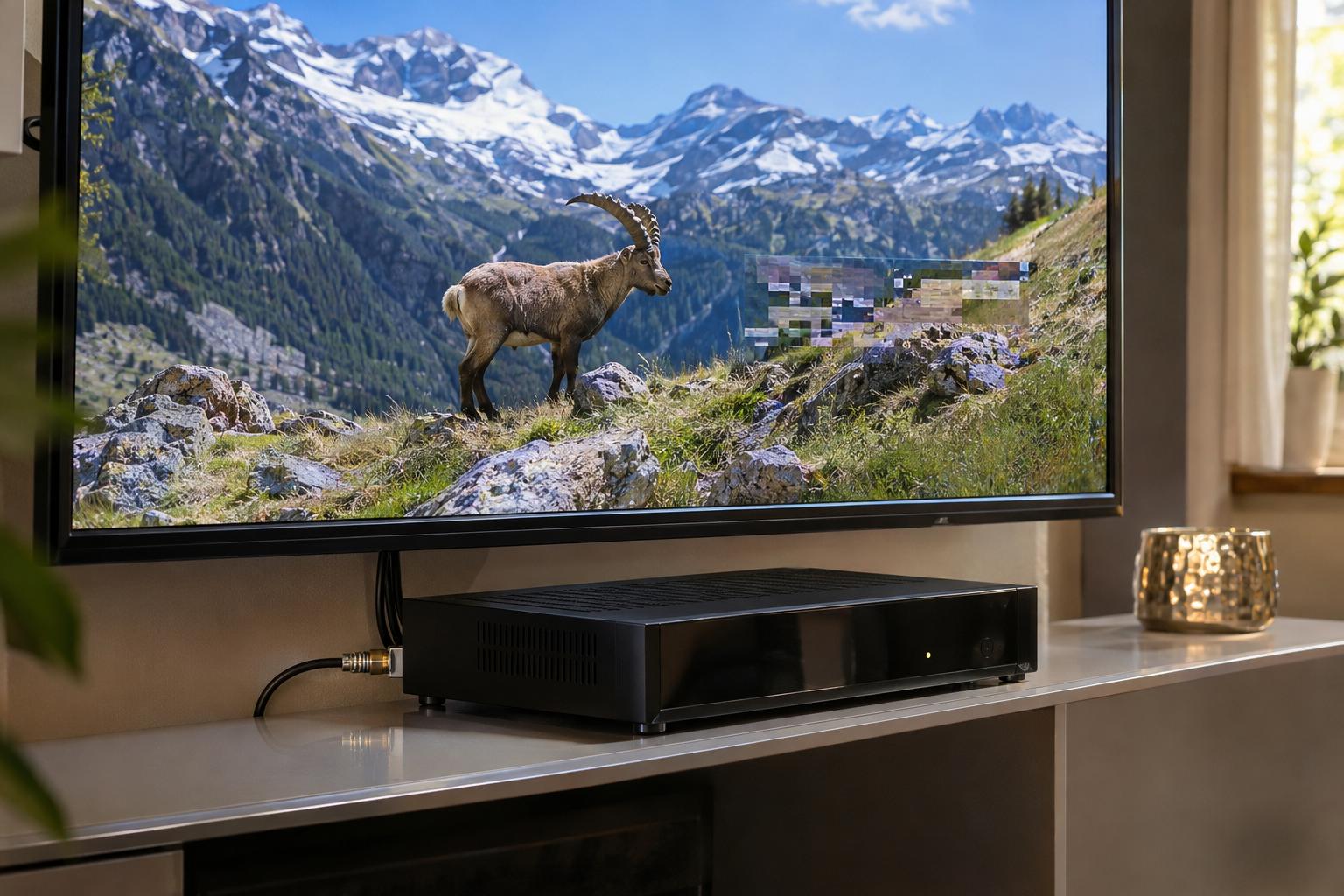
You’re watching Hot Bird 13°E when one channel suddenly breaks into blocky squares. The picture freezes for a moment, then recovers. Switch to another channel and everything looks perfect, even though both come through the same satellite dish. Why does one channel begin pixelating while others continue playing normally?
The answer depends on where the problem begins. A satellite carrier operating close to its decoding threshold may develop uncorrectable data errors before other carriers fail. But picture breakup can also originate in the broadcaster’s video encoding, the receiver’s decoder, or a problem affecting one service rather than the entire transponder. The first step is to determine whether the visible artifacts are caused by RF reception errors or by the video stream after reception.
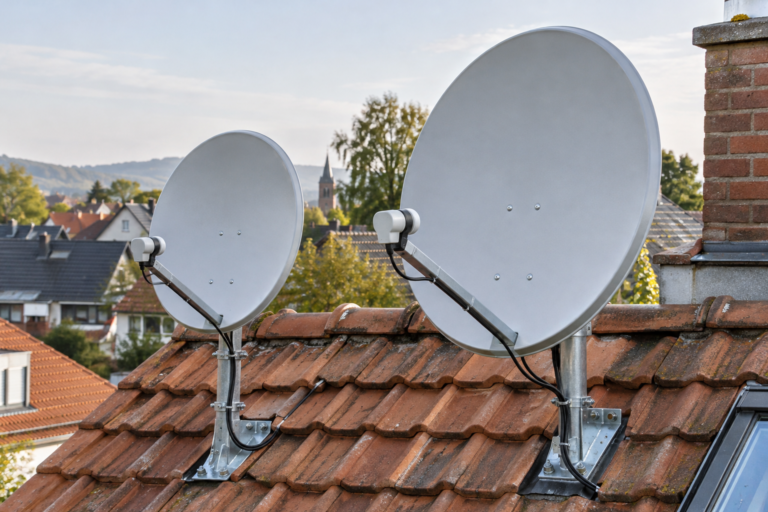
Hot Bird 13°E is served by Eutelsat’s HOTBIRD 13F and 13G satellites. Its digital television services are carried on transponders using supported broadcast transmission formats. A receiver must recover the transmitted data and decode the video before displaying a picture. Problems at different stages can produce similar visual symptoms, but they require different solutions.
What Does Pixelation Mean in Digital Satellite Television?
People commonly use the word pixelation to describe a television picture breaking into visible square blocks, freezing, or becoming partially distorted.
In technical terms, the block-shaped artifacts often associated with digital television are called macroblocking or block-based video artifacts.
However, their presence does not establish a particular cause.
Similar-looking defects can appear because of missing video data, transmission errors, excessive compression, or problems inside the playback device.
Why Digital Video Can Break Into Blocks
Modern video codecs use structured picture representations and compression techniques to reduce the amount of data required to transmit television content.
When compressed data is missing or corrupted, a decoder may be unable to reconstruct certain regions of the picture correctly.
Depending on the codec, error location, and decoder behavior, the visible result may include block-shaped corruption, frozen areas, color distortion, or temporary picture loss.
But this does not mean every visible block is caused by missing data.
Picture Breakup Is Not the Same as Losing Carrier Lock
A satellite receiver may continue reporting a valid transponder lock while the picture becomes unstable.
This can occur when residual data errors affect the delivered stream without immediately causing the demodulator to lose synchronization.
At other times, the receiver may lose carrier lock completely, interrupting all services carried by that transponder.
These are different failure states and should be diagnosed separately.
How Satellite Reception Errors Become Visible Picture Problems
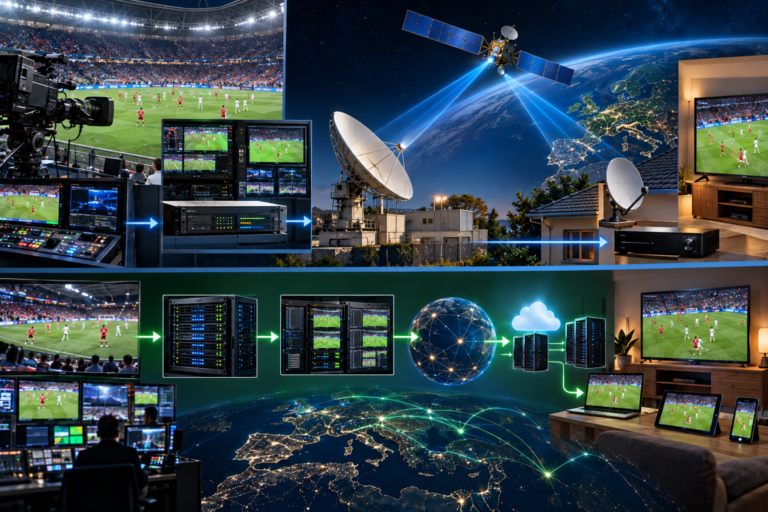
A digital satellite signal passes through several processing stages before the television displays a picture.
The receiver first acquires the carrier and demodulates the incoming waveform.
Forward error correction then attempts to recover the transmitted information despite noise and other impairments.
After successful recovery, the receiver processes the resulting data and extracts the selected video and audio streams.
What Forward Error Correction Does
DVB-S2 uses forward error correction to improve transmission reliability.
Its error-correction architecture includes low-density parity-check coding and an outer Bose-Chaudhuri-Hocquenghem code.
These mechanisms allow a receiver to correct many errors introduced during transmission, provided reception conditions remain within the system’s operating capabilities.
When impairments become too severe, some errors may remain uncorrectable.
What Happens When Errors Remain?
Uncorrectable errors can cause affected data to be discarded, marked invalid, or delivered with missing information, depending on receiver and stream-processing behavior.
If the missing information belongs to the selected video service, the decoder may attempt error concealment.
Error concealment may reuse information from neighboring picture regions or previous frames, although its exact implementation varies.
The viewer may see a brief freeze, block artifacts, or a temporary loss of picture.
Forward error correction can successfully protect the video from many RF errors. Visible picture corruption occurs when the complete delivery and decoding chain cannot reconstruct the intended content reliably. The presence of some pre-correction bit errors does not automatically mean that viewers will see pixelation.
Why Some Hot Bird Channels Pixelate Before Others
Not every Hot Bird transponder has identical reception conditions or transmission requirements.
Individual carriers may differ in received power, modulation configuration, coding rate, and available reception margin.
These differences influence how close a receiver operates to the conditions required for reliable data recovery.
A Marginal Transponder Can Develop Errors First
Imagine two separate Hot Bird carriers arriving through the same dish.
Carrier A has comfortable margin above its required operating threshold, while Carrier B is much closer to that threshold.
If reception quality deteriorates because of rainfall, slight misalignment, or another impairment, Carrier B may develop uncorrectable errors first.
The channels carried by Carrier A can remain stable.
This is one reason viewers sometimes experience breakup on a small number of services while most of the satellite channel list continues working.
Different Modulation Requirements
Digital satellite transmissions can use different modulation and forward-error-correction configurations.
These configurations do not all have identical carrier-quality requirements.
A transmission operating with a more demanding configuration may have less available margin under the same receiving conditions.
However, it is incorrect to assume that every HD channel is harder to receive than every SD channel.
Video resolution alone does not determine the transponder’s RF modulation and coding requirements.
Why Comparing Channels on the Same Transponder Is So Useful
One of the most effective diagnostic questions is whether the affected channels share the same satellite transponder.
Multiple television and radio services can be carried within one transport stream.
These services share the same underlying RF carrier and therefore experience the same carrier-level reception conditions.
When Several Services Break Up Together
If multiple channels on the same transponder develop picture errors at approximately the same time, a shared reception or transport problem becomes a strong possibility.
The relationship becomes more convincing when the artifacts coincide with deterioration in MER, increased uncorrectable errors, or intermittent lock loss.
Nevertheless, shared problems can also occur upstream in the broadcast distribution chain.
A simultaneous failure does not prove the household dish is responsible.
When Only One Service Is Affected
If one channel pixelates while another service on the same carrier remains clean, the investigation should extend beyond the shared RF path.
The affected service may have problems associated with its source encoding, stream data, receiver codec support, or playback process.
Selective residual errors can also affect different services unevenly, depending on which packets are damaged.
Therefore, one affected service does not completely exclude an RF problem, but it makes service-level testing especially important.
Compression Artifacts Versus Satellite Reception Errors
Picture artifacts caused by video compression can resemble errors caused by poor satellite reception.
However, they originate at different stages.
Compression Artifacts From the Broadcast Source
Broadcasters compress video to fit within their available transmission capacity.
When compression is aggressive, certain scenes may show visible blocking, smearing, or loss of fine detail.
Fast motion, complex textures, and rapid scene changes can make compression limitations more noticeable.
If these artifacts are already present in the correctly transmitted video, increasing antenna gain will not remove them.
RF-Related Picture Corruption
Reception errors often appear as sudden, irregular disturbances that may be accompanied by audio interruptions, freezing, or deteriorating error measurements.
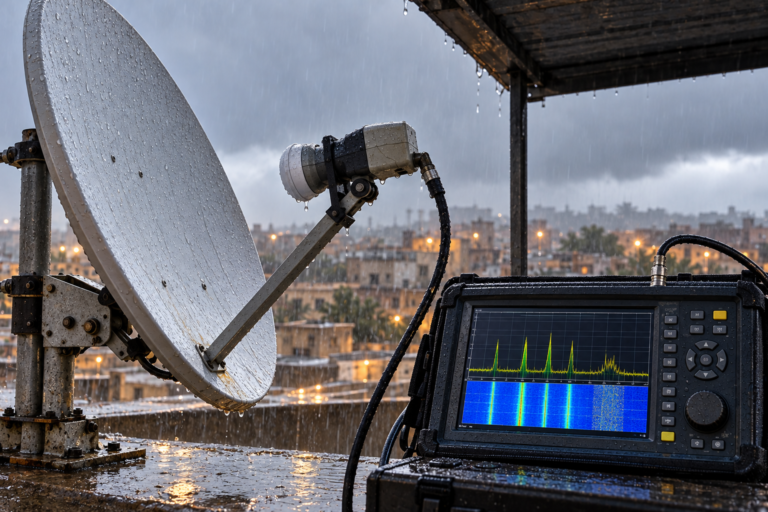
The pattern may worsen during rain, movement of a poorly secured antenna, or other conditions affecting RF quality.
However, appearance alone is not a definitive test.
Reliable diagnosis requires comparing signal measurements, other services, and ideally another compatible receiver.
How BER, MER and C/N Help Diagnose Picture Breakup
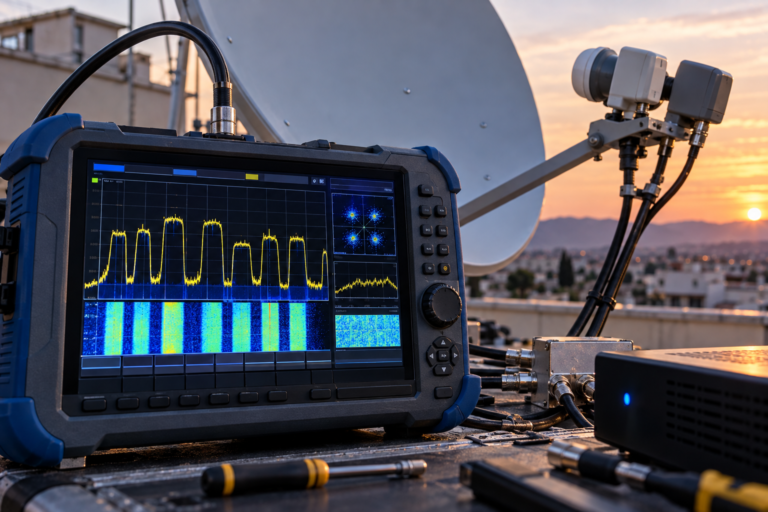
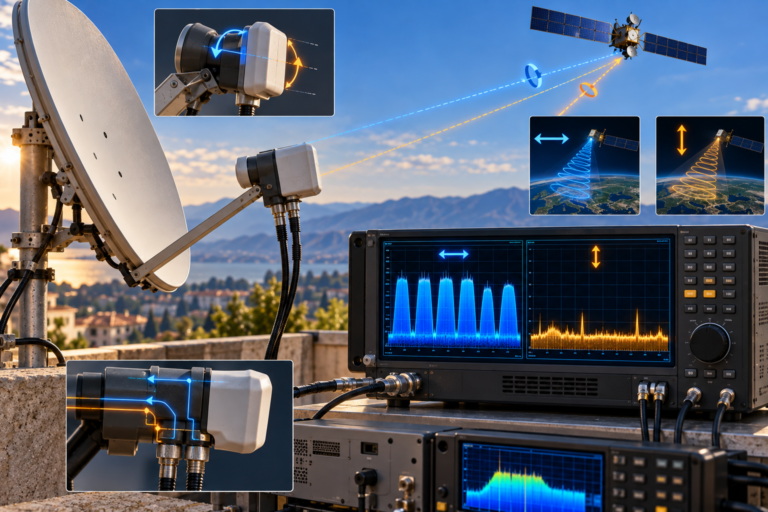
Professional satellite analyzers provide measurements that can help distinguish RF impairment from other playback problems.
Three important measurements are bit error rate, modulation error ratio, and carrier-to-noise ratio.
BER: Errors Before and After Correction
Bit error rate describes the occurrence of bit errors at a specified measurement stage.
In digital satellite equipment, BER readings may refer to different points in the demodulation and error-correction chain.
Pre-correction error measurements describe conditions before the relevant error-correction processing, while post-correction measurements describe errors remaining after the specified stage.
The terminology and measurement points vary between receivers and analyzers.
A low or zero post-correction error reading is generally more directly relevant to reliable data delivery, but a consumer receiver’s BER indicator must be interpreted according to its implementation.
MER: Measuring Modulation Quality
Modulation error ratio measures how far recovered modulation symbols deviate from their ideal constellation positions.
It helps characterize impairments associated with noise, interference, distortion, and other signal defects.
Different satellite transmission modes require different operating conditions, so one universal MER threshold should not be applied to every Hot Bird transponder.
C/N: Carrier Power Relative to Noise
Carrier-to-noise ratio describes the relationship between the wanted carrier and noise within a specified measurement bandwidth.
Insufficient C/N can reduce the receiver’s ability to recover transmitted information reliably.
However, C/N and MER are not interchangeable, particularly when significant non-noise impairments are present.
| Measurement | What It Helps Identify | Important Limitation |
|---|---|---|
| Signal Strength | Receiver-specific RF input indication | Does not prove error-free reception |
| C/N | Carrier quality relative to noise | Does not describe every possible impairment |
| MER | Quality of the recovered modulation | Must be interpreted for the transmission mode |
| Pre-correction BER | Errors before a specified correction stage | Does not directly equal visible picture errors |
| Post-correction BER / Error Indicators | Errors remaining after specified processing | Measurement point and definitions vary |
| Lock Status | Whether the receiver acquired the carrier | Does not guarantee error-free video decoding |
When Pixelation Is Caused by the Receiver
Not every picture problem originates in the antenna or satellite signal.
Some receivers have limitations or faults that affect video playback even when the underlying RF transport is being recovered reliably.
Codec Compatibility
Satellite services may use different video compression formats.
A receiver must support the selected service’s codec and relevant profile, level, and resolution requirements.
Unsupported formats may fail to display correctly or may produce no picture at all.
Software or firmware defects can also affect playback on equipment that otherwise advertises support for a particular codec.
Decoder and Software Problems
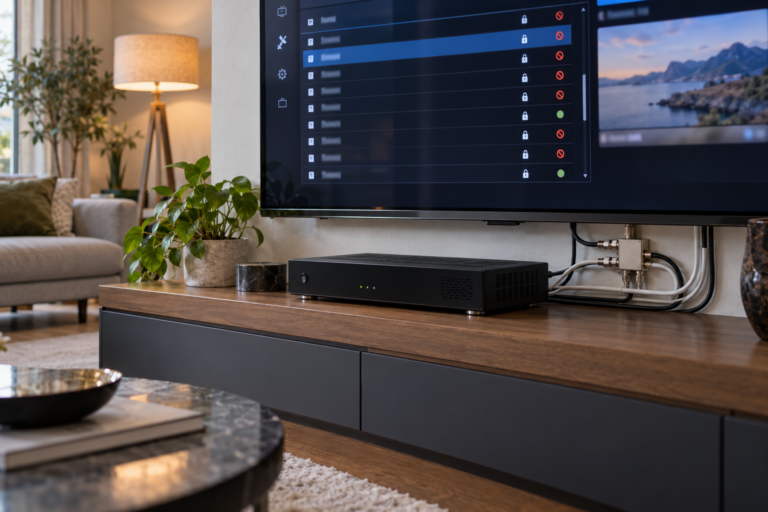
A receiver may experience buffering, decoder instability, or other software-related problems that interfere with normal playback.
These faults should be considered when RF measurements remain stable but picture corruption continues.
Comparing the same service on another compatible receiver can provide useful evidence.
Encrypted Services and Playback
Encrypted television services require legitimate access authorization.
Problems associated with authorization or conditional-access processing may interrupt playback without changing the underlying RF carrier quality.
Such interruptions should not automatically be described as satellite reception failures.
What Different Pixelation Patterns Reveal
| Observed Pattern | Possible Explanation | First Useful Check |
|---|---|---|
| Several channels on one transponder pixelate together | Shared carrier or transport impairment | Measure MER, errors, and lock stability |
| One service pixelates while others on the same carrier remain clean | Service-level encoding, decoding, or selective data problem | Compare the service on another receiver |
| Breakup appears during rain | Reduced reception margin or weather-related hardware fault | Compare clear-sky and rain-period measurements |
| Artifacts appear mainly during complex fast-motion scenes | Possible compression limitations | Compare the same program on another reliable receiving path |
| Picture freezes while RF measurements remain stable | Possible decoder, software, or service-level issue | Check playback behavior and receiver compatibility |
| Multiple transponders break up during wind gusts | Antenna movement or unstable installation | Inspect mounting stability when safe |
| Breakup happens only on one receiver | Local receiver, tuner path, or decoder problem | Compare with compatible known-good equipment |
These patterns are diagnostic clues rather than proof. Several fault types can produce similar visual symptoms.
Step-by-Step: Diagnose Hot Bird Channel Pixelation
Step 1: Identify the Affected Services
Record which channels develop picture artifacts and whether they fail at the same time.
Check whether the services share one transponder or belong to different carriers.
This is often the quickest way to distinguish a shared RF problem from a service-specific issue.
Step 2: Confirm Current Transmission Parameters
Verify the affected carrier’s current frequency, polarization, symbol rate, and supported transmission mode.
Do not rely solely on outdated receiver channel information.
Step 3: Observe the Carrier During Pixelation
Monitor lock status and, where suitable equipment is available, MER, C/N, and relevant error measurements.
Determine whether picture corruption coincides with deteriorating reception quality.
If the error counters are implementation-specific, consult the measurement device’s documentation before interpreting them.
Step 4: Compare Another Service on the Same Carrier
Switch to another accessible service carried by the same transponder.
If both services display similar faults under comparable conditions, investigate the common transport and reception path.
If only one service is affected, expand the investigation to source encoding, service processing, and receiver decoding.
Step 5: Test Another Compatible Receiver
When practical, compare the affected service using another receiver with appropriate codec and transmission support.
Keep the RF path and tuning configuration equivalent.
A reproducible difference between receivers helps isolate equipment-specific behavior.
Step 6: Inspect the RF Installation
If measurements indicate poor reception, check dish alignment, LNB condition, coaxial cabling, connectors, and distribution hardware.
Moisture ingress and unstable connections can create intermittent errors.
Disconnect powered equipment before changing coaxial connections and avoid unsafe outdoor work during storms.
Step 7: Correct the Demonstrated Cause
Improve antenna alignment when pointing loss is confirmed.
Repair defective cabling or switching components when measurements identify those faults.
Consider receiver firmware or compatibility only when evidence points toward playback processing.
A full channel scan should not be treated as a universal repair for picture breakup.
Identify affected channels → Group by transponder → Verify tuning data → Observe MER and error measurements → Compare receivers → Inspect the RF path → Repair the confirmed fault.
This method avoids replacing the dish or LNB before establishing whether reception is actually responsible.
When a Larger Dish Can Reduce Hot Bird Pixelation
If measurements establish that the affected transponder lacks sufficient carrier-to-noise margin, a properly installed antenna with greater gain may improve reception reliability.
Increasing reflector diameter can help recover additional link margin, particularly for marginal carriers.
However, the improvement depends on antenna efficiency, local satellite coverage, feed alignment, and the nature of the impairment.
Our related guide, Why an 80cm Dish Can Transform Hot Bird Reception, explains when a larger reflector may provide useful additional gain and why the benefit is not guaranteed for every installation.
A larger dish will not correct compression artifacts already present in the transmitted video, unsupported codecs, or faulty receiver software.
Reality Check: Pixelation Does Not Always Mean a Weak Signal
A blocky television picture is a visible symptom, not a diagnosis.
Reception-related errors can corrupt delivered video data, but excessive source compression and decoder faults can produce similar-looking artifacts.
When the underlying transponder has adequate quality and other services remain clean, increasing antenna gain may accomplish nothing.
Before replacing equipment, determine whether the problem follows the carrier, the individual service, or the receiver.
Final Verdict
Some Hot Bird 13°E channels pixelate before others because the complete digital television chain does not affect every carrier or service in exactly the same way.
A marginal transponder can develop uncorrectable reception errors before other carriers lose usable quality. But picture breakup may also originate in the broadcast video, transport processing, or receiver decoder.
The most reliable diagnosis compares affected services, identifies their transponders, and examines carrier quality alongside error measurements and receiver behavior.
If RF margin is the limitation, antenna adjustment or appropriate hardware improvements may help. If the problem exists after successful error-free reception, the investigation should focus on service and playback processing instead.
Frequently Asked Questions
Why does only one Hot Bird channel pixelate?
The problem may involve the service’s video encoding, receiver decoding, or selective data errors. If other services on the same transponder remain clean, investigate service-level behavior as well as RF measurements.
Can a strong satellite signal still produce pixelation?
Yes. A high signal-strength percentage does not guarantee adequate modulation quality or error-free data recovery. Picture artifacts can also originate outside the RF receiving path.
What is the difference between pixelation and compression artifacts?
Pixelation is commonly used to describe blocky picture defects. Those defects can be caused by damaged or missing video data, while compression artifacts may already exist in the correctly transmitted video because of encoding limitations.
Does BER explain why Hot Bird channels freeze?
BER can help characterize reception errors, but the measurement stage matters. Errors before forward error correction do not necessarily produce visible problems, while uncorrectable residual errors may disrupt delivered video data.
Can a receiver cause picture breakup with good RF reception?
Yes. Codec incompatibility, firmware defects, and other decoder problems can affect playback even when the selected transponder is received reliably.
Will an 80cm dish stop Hot Bird pixelation?
It may improve reception when inadequate antenna gain or carrier-to-noise margin is responsible. It will not repair broadcaster-side compression artifacts or incompatible receiver decoding hardware.
Why do several Hot Bird channels freeze at the same time?
If the channels share one transponder, simultaneous freezing may indicate a common transport or reception problem. Confirm the relationship through current transmission information and carrier measurements before drawing a conclusion.