Why German Satellite TV Can Look Better Than IPTV
Estimated Reading Time: 12 minutes
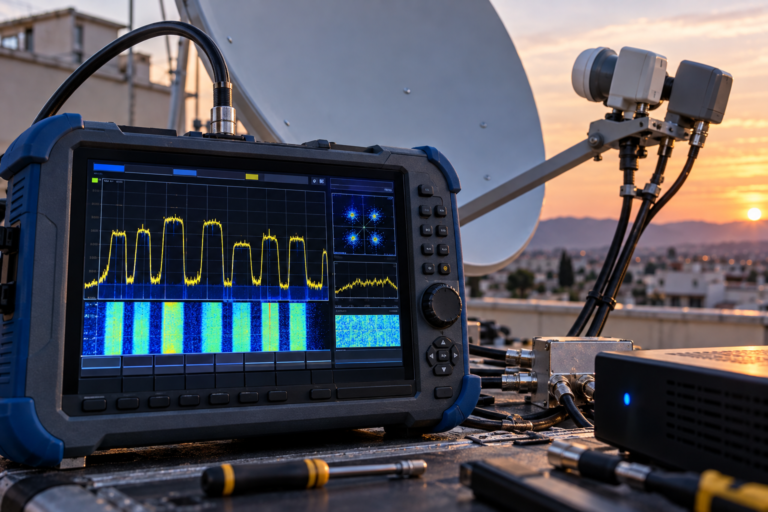
German satellite television can sometimes look cleaner and more detailed than the same channel delivered through IPTV, but satellite is not automatically superior. The visible difference usually comes from how each platform encodes, transcodes, scales, and distributes the video before it reaches the television. A well-engineered IPTV service can match or exceed satellite quality, while a heavily compressed IPTV stream can look softer even when both are labelled HD.
The key issue is not whether the signal travelled through space or through an internet network. Picture quality is determined by the source feed, codec, bitrate, resolution, frame rate, compression efficiency, and the number of processing stages between broadcaster and viewer. Satellite can appear especially strong when the Astra feed preserves a relatively high-quality broadcast encode while an IPTV provider creates another lower-bitrate version for network delivery.
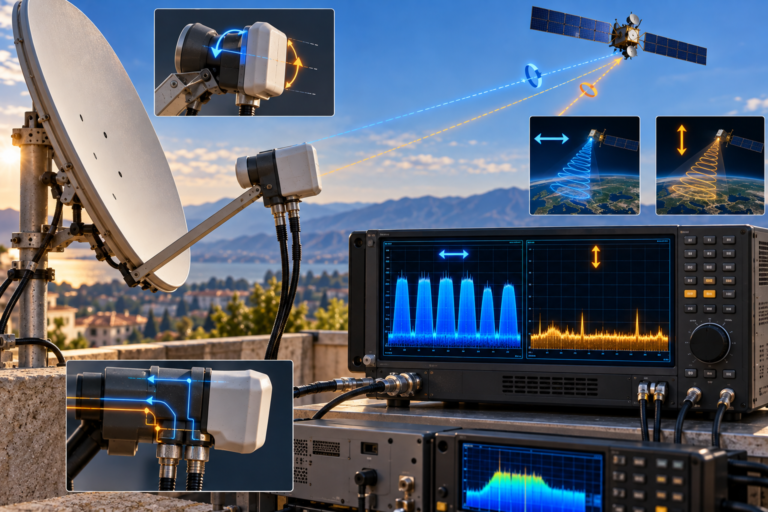
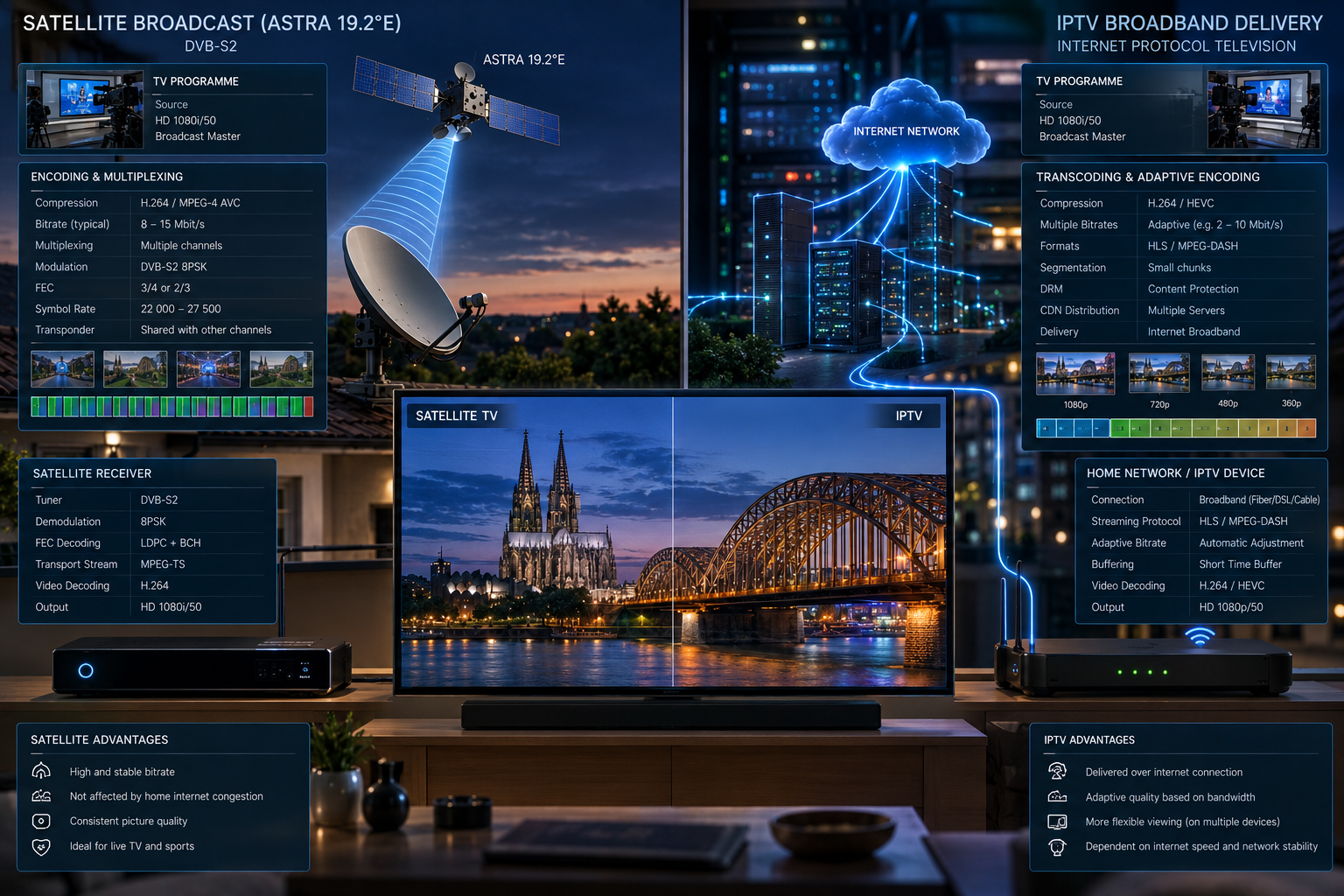
A DVB-S2 satellite carrier can transport multiple television services through one broadcast multiplex. IPTV can deliver the same programmes through managed multicast or adaptive internet streaming. Both systems can carry excellent video. The picture becomes different when the two platforms use different bitrates, codecs, resolutions, GOP structures, statistical multiplexing, or additional transcoding.
- Why Satellite Is Not Automatically Better
- The Source Feed Comes First
- Why Bitrate Matters
- How Video Compression Creates Visible Differences
- Why H.264 and HEVC Matter
- What Statistical Multiplexing Does
- Why Satellite Can Preserve More Detail
- How IPTV Transcoding Can Reduce Quality
- Managed IPTV and OTT Streaming Are Not the Same
- How Adaptive Bitrate Streaming Changes the Picture
- Why Network Congestion Can Lower IPTV Quality
- Why Satellite Quality Does Not Change With Internet Speed
- Why Satellite Can Still Pixelate
- Why IPTV Can Sometimes Look Better Than Satellite
- Resolution Does Not Tell the Whole Story
- How to Compare Satellite and IPTV Properly
- Reality Check
- Final Verdict
- FAQ
Why Satellite Is Not Automatically Better
It is tempting to compare satellite and IPTV as if one transmission technology inherently creates a sharper image.
That is not technically correct.
Once the receiver has recovered a digital satellite transport stream without errors, the visible television picture depends mainly on the encoded video inside that stream.
The same is true for IPTV. If the network delivers the encoded packets correctly and the service uses an equally good video representation, the final image can be essentially identical.
The differences viewers notice usually come from what happened before the video reached the screen.
The Source Feed Comes First
Every television platform starts from a source.
That source may be a studio production feed, a contribution link, or a master distribution feed supplied by the broadcaster.
The quality of that source places an upper limit on everything that follows.
If the source already contains visible compression artefacts, neither satellite nor IPTV can recreate detail that has been removed.
If both platforms receive the same clean source, the next important question is how each one encodes it for distribution.
Why Bitrate Matters
Video compression works by removing information that the encoder estimates can be discarded while keeping the picture visually acceptable.
Higher bitrate generally gives the encoder more data to represent motion, fine texture, film grain, grass, water, smoke, crowds, and other difficult scenes.
Lower bitrate forces the encoder to make more aggressive decisions.
That can produce softness, macroblocking, banding, mosquito noise, or loss of fine texture.
Two services can therefore both display 1920×1080 resolution while one looks significantly better because it receives more useful bitrate.
| Factor | Satellite TV | IPTV / Streaming |
|---|---|---|
| Resolution | Can be HD or UHD | Can be HD or UHD |
| Codec | Commonly H.264, with HEVC used in newer services | H.264 and HEVC are common |
| Bitrate | Determined by broadcast multiplex capacity | Determined by provider profile and network strategy |
| Transcoding | May use a direct broadcast encode | May involve additional platform-specific transcoding |
| Network adaptation | No internet bitrate adaptation | OTT streams may switch quality levels dynamically |
| Congestion effect | Does not depend on household broadband congestion | Can affect OTT stream quality or stability |
| RF/weather effect | Rain fade can damage reception | Not affected by satellite rain fade at the home |
How Video Compression Creates Visible Differences
Modern television video is compressed because uncompressed HD would require far more data than normal broadcast systems can efficiently carry.
An encoder reduces bitrate by exploiting similarities between neighbouring pixels and between consecutive frames.
Easy scenes compress very efficiently.
A static news presenter against a simple background may look excellent at moderate bitrate.
A football match, concert, confetti, fast camera movement, or detailed natural scene can require much more data to maintain the same subjective quality.
If an IPTV provider assigns less bitrate to those difficult scenes than the satellite version receives, the satellite image can look cleaner.
Why H.264 and HEVC Matter
Codec efficiency changes how much visible quality can be delivered at a given bitrate.
H.264 AVC became widely used for HD television because it is substantially more efficient than older MPEG-2 video.
HEVC can provide further compression efficiency, especially for HD and UHD services.
This means bitrate values should never be compared without considering the codec.
An efficiently encoded HEVC stream at a lower bitrate can sometimes outperform an older H.264 or MPEG-2 stream using more data.
The quality of the encoder implementation also matters. Two encoders using the same codec and bitrate can produce noticeably different results.
What Statistical Multiplexing Does
Satellite broadcasters often place multiple television programmes inside one transport stream.
Statistical multiplexing allows the available bitrate to be shared dynamically between those channels.
A service showing a relatively simple scene may temporarily need less data, allowing another channel showing fast action to receive more.
This can improve the overall visual efficiency of the multiplex compared with assigning every programme one rigid bitrate regardless of content complexity.
A well-managed statistical multiplex can therefore deliver strong subjective picture quality from limited transponder capacity.
Why Satellite Can Preserve More Detail
In some distribution chains, the satellite version is close to the broadcaster’s primary consumer broadcast encode.
If that version receives a healthy bitrate and is not repeatedly transcoded, it may preserve fine detail particularly well.
This can become obvious on large televisions.
Hair, grass, stadium crowds, text edges, smoke, water, and detailed backgrounds can appear cleaner and more stable.
Viewers may describe this as satellite looking “sharper,” even when the nominal resolution is exactly the same as IPTV.
How IPTV Transcoding Can Reduce Quality
An IPTV provider does not always pass the broadcaster’s original encoded video directly to the customer.
The incoming service may be decoded or transcoded into another profile optimized for the provider’s network, set-top boxes, apps, or bandwidth targets.
Every lossy transcoding stage creates the possibility of additional quality loss.
This is especially problematic when already compressed video is decoded and compressed again at a significantly lower bitrate.
The second encoder cannot restore information discarded by the first encoder. It must compress an image that may already contain compression artefacts.
This can make block boundaries, ringing, banding, and texture loss more visible.
Managed IPTV and OTT Streaming Are Not the Same
The word IPTV is often used loosely.
Traditional managed IPTV can operate within a provider-controlled network and may use multicast delivery for live television.
OTT streaming services normally deliver video across ordinary IP networks using HTTP-based adaptive streaming.
These systems have different engineering constraints.
A well-provisioned managed IPTV network can deliver a stable high-bitrate stream with excellent quality.
An OTT service must usually cope with changing broadband conditions, Wi-Fi quality, shared household traffic, and variable internet routes.
How Adaptive Bitrate Streaming Changes the Picture
Many internet television services encode the same programme at several quality levels.
The player continuously estimates available network capacity and switches between those representations.
This is known as adaptive bitrate streaming.
When bandwidth is plentiful, the player selects a higher-quality representation.
When available throughput drops, it may switch to a lower bitrate to prevent buffering.
The programme continues playing, but fine detail can suddenly become softer.
Satellite broadcasting has no equivalent household broadband adaptation. The same DVB-S2 multiplex is transmitted continuously to every viewer inside the coverage area.
Why Network Congestion Can Lower IPTV Quality
Internet delivery shares infrastructure with other data traffic.
At the household level, video may compete with downloads, gaming, cloud backups, video calls, or other streaming devices.
Wi-Fi interference can add another limitation.
At larger network levels, peering, content distribution, routing, and provider capacity can affect throughput.
An adaptive player can respond by reducing video bitrate.
This does not mean IPTV itself has poor picture quality. It means some IPTV and OTT implementations intentionally exchange picture quality for uninterrupted playback when network conditions deteriorate.
Why Satellite Quality Does Not Change With Internet Speed
A household’s broadband connection has no effect on the basic DVB-S2 picture coming from a satellite transponder.
Ten thousand homes can watch the same satellite channel simultaneously without each additional viewer consuming additional satellite downlink capacity.
This is one of the major strengths of broadcast architecture.
Once the carrier is transmitted, the same RF signal serves the entire footprint.
If the receiving installation remains above the decoder threshold, the encoded programme arrives at its intended quality regardless of whether the viewer’s internet connection is fast, slow, busy, or completely disconnected.
Why Satellite Can Still Pixelate
Satellite has its own failure mechanism.
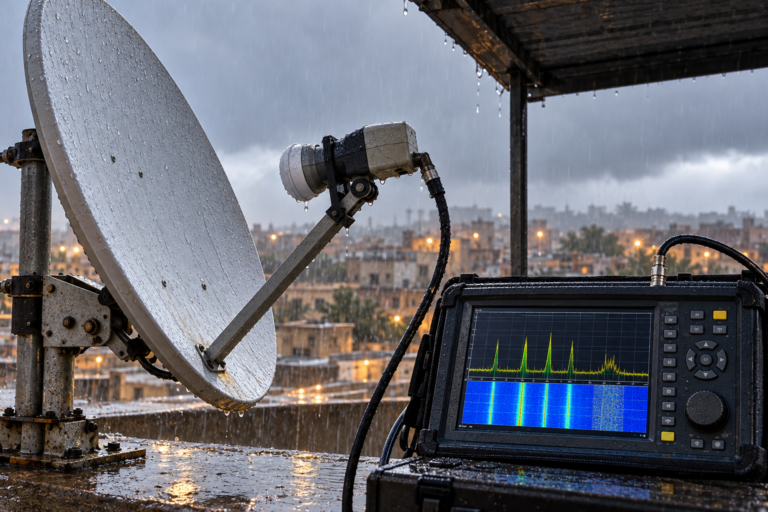
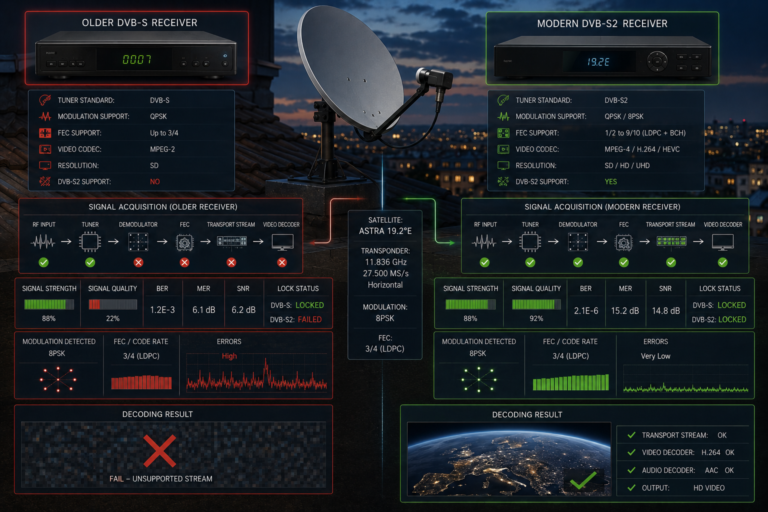
Poor dish alignment, rain attenuation, inadequate dish size, LNB problems, cable loss, interference, or weak signal margin can reduce MER and increase BER.
As long as DVB-S2 Forward Error Correction can repair the damaged data, the picture remains normal.
Once the RF link falls below the required threshold, errors become visible as pixelation, freezing, audio breakup, or complete loss of service.
This is fundamentally different from ordinary video compression artefacts.
A soft IPTV picture may be arriving perfectly at a low bitrate. A pixelating satellite picture may be suffering data corruption in the RF path.
Why IPTV Can Sometimes Look Better Than Satellite
The comparison can also go in the opposite direction.
An IPTV provider may use a newer codec, higher bitrate, progressive scan format, or a cleaner source than the available satellite service.
An internet platform may offer 1080p or UHD while a satellite version remains 720p or 1080i.
A modern HEVC encode can also preserve more detail than an older broadcast encode while using similar or even lower bandwidth.
Therefore, “satellite always looks better” is not technically defensible.
The correct comparison must examine the actual versions being delivered.
Resolution Does Not Tell the Whole Story
Resolution labels are useful but incomplete.
Two 1080 services can look very different.
One may receive a generous bitrate and clean source. Another may be heavily compressed.
Frame rate and scan type also matter.
For fast sports, 720p50 can sometimes preserve motion more naturally than a poorly processed 1080i service even though the numerical resolution looks lower.
Upscaling creates another trap. A platform can deliver a 1080 output that originated from a lower-resolution source.
The output format does not recreate original image detail.
How to Compare Satellite and IPTV Properly
Use the same television and disable unnecessary picture-processing differences where possible.
Compare the same programme at the same moment because content complexity affects compression quality.
Check whether one platform uses a different resolution, codec, or frame rate.
Observe detailed motion scenes rather than static studio shots.
Look at grass, crowds, smoke, water, scrolling graphics, dark gradients, and fast pans.
These expose bitrate limitations much more clearly.
Do not confuse RF reception quality with video encoding quality. A satellite strength bar cannot tell you whether the broadcaster uses a good video bitrate, and a fast internet speed test cannot prove that an IPTV provider is supplying a high-quality encode.
For the RF side of the comparison, see why signal quality matters more than signal strength, which explains why MER, BER, and decoding margin determine whether the satellite transport stream reaches the receiver correctly.
Satellite transmission does not contain some special property that makes pictures inherently sharper than IP delivery.
Once the digital data has been delivered correctly, picture quality is mainly a video-compression issue.
Satellite can look better when its version has a higher effective bitrate, cleaner source, better encoder, or fewer transcoding stages. IPTV can look better when it uses a newer codec, higher-quality source, better processing, or a higher-resolution representation.
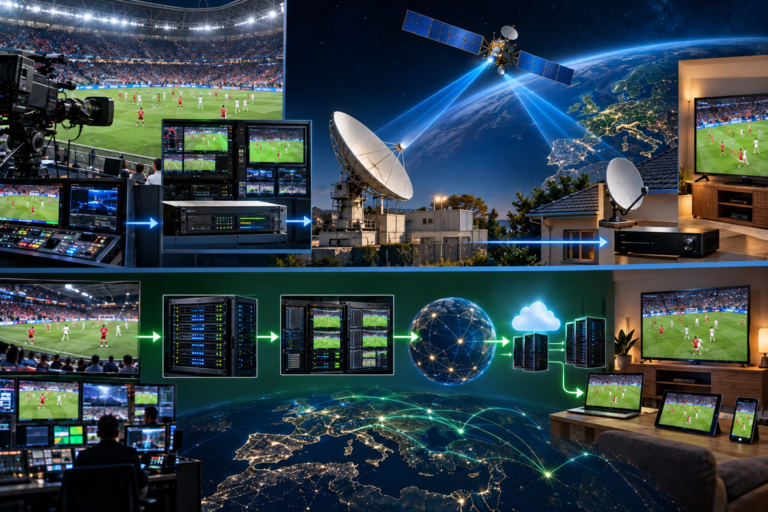
The correct engineering comparison is therefore between two complete distribution chains, not simply between “satellite” and “internet.”
German satellite TV can look better than IPTV when the Astra version preserves more of the broadcaster’s original video quality.
A strong DVB-S2 broadcast feed can deliver consistent bitrate and picture characteristics to every household within the footprint without adapting to home internet speed. If an IPTV provider transcodes that same programme to a lower bitrate or dynamically reduces quality during network congestion, the satellite version can appear noticeably sharper and cleaner.
But satellite does not automatically win.
A high-quality IPTV platform using a modern codec, excellent source, and sufficient bitrate can equal or outperform the satellite version.
What viewers actually see is determined by source quality, resolution, codec, bitrate, encoder efficiency, transcoding history, motion complexity, and delivery conditions. The transport path matters, but the encoded video inside that path matters much more.
| Question | Answer |
|---|---|
| Does German satellite TV always look better than IPTV? | No. Either platform can look better depending on the source, codec, bitrate, processing, and distribution chain. |
| Why can Astra look sharper than IPTV? | The satellite version may use a higher-quality encode or avoid an additional low-bitrate transcoding stage used by an IPTV provider. |
| Is bitrate more important than resolution? | Both matter, but resolution alone does not guarantee quality. A heavily compressed 1080 stream can look worse than a cleaner lower-resolution service. |
| Does a higher satellite signal strength improve picture detail? | No. Once the digital transport stream is decoded without errors, additional RF strength does not improve the encoded video quality. |
| Can low satellite signal reduce picture quality gradually? | Usually not in the same way as video compression. Digital satellite reception tends to remain correct until errors exceed the correction margin, then pixelation and freezing appear. |
| What is transcoding? | Transcoding means decoding or converting an existing compressed video stream into another encoded version, often with different bitrate, codec, or resolution. |
| Why can transcoding make IPTV softer? | Lossy re-encoding can discard additional image information, especially when the new stream uses a lower bitrate. |
| What is adaptive bitrate streaming? | It is a streaming method that switches between multiple encoded quality levels according to available network conditions. |
| Does internet congestion affect satellite picture quality? | No. Basic satellite broadcasting does not depend on household internet throughput. |
| Can IPTV look better than satellite? | Yes. IPTV can look better when it uses a cleaner source, more efficient codec, higher bitrate, better processing, or higher-quality video format. |
| Is H.265 or HEVC automatically better than H.264? | HEVC is generally more compression-efficient, but final quality still depends on encoder quality, bitrate, source, and settings. |
| What is the best way to compare IPTV and satellite? | Compare the same channel and programme on the same display while checking codec, resolution, frame rate, bitrate where available, and visible artefacts during complex motion scenes. |