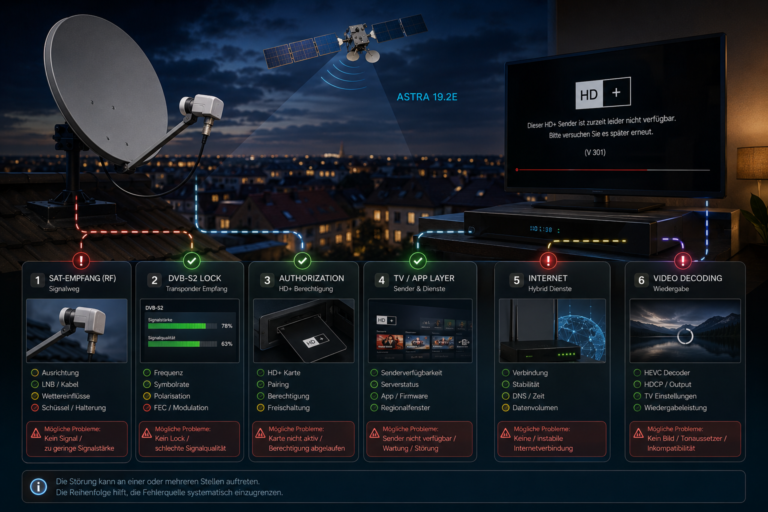
Why Older Receivers Cannot Decode New German Channels
Estimated Reading Time: 12 minutes
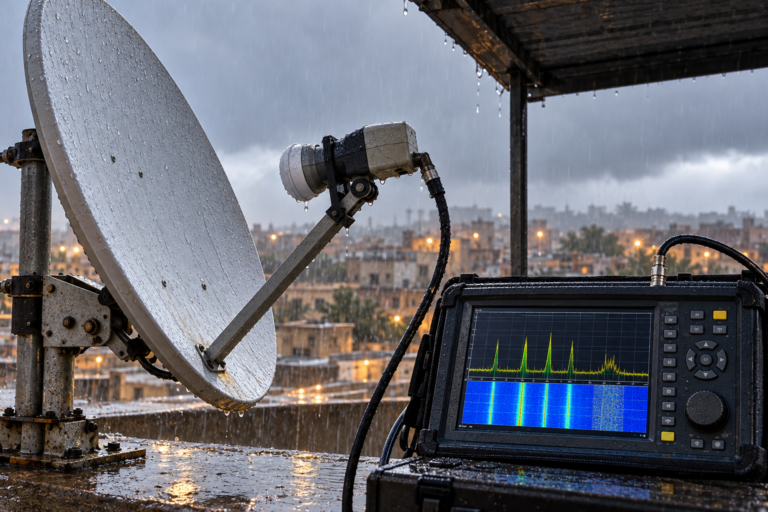
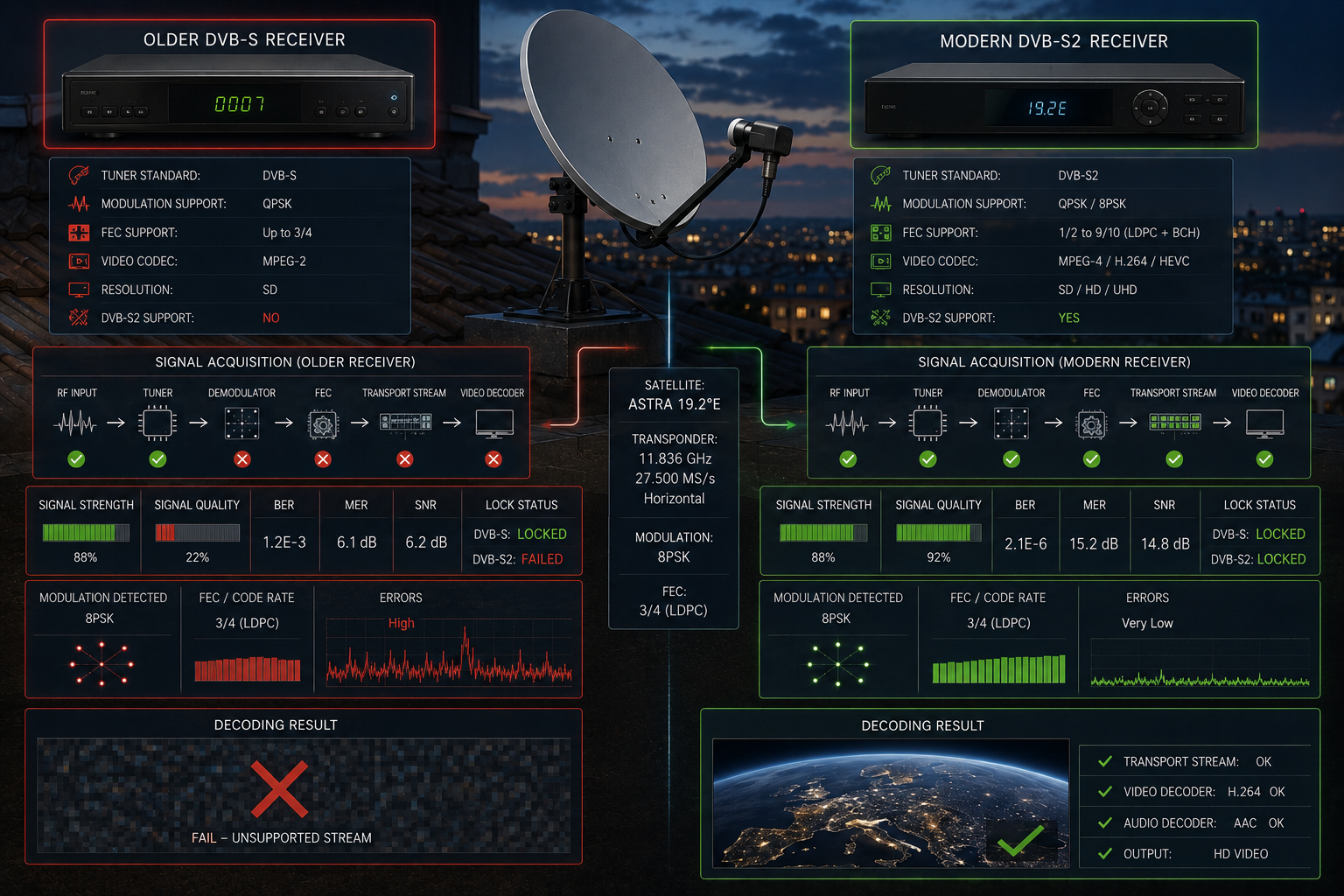
An older satellite receiver can show strong signal strength from Astra 19.2E and still fail to display newer German channels. This does not necessarily mean the dish is misaligned. The receiver may simply understand the RF energy but lack the hardware or software required to decode the transmission standard, modulation, transport stream, or video format used by the channel.
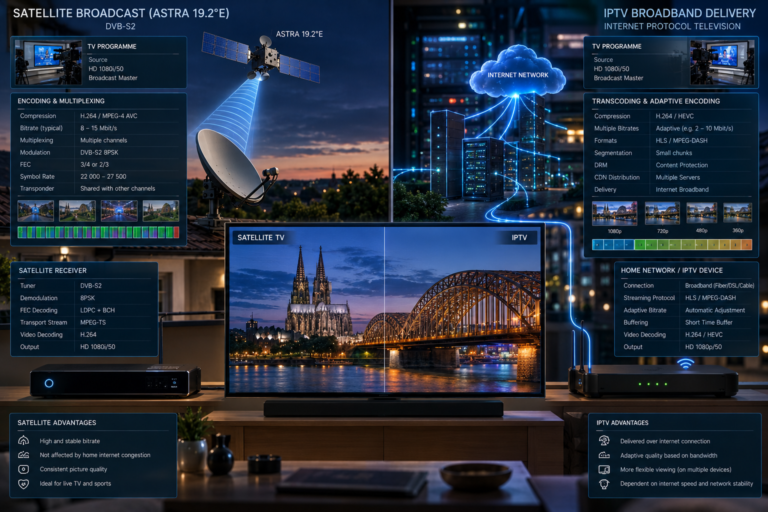
Modern German satellite services have increasingly moved toward DVB-S2, efficient modulation, and newer video compression. ZDF now states that satellite viewers need an HD-capable television with an integrated DVB-S2 tuner or an external DVB-S2 receiver for its current HD services. That means a receiver designed only for the older DVB-S and MPEG-2 environment can become technically obsolete even though the dish, LNB, and coaxial cable remain completely usable.
A satellite receiver has to pass several compatibility stages before a picture appears. It must support the RF transmission standard, the modulation, the Forward Error Correction mode, the transport stream structure, and the video and audio codecs inside the service. Failure at any one of these stages can produce a black screen even when signal strength is high.
- Why Strong Signal Does Not Mean Compatible Reception
- DVB-S and DVB-S2 Are Different Receiver Generations
- Why 8PSK Support Matters
- How Forward Error Correction Changed
- Why MPEG-2 Receivers Struggle With Modern HD
- H.264 and HEVC Are Separate Compatibility Layers
- Why a Receiver Can Find the Channel but Show No Video
- What Happens Inside the Tuner
- Transport Stream and Service Information Changes
- Why Old Channel Lists Cause Confusion
- Firmware Limits and Unsupported Features
- Why One New German Channel Works and Another Does Not
- How to Tell RF Failure From Receiver Incompatibility
- When a Channel Scan Is Enough
- When a New Receiver Is Really Required
- How to Troubleshoot an Older Receiver Logically
- Reality Check
- Final Verdict
- FAQ
Why Strong Signal Does Not Mean Compatible Reception
Signal strength only tells you that RF energy is reaching the tuner.
It does not prove that the receiver can understand the digital structure carried by that signal.
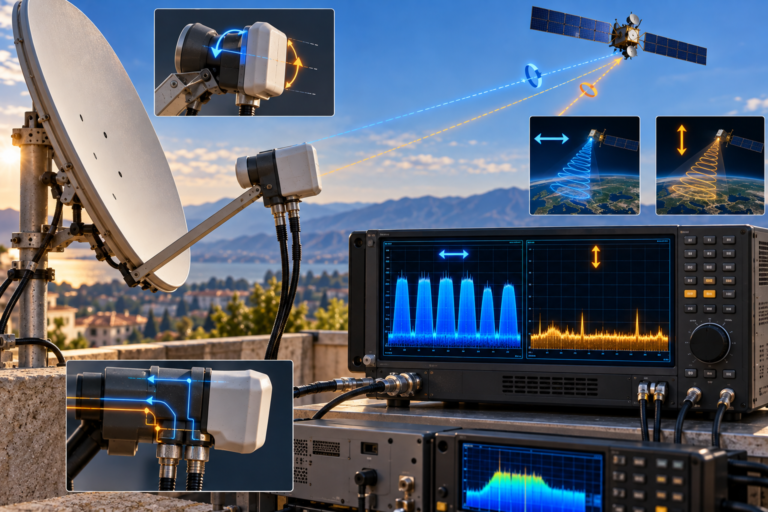
An older receiver may detect a modern DVB-S2 transponder and show a high strength bar because its front-end tuner can see the carrier power. The demodulator behind the tuner may still be incapable of decoding the physical-layer format.
This creates a classic symptom: strong signal, zero quality, and no picture.
DVB-S and DVB-S2 Are Different Receiver Generations
The original DVB-S standard was widely used for early digital satellite television.
Many older German SD services were transmitted in DVB-S using QPSK modulation.
DVB-S2 introduced a more advanced physical layer with stronger Forward Error Correction and more flexible modulation and coding options.
A DVB-S-only receiver does not become DVB-S2 compatible through a channel scan. The necessary demodulation capability must exist in hardware or in a chipset specifically designed for DVB-S2.
This is one of the main reasons older receivers cannot follow the full transition to modern German HD satellite services.
Why 8PSK Support Matters
Many DVB-S2 services use 8PSK rather than the older QPSK environment associated with many legacy receivers.
QPSK uses four principal constellation states. 8PSK uses eight.
The receiver therefore needs a demodulator capable of distinguishing those additional states and tracking them accurately under real-world signal conditions.
An old receiver may detect the RF carrier but simply not know how to convert the 8PSK symbol stream into valid coded bits.
| Compatibility Stage | Older Receiver Limitation | Visible Result |
|---|---|---|
| DVB transmission standard | DVB-S only | Modern DVB-S2 transponder cannot be decoded |
| Modulation | No 8PSK support | Strong RF but no digital lock |
| Video codec | MPEG-2 only | Channel may be found but HD video cannot be displayed |
| HEVC support | No hardware decoder | Black picture on newer HEVC services |
| Firmware | Old service parsing or scan logic | Missing or incorrect channel entries |
| HDMI and output | Limited video output support | Channel decodes but television output fails or is restricted |
How Forward Error Correction Changed
DVB-S2 uses a more advanced Forward Error Correction system than the original DVB-S generation.
The receiver processes LDPC coding together with BCH coding to recover damaged digital information.
These algorithms require specific decoder hardware and processing capability.
A receiver designed before DVB-S2 cannot simply approximate this process using the older DVB-S decoder. The complete physical-layer architecture is different.
This is why support for DVB-S2 is a genuine receiver capability rather than a software label.
Why MPEG-2 Receivers Struggle With Modern HD
The RF layer is only the first compatibility test.
Once the satellite carrier has been successfully demodulated, the receiver still has to decode the compressed video inside the transport stream.
Many older SD receivers were designed around MPEG-2 video.
Modern HD services commonly use more efficient codecs such as H.264 AVC.
A receiver without an H.264 hardware decoder can sometimes identify the service name and programme data while remaining unable to reconstruct the actual HD picture.
H.264 and HEVC Are Separate Compatibility Layers
H.264 and HEVC should not be confused with DVB-S2.
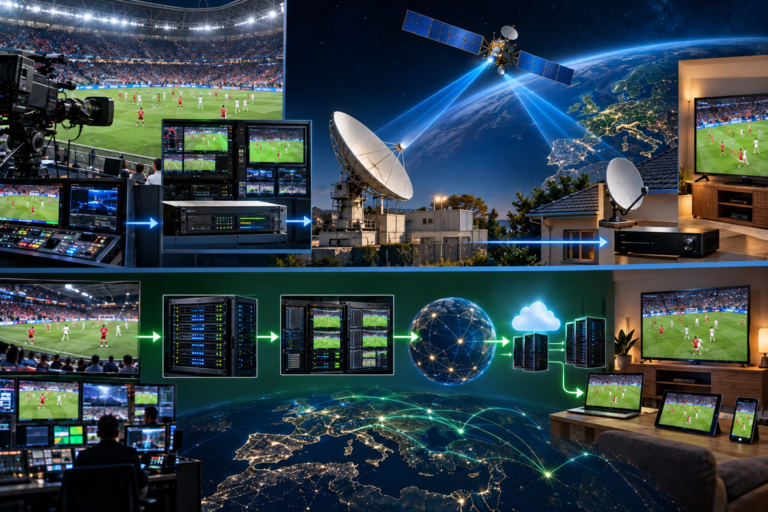
DVB-S2 describes how digital information travels through the satellite RF link.
H.264 and HEVC describe how video pictures are compressed inside that recovered digital information.
A receiver can therefore support DVB-S2 perfectly and still fail on a newer channel if its video decoder does not support the codec being used.
This is especially important with HEVC. HEVC decoding usually requires dedicated hardware acceleration. A firmware update cannot add full HEVC support to a receiver whose chipset was never designed to decode it.
Why a Receiver Can Find the Channel but Show No Video
This symptom often proves that the RF path is healthier than the viewer assumes.
If the receiver scans the transponder successfully, displays the channel name, shows programme information, and possibly plays audio, then the DVB-S2 carrier has probably been recovered correctly.
The failure is happening later in the chain.
The most likely cause is an unsupported video codec, receiver software problem, or service-level compatibility issue.
Realigning the dish will not fix an unsupported decoder.
What Happens Inside the Tuner
The tuner front end first selects the required intermediate frequency from the LNB.
Carrier recovery then tracks the exact frequency and phase of the transmission.
The demodulator must identify the symbol timing and modulation states before passing coded data into the Forward Error Correction chain.
If the receiver supports only DVB-S, it cannot correctly process a DVB-S2 physical-layer frame even if the RF power is strong.
This is why the signal-strength bar can be active while the quality bar remains at zero.
Transport Stream and Service Information Changes
After successful demodulation, the receiver reconstructs the transport stream containing television, audio, subtitles, and service information.
Modern services can use different programme identifiers, stream types, audio formats, and signalling structures from those common when an older receiver was designed.
A very old receiver may therefore struggle even after RF lock if its software cannot interpret newer service information correctly.
This problem is less fundamental than missing DVB-S2 hardware, but it can still cause incomplete or incorrect channel scanning.
Why Old Channel Lists Cause Confusion
A broadcaster can change frequency, transponder, service identifier, or other parameters while the receiver continues storing an obsolete channel entry.
Selecting that old entry may produce no signal, no service, or an incorrect programme even though the replacement transmission is available.
This is why a new scan should always be attempted before deciding that the receiver itself is obsolete.
If the device supports the current transmission standard and codec, a rescan may be all that is required.
Firmware Limits and Unsupported Features
Receiver firmware controls channel scanning, transport stream parsing, decoder configuration, user interface, and many compatibility functions.
Manufacturers sometimes release updates that improve support for new transponder parameters or correct scanning problems.
However, firmware cannot overcome every limitation.
A software update cannot transform a DVB-S chipset into a DVB-S2 demodulator. It also cannot provide full HEVC decoding if the required hardware engine is absent.
The difference between a software limitation and a hardware limitation is therefore critical when evaluating an old receiver.
Why One New German Channel Works and Another Does Not
Not every modern German channel uses the same transmission parameters or codec.
One service may still use a format supported by the old receiver, while another uses DVB-S2, 8PSK, H.264, or HEVC.
The two channels may also sit on different transponders with different symbol rates, FEC settings, frequencies, and signal margins.
This explains why partial compatibility is common.
The fact that one German HD service works does not prove that the receiver supports every newer service.
How to Tell RF Failure From Receiver Incompatibility
Start with digital quality rather than raw strength.
If strength is high but quality remains zero on every modern DVB-S2 carrier, receiver compatibility becomes a strong suspect.
If another known DVB-S2 service works on the same receiver, then the problem is more likely to involve that specific transponder, signal margin, or video codec.
If the channel is found and service information appears, the tuner and demodulator are probably working. The investigation should move toward codec and software compatibility.
If several channels on the same transponder fail together while other DVB-S2 carriers work, the fault may instead be RF-related.
When a Channel Scan Is Enough
A compatible receiver can miss new German channels simply because its stored database is outdated.
This can happen after broadcasters move a service to another transponder or end an older SD simulcast.
Performing a full satellite scan can update frequency and service information.
If the receiver finds the new HD service and decodes it normally, no hardware replacement is needed.
This is particularly relevant after German broadcasters retire old SD services and viewers continue selecting the obsolete channel entry.
When a New Receiver Is Really Required
A new receiver is required when the existing hardware cannot process a transmission layer that the new service depends on.
A DVB-S-only receiver cannot decode a DVB-S2 carrier.
A receiver without 8PSK capability cannot recover an 8PSK transmission.
A receiver without H.264 or HEVC support cannot decode video compressed using those formats.
In these situations, dish alignment and rescanning cannot solve the problem because the missing capability is inside the receiver hardware itself.
How to Troubleshoot an Older Receiver Logically
First identify the exact channel and transponder that fails.
Check whether the receiver supports DVB-S2 and the modulation used by that transponder.
If the carrier locks successfully, determine the video codec used by the service and compare it with the receiver specifications.
Perform a fresh satellite scan to eliminate obsolete channel-list data.
Check for available manufacturer firmware updates, but do not assume software can add hardware capabilities that were never present.
If other receivers connected to the same dish decode the channel correctly, the antenna system is probably healthy and the older receiver becomes the main suspect.
The German transition away from duplicate SD transmission makes these compatibility limits more visible. Our guide to why some German channels changed to HD only explains why broadcasters are retiring legacy SD paths and concentrating distribution on modern HD services.
An old receiver is not automatically useless just because it is old.
If it supports the required DVB-S2 transmission, modulation, codec, and current service information, it may continue working perfectly.
The real issue is capability, not age itself.
Likewise, a black screen does not automatically prove receiver incompatibility. Poor MER, high BER, wrong transponder parameters, dish misalignment, LNB problems, and cable faults can create similar symptoms.
Older receivers cannot decode some new German channels because modern satellite television uses several technologies that did not exist in many first-generation digital boxes.
The receiver must support DVB-S2 at the physical layer, the modulation used by the transponder, the Forward Error Correction structure, the transport stream, and the video codec used by the programme.
A device can therefore show strong RF signal and still fail completely. It may detect the carrier but be unable to demodulate DVB-S2, or it may recover the transponder successfully but lack the H.264 or HEVC hardware needed to display the video.
The correct troubleshooting order is simple: verify RF lock, confirm DVB-S2 and modulation support, check the video codec, rescan the satellite, and only then decide whether the receiver has reached the end of its useful compatibility range.
| Question | Answer |
|---|---|
| Why does my old receiver show signal but no German HD channel? | It may detect RF power but lack DVB-S2, 8PSK, or the required video codec. |
| Can a DVB-S receiver decode DVB-S2? | No. DVB-S2 requires compatible demodulator hardware. |
| Why does 8PSK matter? | 8PSK uses eight constellation states and requires receiver hardware capable of demodulating that format. |
| Can firmware add DVB-S2 support? | Not if the receiver hardware was designed only for DVB-S. The physical demodulator capability must exist in the chipset. |
| Can firmware add HEVC support? | Usually not if the receiver lacks the required hardware decoder. HEVC normally depends on dedicated processing capability. |
| Why does the channel name appear but no video is shown? | The receiver may have recovered the transport stream but lack support for the service’s video codec. |
| Can a channel scan solve the problem? | Yes, if the receiver is technically compatible and only the stored frequency or service information is outdated. |
| Why do some new German channels work while others do not? | They can use different transponders, modulation, FEC, and codecs, so compatibility requirements are not identical. |
| Does strong signal quality prove codec compatibility? | No. RF reception and video decoding are separate stages. |
| Do I need a new dish for DVB-S2? | Usually not. A correctly aligned existing dish and LNB can receive DVB-S2 if the receiver hardware is compatible and the signal margin is adequate. |
| What should I check before buying a new receiver? | Check DVB-S2 support, 8PSK capability, codec support, current channel scan, firmware, and whether another receiver works correctly from the same dish. |