Why Some Eutelsat 16E Frequencies Suddenly Move
Estimated reading time: 18 minutes.
- Why frequencies appear to move.
- Transponder reallocations.
- Broadcaster migration between carriers.
- Frequency drift and LNB accuracy.
- Receiver database issues.
- Blind scan behavior.
- DVB-S2 network updates.
- How to keep channel lists accurate.
- Do Frequencies Really Move?
- Transponder Reallocation Explained
- Why Broadcasters Change Frequencies
- Receiver Databases And Scan Results
- Frequency Drift Inside The LNB
- Blind Scan Can Create Confusion
- Network Information Updates
- Why Some Changes Seem Random
- Technical Comparison Table
- How To Handle Frequency Changes
- Reality Check
- Final Verdict
- FAQ
Do Frequencies Really Move?
Most of the time, no.
The satellite does not physically shift frequencies from one day to the next.
Instead, channel providers often move services between transponders.
The receiver sees a new frequency assignment and the user assumes the original frequency moved.
What actually moved was the service.
The underlying satellite infrastructure remained unchanged.
Transponder Reallocation Explained
Satellite operators regularly reorganize transponder capacity.
Bandwidth must be shared between many television services.
As channels launch, close, upgrade to HD, or change distribution partners, transponder usage evolves.
A broadcaster may leave one carrier and move to another for technical or commercial reasons.
To viewers, this appears as a sudden frequency change.
To engineers, it is simply capacity management.
Why Broadcasters Change Frequencies
Broadcasters rent capacity from satellite operators.
Contracts change over time.
A channel may move to reduce costs, increase coverage efficiency, support HD upgrades, or join a different multiplex.
When this happens, viewers must update channel lists.
The service remains available.
Only its location within the satellite network changes.
Receiver Databases And Scan Results
Receivers maintain internal databases of frequencies and channels.
Over time, these databases become outdated.
A frequency that once carried a channel may now be empty.
The channel may exist elsewhere on the satellite.
Users who rely on old channel lists often experience missing services until they perform a fresh scan.
The frequency did not move unexpectedly.
The database simply became outdated.
Frequency Drift Inside The LNB
Another source of confusion comes from the LNB itself.
The local oscillator inside the LNB converts satellite frequencies into signals the receiver can process.
As components age, frequency accuracy may decline.
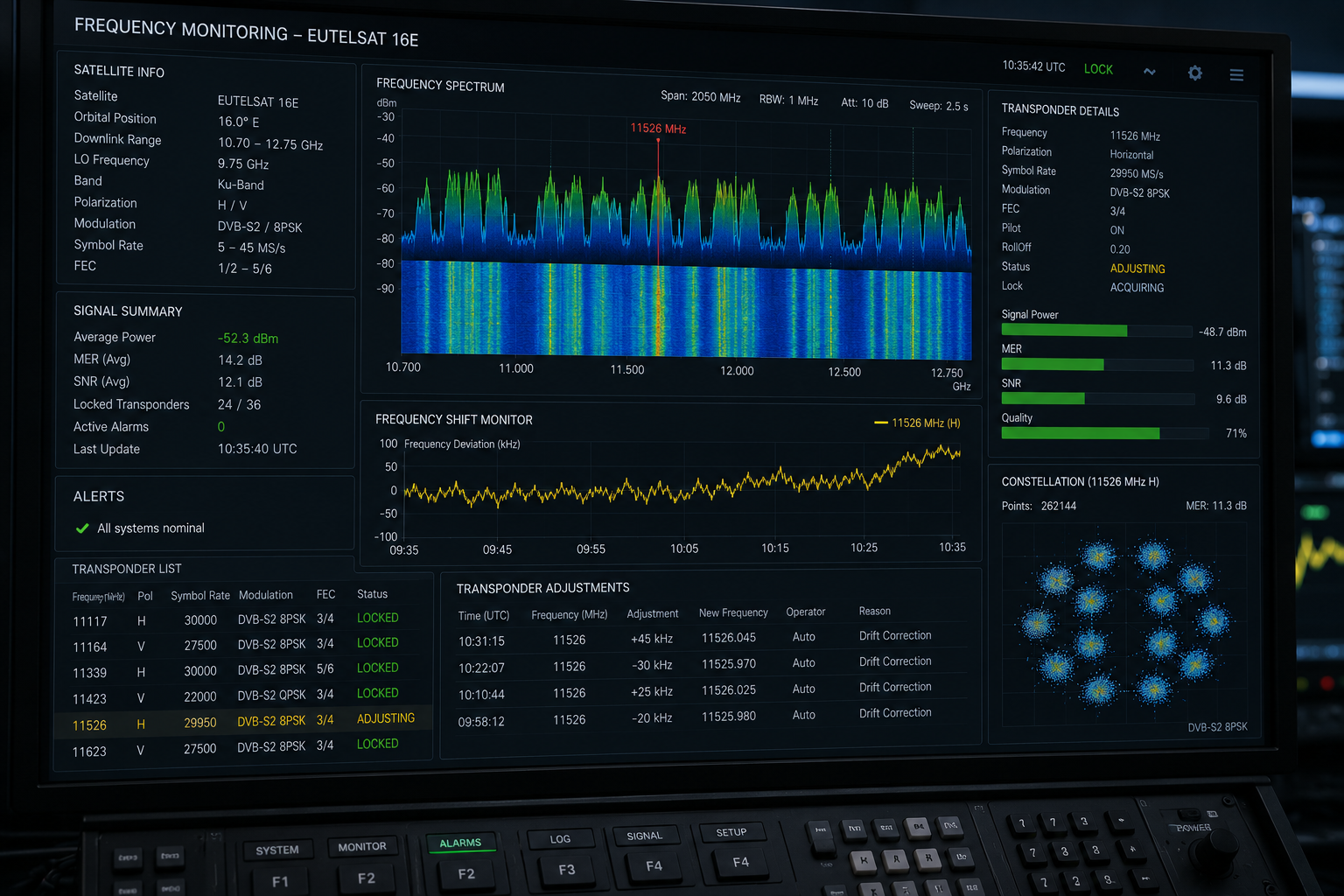
Small amounts of drift can make frequencies appear slightly different from expected values.
Most receivers compensate automatically.
However, older LNBs sometimes create unusual tuning behavior.
Blind Scan Can Create Confusion
Blind scan works by estimating transponder locations.
Different receivers may report slightly different frequency values for the same carrier.
This does not mean the frequency moved.
It simply reflects the way each receiver calculates and stores scan results.
Some receivers round values differently.
Others compensate for oscillator drift automatically.
The result is apparent frequency variation even when the signal itself remains unchanged.
Network Information Updates
Modern DVB-S and DVB-S2 systems transmit network information tables.
These tables help receivers discover additional frequencies automatically.
When operators update network data, receivers may reorganize channel lists after a scan.
To the user, channels appear to have moved.
In reality, the receiver simply learned more accurate information about the satellite network.
Why Some Changes Seem Random
Not all frequency changes are announced publicly.
Smaller broadcasters may relocate services without attracting much attention.
Temporary feeds can appear and disappear.
Regional services may move between multiplexes.
Some transponders experience operational adjustments.
This creates the impression that frequencies change randomly even though there is usually a technical or commercial reason behind the move.
Technical Comparison Table
| Situation | What Users Think | What Actually Happens |
|---|---|---|
| Channel disappears | Frequency moved | Channel changed transponder |
| New scan finds channel elsewhere | Satellite changed frequency | Receiver updated channel location |
| Frequency value changes slightly | Carrier moved | LNB or scan variation |
| Different receiver shows different frequency | Inconsistent transmission | Different scan algorithms |
| Temporary service appears | Random frequency activity | Operational feed allocation |
| Updated channel list | Frequency instability | Database correction |
How To Handle Frequency Changes
Run periodic blind scans or network scans.
Keep receiver firmware updated.
Use reliable channel databases when available.
Monitor signal quality to ensure apparent frequency problems are not actually reception problems.
If channels disappear frequently, verify LNB stability and frequency accuracy.
Many apparent frequency changes are actually caused by local equipment rather than the satellite itself.
For a deeper understanding of scanning limitations, read Why Blind Scan Misses Half The Channels On 16E.
Most Eutelsat 16E frequencies do not suddenly move. What usually changes are transponder assignments, broadcaster locations, receiver databases, or scanning results. The satellite remains stable while the service structure around it evolves.
The reason some Eutelsat 16E frequencies appear to move is that broadcasters regularly change transponders, receivers update network information, and scanning systems interpret signals differently. In many cases, nothing has happened to the frequency itself. The service has simply been relocated or rediscovered through updated satellite information.
FAQ
| Question | Answer |
|---|---|
| Do satellite frequencies physically move? | No. Most apparent changes are channel or transponder relocations. |
| Why did my channel disappear overnight? | It may have moved to a different transponder or frequency assignment. |
| Can blind scan show different frequencies? | Yes. Different receivers may calculate carrier locations differently. |
| Does an old LNB affect frequency accuracy? | Yes. Frequency drift can create unusual tuning behavior. |
| Should I rescan regularly? | Yes. Periodic scans help maintain an accurate channel database. |
| Can receiver firmware affect scanning? | Yes. Updated firmware often improves frequency detection and channel discovery. |