Astra 19.2 vs 28.2 Coverage and Signal Explained
Estimated reading time: 16 minutes.
The biggest difference between Astra 19.2E and Astra 28.2E is not the satellite itself. It is how the signal is distributed across the ground. Many users focus on channels or frequency, but the real reason behind reception differences is the coverage footprint and how the signal behaves inside that footprint.
Two users can use the same receiver, same dish size, and same setup, yet get completely different results depending on which satellite they are trying to receive. This is because Astra 19.2E and Astra 28.2E use different beam designs, different signal distribution strategies, and different reception priorities.
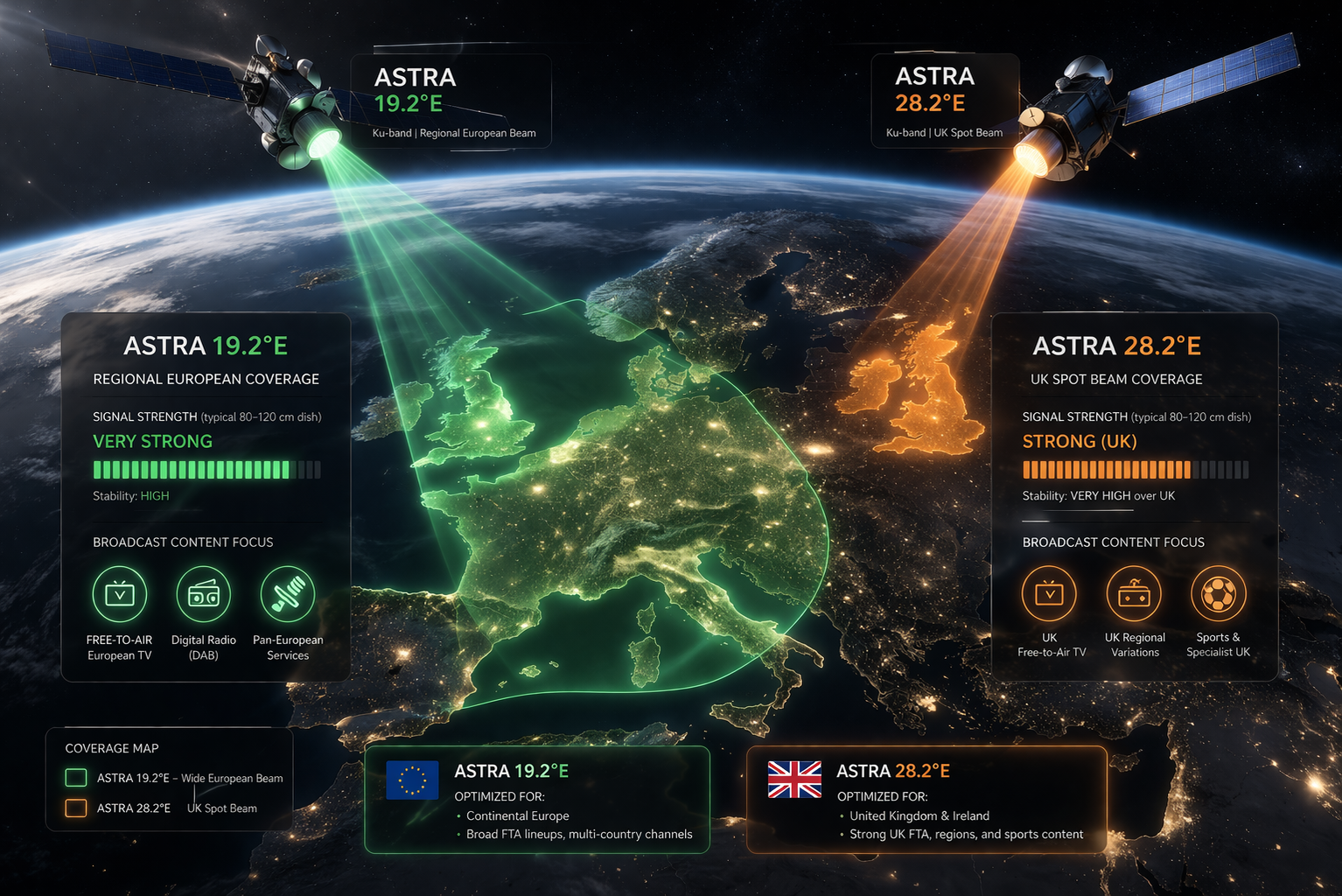
Astra 19.2E uses wide European coverage beams, while Astra 28.2E uses a mix of European beams and highly focused UK spot beams. This directly affects signal strength, stability, and dish size requirements.
- What satellite coverage footprint means
- Astra 19.2E coverage behavior
- Astra 28.2E coverage behavior
- UK spot beam vs wide beam explained
- Signal strength and quality differences
- Signal behavior at the edge of coverage
- Dish size impact on reception
- Analytical coverage comparison table
- Real impact on reception setups
- FAQ
What satellite coverage footprint means
A satellite footprint is the area on Earth where its signal can be received. It is not uniform. Some areas receive strong signals, while others receive weaker signals.
This footprint is designed intentionally. It defines where the satellite is meant to operate effectively.
Understanding footprint is essential because it determines signal strength, stability, and required dish size.
Astra 19.2E coverage behavior
Astra 19.2E is designed for wide European coverage. Its beams are spread across central and western Europe.
This allows consistent signal reception across many countries. It is one of the main reasons why Astra 19.2E is easy to receive in most parts of Europe. :contentReference[oaicite:0]{index=0}
The wide beam design provides stable signal levels with less sensitivity to location.
Astra 28.2E coverage behavior
Astra 28.2E uses a different strategy. It combines wide European beams with highly focused spot beams.
The most important of these is the UK spot beam. This beam concentrates signal power on the United Kingdom while reducing coverage outside it. :contentReference[oaicite:1]{index=1}
As a result, reception outside the UK becomes more difficult, even if the satellite is technically strong.
UK spot beam vs wide beam explained
A wide beam spreads signal over a large area. This reduces signal intensity but increases coverage.
A spot beam focuses signal on a smaller region. This increases signal strength inside that region but reduces it outside.
Astra 19.2E mainly uses wide beams, while Astra 28.2E relies heavily on spot beam technology for UK channels. :contentReference[oaicite:2]{index=2}
Signal strength and quality differences
Inside the UK, Astra 28.2E can provide extremely strong signals due to its focused beam.
Outside the UK, the same signal becomes weaker and more sensitive to alignment and noise.
Astra 19.2E provides more balanced signal levels across Europe, resulting in more consistent reception.
Signal behavior at the edge of coverage
At the edge of a satellite footprint, signal quality becomes unstable. This is where most reception problems occur.
For Astra 28.2E, many regions outside the UK fall into this edge zone. This leads to weak signals, freezing, or complete signal loss.
Astra 19.2E has a wider stable zone, so fewer users experience edge related issues.
Dish size impact on reception
Dish size plays a major role in receiving weak signals. Larger dishes collect more signal and improve quality.
Astra 19.2E can often be received with standard dish sizes across Europe.
Astra 28.2E may require larger dishes outside the UK, especially for UK spot beam channels. :contentReference[oaicite:3]{index=3}
Analytical coverage comparison table
| Feature | Astra 19.2E | Astra 28.2E |
|---|---|---|
| Beam type | Wide European beam | Wide + UK spot beam |
| Coverage area | Most of Europe | UK focused with limited spread |
| Signal stability | Consistent across regions | Strong in UK weaker outside |
| Edge performance | Moderate | Weak outside target area |
| Dish requirement | Standard size | Larger dish outside UK |
Real impact on reception setups
In real installations, these differences determine how easy or difficult reception will be.
Astra 19.2E is more forgiving and stable in most European regions. Astra 28.2E requires more precise setup and may need stronger equipment outside its core coverage area.
This is why many users can easily receive Astra 19.2E but struggle with Astra 28.2E using the same setup.
Coverage footprint is the main factor behind reception differences. The satellite is not weaker. It is simply designed to focus signal in a specific region.
Astra 19.2E provides wide and stable coverage across Europe, making it easier to receive. Astra 28.2E offers stronger signal inside the UK but becomes more difficult outside it due to its focused beam design. Understanding this difference is essential for choosing the right satellite and optimizing reception.
FAQ
| Question | Answer |
|---|---|
| Why is Astra 28.2E weaker outside the UK | Because it uses a focused spot beam targeting the UK. |
| Which satellite has wider coverage | Astra 19.2E covers most of Europe with wide beams. |
| Do both satellites use the same technology | Yes but with different beam design and coverage strategy. |
| Why do I need a bigger dish for Astra 28.2E | Because signal is weaker outside its main coverage area. |
| Can I receive both satellites easily | Yes but reception quality depends on your location and setup. |