
DirecTV vs YouTube TV Signal Stability and Performance
Estimated reading time: 18 minutes.
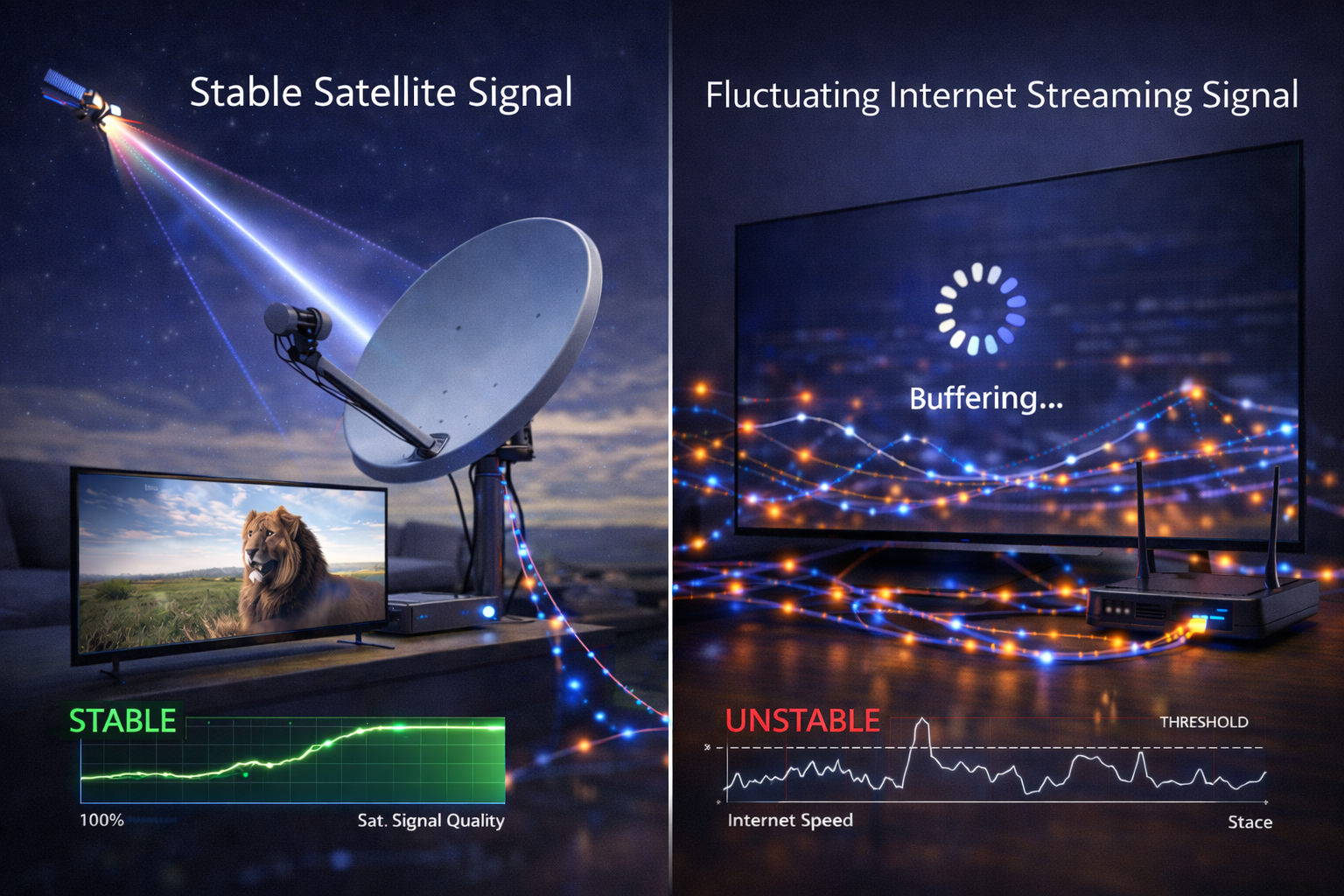
When comparing DirecTV and YouTube TV, the biggest difference is not the channels or pricing. It is signal stability. One system relies on satellite broadcast, while the other depends entirely on internet delivery. This difference directly affects how stable the viewing experience is, especially during live sports events.
Many users notice that satellite TV feels consistent, while streaming sometimes buffers or drops quality. This is not random. It is the result of how each system handles signal transmission, processing, and delivery under real world conditions.
DirecTV uses a broadcast signal with fixed delivery, while YouTube TV depends on internet streaming where performance changes based on network conditions and server load.
- What signal stability really means
- How satellite signal remains stable
- Why streaming signal fluctuates
- Latency vs stability relationship
- Impact of internet conditions
- Performance during high demand events
- Quality fluctuations in streaming
- Analytical stability comparison
- Real world user experience
- FAQ
What signal stability really means
Signal stability refers to how consistent the video stream remains over time.
A stable signal means no interruptions, no buffering, and no sudden quality drops.
In live TV, stability is often more important than peak quality.
How satellite signal remains stable
DirecTV uses satellite broadcasting where the signal is transmitted once and received by all users at the same time.
This method is independent of internet conditions and does not change based on the number of viewers.
Once the dish is aligned and signal is locked, performance remains consistent unless affected by weather or physical issues.
Why streaming signal fluctuates
YouTube TV delivers content over the internet using adaptive streaming.
The system continuously adjusts video quality based on available bandwidth.
If internet speed drops or network congestion increases, the stream quality decreases or buffering occurs.
Latency vs stability relationship
Latency and stability are connected but not identical.
Satellite systems provide consistent latency, which helps maintain stable playback.
Streaming systems introduce variable latency due to buffering, which can affect perceived stability.
Impact of internet conditions
Streaming performance depends on multiple factors including bandwidth, packet loss, and network congestion.
Even a fast connection can experience instability if the network is congested.
Satellite systems avoid this issue because they do not rely on internet infrastructure.
Performance during high demand events
During major sports events, streaming platforms handle millions of users simultaneously.
This increases server load and can lead to buffering or delays.
Satellite systems handle large audiences efficiently because the signal is broadcast once regardless of user count.
Quality fluctuations in streaming
Streaming platforms use adaptive bitrate technology.
This means video quality changes based on connection speed.
While this prevents complete interruption, it results in inconsistent viewing quality.
Analytical stability comparison
| Factor | DirecTV Satellite | YouTube TV Streaming |
|---|---|---|
| Signal type | Broadcast | Internet streaming |
| Stability | High and consistent | Variable |
| Dependence | Independent of network | Network dependent |
| Quality consistency | Stable | Adaptive and changing |
| Performance under load | Unaffected | May degrade |
Real world user experience
In real use, satellite viewers experience stable playback with minimal interruptions.
Streaming users may experience buffering, delays, or quality drops depending on network conditions.
In areas with strong internet infrastructure, streaming can perform well, but it still remains variable.
Streaming stability is not guaranteed even with high speed internet. Network conditions always introduce variability.
DirecTV provides stable and consistent signal performance through satellite broadcasting. YouTube TV offers flexible streaming but introduces variability due to network dependence. For live sports, stability often favors satellite systems.
FAQ
| Question | Answer |
|---|---|
| Which is more stable DirecTV or YouTube TV | DirecTV is generally more stable due to broadcast delivery |
| Why does streaming buffer | Because it depends on internet conditions and bandwidth |
| Does internet speed guarantee stability | No network congestion can still affect performance |
| Is satellite affected by internet | No it operates independently |
| Which is better for live sports | Satellite often provides more consistent experience |